 Custom
Outdoor Wedding Dress: Rain, Grass, and Humidity Guide
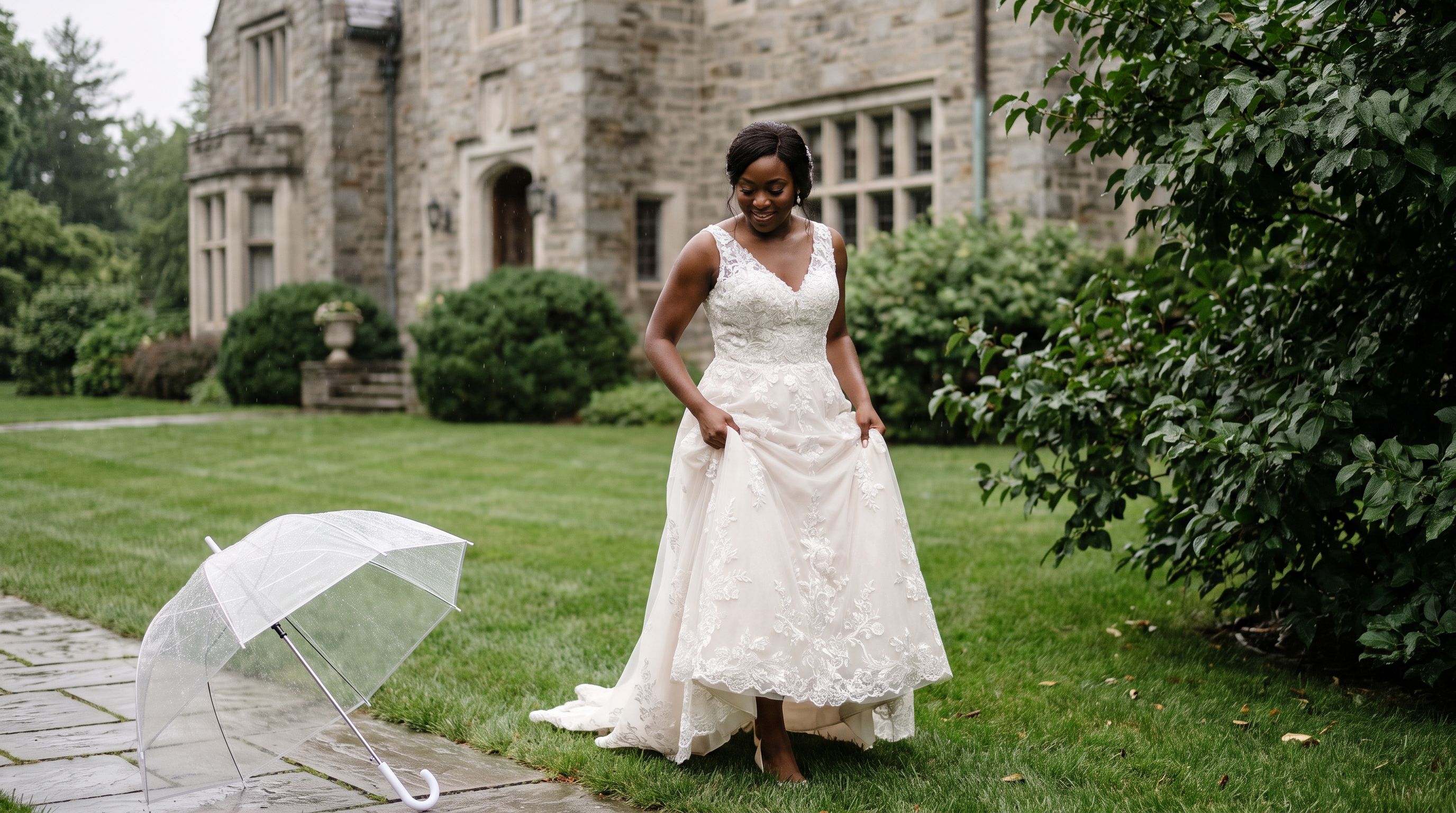
Outdoor ceremonies are common at every budget level — lawns, vineyards, beaches, courtyards, rooftops, backyards. And they are wonderful. But every dressmaker who has worked a garden season knows the three quiet villains: water, grass, and humidity. None of them have to ruin anything. They just have to be planned for, at the fabric stage, when a change costs nothing.
Plenty of outdoor weddings get rained on and still go beautifully. The people who come through a downpour beaming are the ones whose plan — and whose outfit — could absorb it. That’s true whether you’re wearing a white gown, a lehenga, a hanbok, an áo dài, or planning a second-look change partway through the night. Multi-outfit celebrations need the same weather thinking applied twice: one plan for the ceremony surface, one for whatever happens after.
What actually goes wrong outdoors (and what doesn’t)
Most people worry about the wrong things. A little drizzle will not “shrink” anything, and a damp hem dries. The real issues are more specific:
- Water spotting. Smooth, lustrous silks — duchesse satin, charmeuse, dupioni — can show faint rings where droplets dry, especially in strong sun. Sometimes they steam out; sometimes they wait for the cleaner.
- Hem soiling. Wet grass transfers green chlorophyll stain. Sand abrades. Gravel and pavement grey a train within minutes.
- Humidity and body heat. Heavy linings, multiple layers of tulle, and dense beading turn a pretty dress into a sauna. Natural fibers breathe; some linings don’t.
- Wind. Lightweight chiffon, organza, and single-layer tulle lift and wrap. Lovely in photos, stressful during vows.
Fabrics that handle weather — and the ones that don’t forgive
There’s no single “outdoor fabric,” but there is a reliable rule: matte, textured, and slightly weighty beats glossy, flat, and delicate.
Forgiving in damp or humid conditions: silk crepe, crepe-back satin used matte side out, silk georgette, silk-blend mikado, fine wool crepe (cooler weather), heavier lace over a stable lining, and well-made polyester crepes. Texture hides droplet marks; matte surfaces don’t flash every imperfection.
Beautiful but demanding: silk charmeuse, silk duchesse satin, silk dupioni, and delicate silk organza. These can be gorgeous outdoors — plenty of people wear them happily — but they need a covered ceremony, a dry path, or a realistic acceptance that a mark may appear.
Fabric also behaves differently from body to body, and a good maker will say so out loud. Breathable linings and sewn-in underarm shields matter far more for larger busts and for anyone who simply runs warm; a cotton or bemberg lining will outperform a cheap polyester one on a humid afternoon. A stable underlining is what keeps crepe from clinging over fuller hips and softer middles once the air gets damp. And a faced hem does the same useful work on a tall frame as on a petite one — it holds a lightweight skirt off the legs instead of letting it wrap. If you’re dressing for modesty with sleeves or a higher neckline, ask specifically about layering weight, because coverage and heat management have to be solved together.
If you’re weighing the trade-offs more broadly, our guides to crepe, satin, and mikado and hot-weather fabric choices go deeper on hand, weight, and photographs.
Weather doesn’t ruin outdoor weddings. Weather you didn’t plan for does.
The hem is where outdoor weddings are won or lost
More outdoor regret comes from hem length than from fabric choice. A hem set for a ballroom floor behaves completely differently on turf.
- Account for sinkage. Block heels, stilettos, and even the edge of a flat sole press into soft grass, so a hem that grazes the floor indoors can drag outdoors. Many makers finish an outdoor hem a touch shorter — a clean quarter to half inch of clearance in front — so you walk instead of sweep.
- Hem in your actual shoes, whatever they are: flats, boots, sneakers, block heels, or orthopedic footwear. Stand in your natural posture, and bring a second pair if you plan to change partway through.
- Ask for a faced hem with horsehair braid in lighter fabrics. It gives the hem body, holds the skirt slightly away from your legs, and resists wind wrap.
- Plan for mobility aids. If you use a cane, crutches, or a wheelchair on turf or gravel, ask for extra front clearance so nothing catches a tip or a wheel, and choose a bustle that lifts the train high and compactly rather than one that lets fabric pool behind you.
- Consider a hem protector or underlining in the lowest few inches — a sacrificial layer is far easier to clean than the face fabric.
Trains need the same honesty. A cathedral train on a lawn is a commitment; a chapel-length train or a detachable one lets you have the aisle moment and then move freely at cocktails. And your bustle style should be chosen with the surface in mind — an overbustle that lifts the train higher is friendlier to wet grass than a French bustle that still skims the ground.
Rain plans that still look like you
The goal isn’t to hide from weather; it’s to have a second version of your look ready.
-
Build in a cover piece
A silk or lace cape, a light bolero, or detachable sleeves can double as weather insurance and as a style change. Our cape versus sleeves comparison covers how each one behaves in wind. -
Choose a hem you can lift
A wrist loop or discreet interior ribbon lets you gather the skirt one-handed for a wet path, without hiking it awkwardly. -
Plan the dry-down
A steamer, a hairdryer on cool, white cotton towels, and twenty minutes of hanging time recover most damp hems. Ask your maker which direction to press your fabric — and note that steam itself can water-mark silk dupioni and charmeuse. On any lustrous silk face, press from the lining side through a pressing cloth, never with direct steam on the outside. -
Pack a true emergency kit
Clear umbrellas, a stain pen tested on a scrap first, safety pins, and a plastic sheet or old towel for the car seat. -
Brief one person
Give one trusted friend the job of carrying the kit and lifting the train on thresholds. Nobody should be improvising that while also managing a skirt, a bouquet, and uneven ground.
What weatherproofing adds to a custom budget
The reassuring news: making a dress outdoor-ready is mostly about smart choices, not expensive ones. Fabric substitutions can even lower your cost. The add-ons below are illustrative ranges — they move with your fabric, your region, your maker’s experience, and how intricate your design is.
None of this assumes a full custom budget. A very common lower-cost path is a ready-to-wear or secondhand dress taken to a skilled seamstress for a custom bustle, a grass-appropriate hem, and a breathable lining swap — weather-readiness for a fraction of a built-from-scratch price. Asking a custom maker to substitute a good poly crepe for silk satin, or lace for a beaded panel, is another legitimate way to buy outdoor durability instead of yardage cost.
Underlining, a faced hem, sewn-in dress shields, and a wrist loop are usually small line items folded into construction rather than priced separately — but ask, so there are no surprises. If your celebration spans a beach ceremony and an inland reception, the destination planning guide covers travel, packing, and pressing on arrival.
What to ask before you sign off on fabric
A maker who works with outdoor weddings will answer these easily — and the answers tell you a great deal about their experience:
- How does this exact fabric behave when a few drops of water dry on it? Can we test a swatch?
- Will you underline or line the skirt, and how breathable is that lining in heat?
- How are you finishing the hem, and how much clearance will I have on grass?
- If it rains, what’s your recommended way to dry and press this fabric on the day?
- Can we add a cover piece later, or does it need to be planned into the fabric order now?
If you’re still choosing who will make your dress, bring your venue photos and your weather questions to a consultation. A dressmaker who immediately asks about your ground surface, your shoes, and your ceremony timing is someone who has done this before — and that’s exactly the person you want holding the pins.
Ready to bring your dream dress to life?
Tell us what you're picturing — style, timeline, and budget — and we'll connect you with custom dressmakers who can make it. Free, no obligation.
Get matched with a dressmakerRelated guides
Halter vs One-Shoulder vs Asymmetric Gown: Fit & Cost
Halter vs one-shoulder wedding dress: how each neckline carries weight, flatters different shoulders and busts, what it costs custom, and what to ask your maker.
Read guide →
Butter Yellow Wedding Dress: Custom Color, Fit, Cost
Butter yellow is bridal's softest new neutral. Here's how custom dyeing works, which fabrics hold the shade, what it costs, and how to pick your tone.
Read guide →
Strapless vs Straps vs Off-the-Shoulder: Fit Guide
Strapless vs straps vs off-the-shoulder wedding dress: how each one is supported, what it costs in a custom gown, and how to choose for your body and day.
Read guide →