 Custom
 Crepe vs Satin vs Mikado: Wedding Dress Fabric Guide
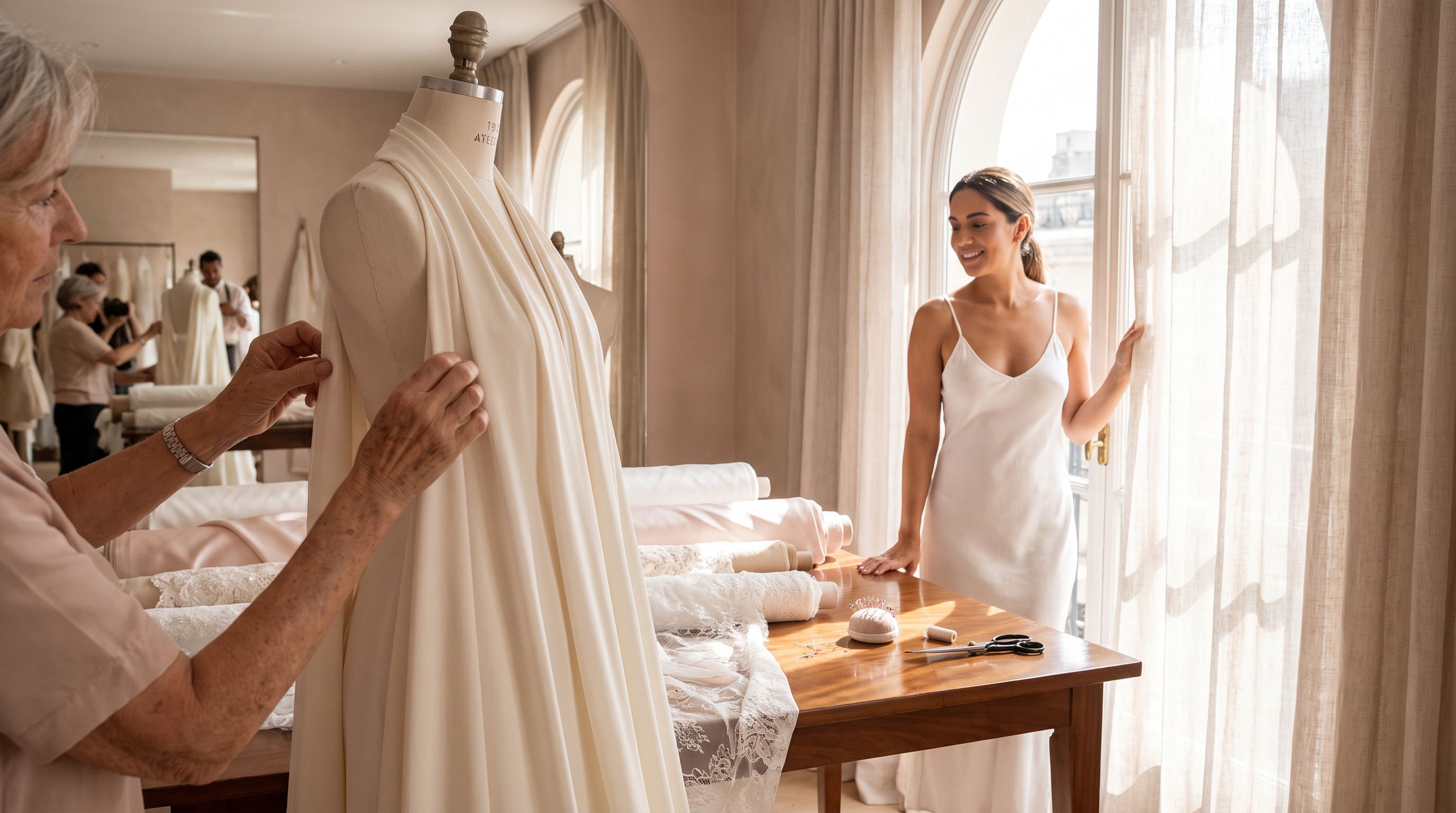
Most people arrive at their first consultation with a picture, not a fabric. That’s completely normal — and it’s also why two dressmakers can quote wildly different prices for what looks like “the same dress.” The silhouette is only half the story. The cloth decides whether that column gown skims or clings, whether the bow holds its shape or flops by cocktail hour, and whether you’re comfortable in August heat.
This is the conversation worth having early, because fabric affects fit, cost, timeline and comfort all at once. Here’s how a maker actually thinks about it.
Crepe, satin and mikado are doing three completely different jobs
These three names come up constantly, and they’re not interchangeable.
Crepe is a matte fabric with a subtle grainy texture created by twisted yarns. It has weight and fluidity — it falls close to the body and moves with you. Four-ply silk crepe is the luxury version: dense, opaque, forgiving. Lighter crepes are prettier in motion but reveal more of what’s underneath, which is why crepe gowns almost always need thoughtful underlining.
Satin is a weave, not a fiber, which is why “satin” can mean two totally different dresses. Duchesse satin is heavy, slightly stiff and holds a ballgown skirt with real presence. Charmeuse is lightweight and liquid with a high shine — gorgeous on a bias-cut slip, and utterly unforgiving of any bump, seam or shapewear line. High shine reflects light, and light reveals texture.
- Bust support in fluid fabrics is built in, not bought separately. With crepe and charmeuse there is nowhere to hide a bra, so support comes from inside the gown: built-in cups, an internal corselette, boning through the side and princess seams. These genuinely change what the fabric can do — a corselette lets soft crepe hold a neckline that would otherwise slip. If you have a larger bust, expect underlining plus internal structure rather than relying on shapewear alone; a smoothing garment can’t lift what the dress isn’t engineered to hold. Raise this at the first consultation, not the third fitting.
Mikado is the sculptor of the group. Traditionally a silk blend, it’s thick, smooth, faintly lustrous and structural — it stands away from the body. If you love clean architectural lines, a dramatic portrait neckline, a sharp bow or a skirt that keeps its shape in wind, mikado does that. It also resists wrinkles better than most, which matters if you’re travelling with your gown.
Height and proportion matter as much as shape. Mikado’s stiffness can overwhelm a short torso, swallowing the waist definition that makes a petite frame read balanced — a lighter-weight mikado or a duchesse satin often behaves better. Crepe has the opposite quirk: it needs weight to hang correctly on a taller frame, so a thin crepe that drapes beautifully at 5’2” can look starved and cling-prone stretched over a longer line. Duchesse satin sits between the two, holding structure without mikado’s hard edge.
The floaty family: chiffon, georgette, organza and tulle
If your inspiration is soft, romantic or ethereal, you’re looking at the lightweight family. Chiffon and georgette are sheer and drapey — they need layering, and they’re a natural choice for destination and warm-weather weddings because they move with air. Organza is crisp and sheer, used for volume that floats rather than hangs. Tulle is netting: the engine behind full romantic skirts, illusion sleeves and cathedral veils.
These fabrics are usually inexpensive per yard, but they can be labour-expensive. A tulle ballgown skirt may take many layers and long, curved hems finished by hand. Cheap cloth, costly hours.
Silk or synthetic — and why the honest answer isn’t always silk
Silk breathes, takes dye with extraordinary depth, and drapes in a way that’s hard to fake. It’s also more delicate: silk crepe and charmeuse can water-spot from rain, a spilled drink, or genuinely, from tears. It creases. It’s usually dry-clean only.
Modern polyester and poly-blend crepes have improved enormously. A heavy stretch crepe with a few percent elastane can drape beautifully, resist wrinkling, survive an outdoor ceremony and cost a fraction of silk. Many respected designers use blends deliberately, not as a compromise.
Colour is where the gap widens again. Plenty of people aren’t wearing white at all — blush, dove blue, black, deep green and red are all fully at home in bridal — and natural fibres hold saturated colour far better than polyester, which can read flat or slightly muddy in deep reds, jewel tones and true black. If you’re wearing red or gold for a South Asian or Chinese ceremony, or planning a two-outfit day with a white ceremony gown and a coloured reception look, silk crepe and duchesse satin are worth the premium precisely because the colour stays rich under both daylight and warm indoor lighting.
The best fabric for your gown is the one that behaves well on your body, in your venue, on your actual wedding day — not the one with the most prestigious name on the selvedge.
What fabric actually adds to your budget
Here’s the part people most want and rarely get straight: realistic ranges. Prices vary enormously by supplier, country, season and quality tier, so treat these as a starting frame to discuss with your maker — not a quote.
Then multiply by yardage. A slim column with a modest train might use roughly 4–8 yards of face fabric; a full ballgown with layered tulle and a cathedral train can climb past 20 yards once you count underlining, lining and horsehair-hemmed layers. Lace works the same way: a lace-overlay bodice usually needs only about 1.5–3 yards, while a fully laced gown with sleeves and a lace-edged train can take 8–15 yards or more. At around $150/yd, that’s the difference between a few hundred dollars and several thousand — which is why makers ask where you want the lace before quoting.
One ownership cost most fabric guides skip: cleaning and preservation. Silk charmeuse and heavily beaded gowns are meaningfully more expensive to clean than a poly crepe, and riskier — beads can be heat-sensitive, and silk can water-mark during spot treatment. Ask what post-wedding cleaning is likely to cost before you fall in love with the beading.
Even so, fabric is frequently a smaller share of a custom quote than expected. Pattern drafting, a toile, construction, boning, hand-finishing and multiple fittings are usually the larger cost — which is exactly why a heavily beaded gown costs more than a plain one in the same fabric. For the full picture, our breakdown of what a custom wedding dress actually costs walks through every line item.
Matching cloth to silhouette, season and venue
A few rules of thumb experienced makers apply almost automatically:
- Structured shapes need structured cloth. A dramatic ballgown in soft crepe will collapse; it needs mikado, duchesse satin, taffeta or serious underskirt engineering.
- Body-skimming shapes need weight, not stiffness. Heavy four-ply crepe skims and smooths. Thin shiny satin highlights.
- Heat changes everything. Silk crepe, chiffon, georgette and light lace over cotton-blend lining wear far cooler than layered mikado or heavy beading.
- Cold and formal venues reward substance. Duchesse satin, mikado, velvet trim and long sleeves suit winter and cathedral settings.
- Photography matters. High-shine satin reflects flash and reads brighter; matte crepe photographs soft and modern; sequins sparkle in candlelight but can look busy in direct sun.
How to choose fabric with your dressmaker
-
Describe the feeling, not just the fabric name
Say “I want it soft and understated” or “I want it to look sculpted.” Makers translate feelings into cloth better than they translate borrowed terminology.
-
Handle three to five candidate fabrics against your skin
Check undertone in daylight next to your face. Ivory and warm champagne flatter many complexions more kindly than stark optic white — and if you’re wearing colour, judge the depth of the dye in the same light. This must be seen, not guessed.
-
Test drape over your own body
Have the maker pin or drape a length at your waist and hip. Fluid fabrics behave differently on different bodies; this is the most useful five minutes of the appointment.
-
Ask about lining, underlining and structure
The layers you can’t see decide comfort, smoothness and support. Silk organza underlining, cotton-blend linings, boning and horsehair-braid hems all affect price and performance.
-
Confirm care, wrinkle behaviour and lead time
Ask whether the fabric water-spots, how it travels, and whether it’s in stock. Imported silk and specialty lace can add weeks — plan it into your overall custom gown timeline.
-
Ask to see the fabric again on the toile
A good maker will discuss substituting a similar-weight fabric in your muslin so you can judge shape before committing to expensive cloth.
Signs you’re in good hands
A skilled dressmaker will happily tell you when a fabric is wrong for your design — even if it’s the one you asked for. They’ll explain trade-offs rather than upselling silk by default, show you swatches you can take home and view in different light, and give you a written breakdown separating fabric cost from labour. They’ll also ask about your venue, your climate and how you want to feel all day, not only how you want to look in photos.
A useful next step you can take on your own this week: order swatches of two or three candidate fabrics from two different suppliers, so you can compare quality at similar price points. Photograph them in your venue’s light — same time of day, indoors or out — and note which ones look different on camera than in person. Then fold each swatch, leave it in a bag overnight, and look at it in the morning. That single test tells you more about how a fabric will survive a getting-ready room, a car journey and a long reception than any description ever will.
Ready to bring your dream dress to life?
Tell us what you're picturing — style, timeline, and budget — and we'll connect you with custom dressmakers who can make it. Free, no obligation.
Get matched with a dressmakerRelated guides
Custom Wedding Dress for Apple-Shaped Brides: Fit Guide
How a custom wedding dress solves fit for apple-shaped brides: the best silhouettes, internal support, fabrics, fittings, and realistic costs.
Read guide →
Custom Wedding Dress for a Small Bust: A Real Fit Guide
A custom wedding dress for a small bust: how bodices get cup-sized, strapless support without heavy padding, flattering necklines, and realistic cost ranges.
Read guide →
Custom Winter Wedding Dress: Fabric, Sleeves, Warmth
How to design a custom winter wedding dress that's genuinely warm: the best fabrics, sleeve and lining choices, capes, realistic costs, and timeline tips.
Read guide →