 Custom
Butter Yellow Wedding Dress: Custom Color, Fit, Cost
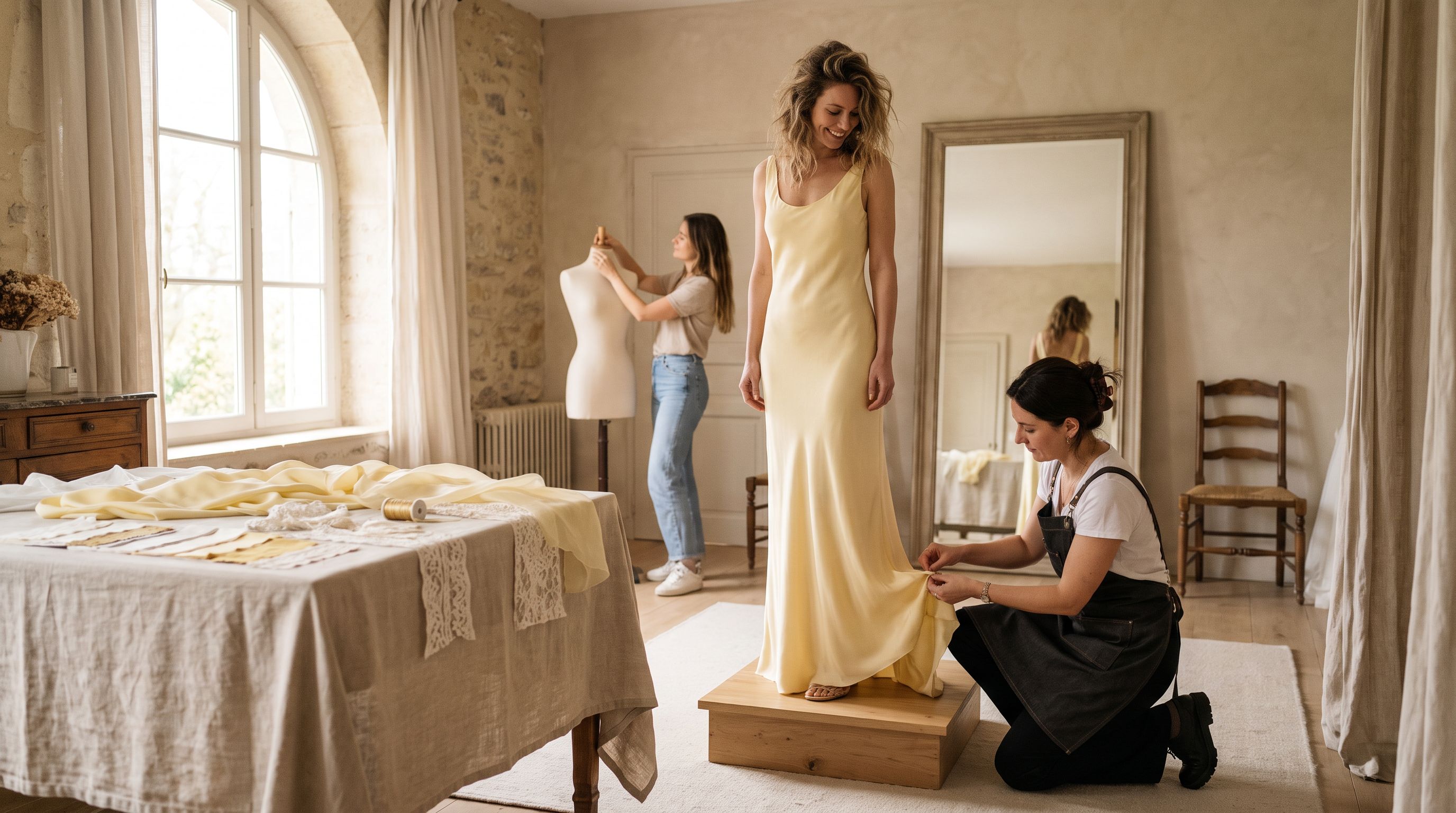
Why soft yellow is suddenly everywhere in bridal
Color in bridalwear used to mean blush at its boldest. That’s changed. Butter yellow has turned up in designer weddings covered by the major bridal press, and it has been one of fashion’s dominant soft neutrals for several seasons — bridal typically follows ready-to-wear by about a year.
What makes it work is that it reads as a neutral, not a statement. From across a room it photographs as warm ivory with a glow. Up close it’s unmistakably yellow. That’s a very different proposition from a black or red gown, and it’s why brides who’d never consider “a colored wedding dress” keep falling for this one.
Color also carries meaning, and yellow carries a lot of it. In many South Asian traditions yellow is auspicious and celebratory — the color of haldi and mehndi festivities — so a butter gown can feel like a beautiful thread between events rather than a departure. In some East Asian and Latin American families, yellow has older associations worth a gentle conversation before you commit. If you’re blending traditions across a weekend, bring your ceremony outfits (or photos of them) to your swatch appointment so the butter shade sits well beside them.
Why you’ll almost certainly need it made
Salons stock what sells at volume — white through champagne. You may find one pale yellow sample, in one size, in a silhouette you didn’t want. Ready-to-wear yellow gowns, meanwhile, rarely have bridal construction: no boning, no internal support, thin linings that go sheer under flash.
So the routes are: a gown made in dyed-to-order fabric, an existing ivory gown dyed (risky, often impossible on mixed fibers), or color built optically with a yellow underlayer beneath ivory tulle. Most makers will steer you to the first.
How custom color actually gets onto the fabric
How it works: Silk crepe, duchesse, organza or tulle is dyed to a specific shade by a mill or dye house before construction begins.
Pros: Saturated and consistent; every layer matches. Lace, buttons and thread can be dyed in the same bath.
Cons: Longer lead time, minimum yardage, and dye lots vary — order extra for alterations and repairs.
How it works: A butter yellow silk or lining layer sits beneath ivory tulle, organza, or lace, so the color reads through, softened.
Pros: Cheaper, faster, uses stock bridal lace. The shade shifts with light and movement.
Cons: Less control; the top layer mutes the color. Difficult on open-back or sheer-bodice designs where the underlayer shows unevenly.
Hand-dyeing a finished gown is the third option and the one to approach carefully. Silk takes dye beautifully; polyester needs disperse dyes and heat that can damage boning, horsehair, and elastic, and mixed fibers come out patchy. Our breakdown of silk versus polyester explains why fiber matters for far more than color.
What a butter yellow custom gown tends to cost
There’s no separate “yellow price list.” You pay for what you’d pay for in ivory — design time, pattern drafting, a toile, fittings, fabric, hand finishing — plus a color premium from dye-house minimums, sampling, and buying extra yardage from one dye lot.
The real cost drivers are worth naming, because they let you estimate your own situation:
- Fiber and weight. Dyed-to-order silk crepe or duchesse costs meaningfully more per yard than stock polyester satin.
- Yardage. A full A-line with a cathedral train can need three times the fabric of a slip gown — and color multiplies that difference.
- Size, train and support. Fuller sizes, longer trains, and cup-size-specific internal support all increase the dyed yardage required, and dye-house minimums mean this belongs in the conversation before the quote, not after.
- Matching components. Lace, horsehair, buttons, thread, and veil dyed to match add labor and sampling rounds.
- Your maker’s experience and city. Unchanged by color, but the biggest variable overall.
Fit, support, and what pale yellow actually shows
Ivory scatters light. A warm pale yellow in silk picks up every shadow, so whatever structure sits underneath tends to read as a visible line on the surface. That’s not a reason to avoid internal support — it’s a reason to choose it deliberately.
Talk through the options: boning (spiral steel in channels for a bodice that holds a shape on its own), an internal corselette or waist stay that carries the gown’s weight off your shoulders and stops a strapless neckline migrating, and built-in cups — moulded or sewn, drafted to your actual cup size rather than a generic B. Over a structured bodice, satin shows every boning channel and seam ridge; matte crepe, or a lighter fabric that’s been underlined, forgives far more. If you want strong shaping and a flawless surface, the fabric choice is doing half that work.
At fittings, flag three things specifically. Bra-strap ghosting: if you’re wearing a bra under a fitted bodice, the strap print shows on the muslin and will show on the day — decide on built-in support early. Lining show-through: photograph yourself with flash at every fitting, because a lining that looks opaque in daylight can disappear under a photographer’s strobe. Hem and edge details: horsehair braid ridges and white lining peeking at the hem are far more visible in pale yellow than in ivory.
Choosing the right shade for your skin and venue
If your skin has warm or golden undertones, a deeper, creamier butter tends to look rich rather than washed out. Cool or pink undertones are usually happiest in a paler, whiter butter, closer to clotted cream. Deep, rich skin tones often look spectacular in a more saturated butter or soft primrose — the barely-there versions lose contrast. Olive undertones want to avoid anything leaning green-yellow.
This is impossible to judge on a screen. Hold swatches under your jaw in north-facing daylight, bare-faced, then photograph with flash — and finally look under warm artificial light, because candlelight pushes yellow toward gold and cool LED flattens it toward beige.
Commissioning it, step by step
-
Bring references — and say what you dislike
Save five images and note why each works. “This shade, not that one; this is too lemon.” Pictures and swatches beat adjectives.
-
Approve a physical swatch before cutting
Ask for a dyed strike-off in your actual fabric, not a printed color card, and live with it at home for a few days.
-
Confirm every layer
Lining, underlayer, horsehair, thread, zipper tape, covered buttons. White lining flashing at the hem looks unfinished.
-
Build the toile in muslin
Silhouette and support get solved on a cheap mock-up. Your dyed fabric is too hard to replace to use as a test garment.
-
Plan accessories around the gown
Veils and shoes are easier to source once the final shade exists. Ivory tulle over butter silk reads as deliberate, soft contrast.
A colored gown isn’t braver than an ivory one — it’s just more specific, and specificity is exactly what custom work is for.
Questions worth asking any maker
A dressmaker comfortable with color will answer these without hesitation: Have you worked with dyed-to-order fabric, and can I see photos? Which dye house do you use, and what are their minimums and lead times? Will sampling be itemized in my quote? What happens if delivered fabric doesn’t match the approved swatch? How much surplus are we ordering? Hesitation on the supplier question is a quiet red flag — as is anyone promising to dye a finished polyester gown to an exact shade.
Caring for dyed silk, before and after the day
Dyed fabric isn’t as stable as white, and a good maker raises this early. Perspiration and aluminium-based deodorants can lift or shift dye at the underarm, so apply deodorant well ahead and let it dry fully, and ask about discreet dress shields in the lining if you run warm. Some dyes also shift or fade under hours of direct sun, which matters for a midday outdoor ceremony — plan shade for photos and the ceremony itself where you can.
Afterwards, tell your cleaner in writing that the gown is dyed-to-order before any cleaning or preservation, and hand over a surplus swatch so they can test solvents on that instead of your hem.
If butter yellow turns out to be a step further than you want, the same conversations apply to any non-white gown — our guide to black, blue, and red custom wedding dresses covers the deeper end of the spectrum.
Your working-backwards timeline
Count back from your wedding date and put these three markers in your calendar now:
- Swatch approved and fabric ordered: 7–8 months out. This is the deadline that protects everything after it.
- Dyed fabric delivered, checked against the approved strike-off, and cut: 5–6 months out.
- First fitting in your real fabric: 3–4 months out, with final fitting 2–3 weeks before the wedding.
If your date is closer than that, the underlayer route or a simpler silhouette in stock fabric is the honest answer — and worth raising in your very first conversation with a maker.
Ready to bring your dream dress to life?
Tell us what you're picturing — style, timeline, and budget — and we'll connect you with custom dressmakers who can make it. Free, no obligation.
Get matched with a dressmakerRelated guides
Outdoor Wedding Dress: Rain, Grass, and Humidity Guide
How to choose a custom outdoor wedding dress that survives rain, grass, wind, and humidity — fabric picks, hem strategy, and what weatherproofing costs.
Read guide →
Halter vs One-Shoulder vs Asymmetric Gown: Fit & Cost
Halter vs one-shoulder wedding dress: how each neckline carries weight, flatters different shoulders and busts, what it costs custom, and what to ask your maker.
Read guide →
Strapless vs Straps vs Off-the-Shoulder: Fit Guide
Strapless vs straps vs off-the-shoulder wedding dress: how each one is supported, what it costs in a custom gown, and how to choose for your body and day.
Read guide →