 Custom
Strapless vs Straps vs Off-the-Shoulder: Fit Guide
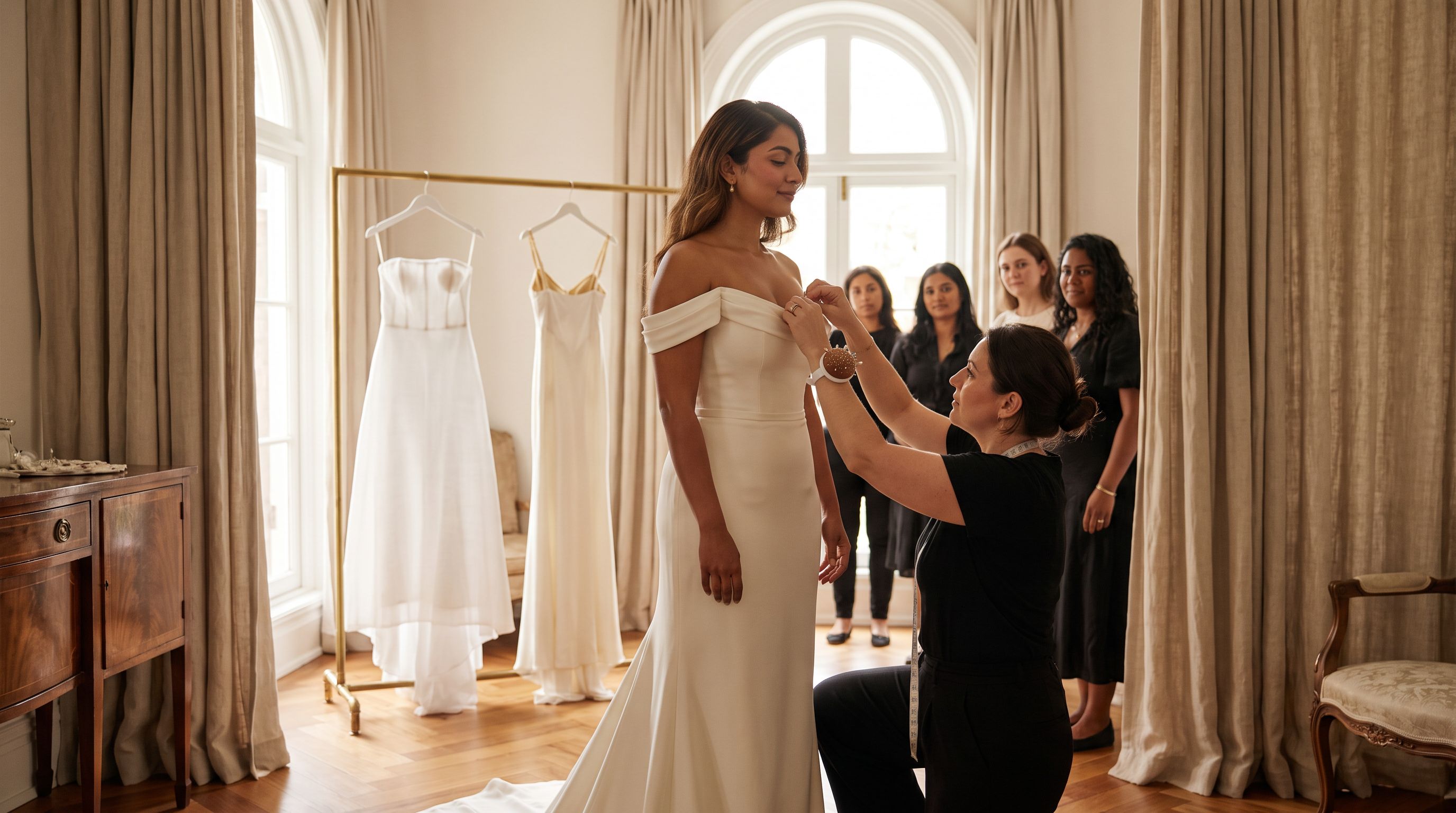
The real question isn’t straps or no straps — it’s what’s holding the dress up
When people describe a dream gown, they usually start at the top: strapless, I think, or something off the shoulder like the photo. That’s a style instinct, and it’s a valid one. From a dressmaker’s chair, though, those three words describe three different engineering problems.
Every gown has to resist gravity in one of two ways — gripping your body or hanging from your shoulders — or some combination of both, which is what off-the-shoulder usually is. Knowing which job your neckline is doing tells you most of what you need to know about comfort at 11pm, how many fittings you’ll need, and where your money goes. Everything below applies to anyone commissioning a gown: brides, non-binary and gender-diverse clients, anyone having a dress made for a day that matters.
Strapless: what it actually takes to stay put
A well-made strapless bodice isn’t a tube of fabric with boning tossed in. In a custom gown it’s usually a separate inner layer — a corselet, or foundation — cut in a firm, stable fabric, boned at the seams and finished with a waist stay: a grosgrain ribbon that hooks around your natural waist and anchors the gown at the most stable part of your torso, so the bodice isn’t hanging off your bust.
What makes strapless succeed or fail:
- Rib cage fit, not bust fit. The bodice should be snug under the bust, where your ribcage is bone. That’s why a maker often fits the inner structure first, before you ever see the pretty outer layer.
- Bone placement and quality. Spiral steel at curved seams, flat steel at centre back. Plastic boning plus a long night of dancing is where “it kept sliding down” stories come from.
- Bust size and shape. A fuller bust is absolutely wearable strapless — it just needs more engineering, usually built-in cups or a corselet with a deeper underband. Our guide to support options for a full bust and small waist goes deeper.
Straps: the most underrated choice in bridal
Straps get treated as the safe option, which undersells them. Mechanically, they move weight onto your shoulders, so the bodice can be lighter, less tightly fitted through the ribs, and far easier to breathe in. With a long train, a heavy beaded skirt or layers of tulle, straps quietly solve a weight problem that strapless has to muscle through.
They do styling work too: thin straps lengthen a short torso, wider straps balance a fuller bust, illusion straps in fine tulle give the strapless look with real security. Coverage isn’t only aesthetic, either — some ceremonies, venues and faith traditions ask for shoulders or arms to be covered, and a detachable band, overlay or pair of sleeves can let one gown serve a modest ceremony and a barer reception.
A strap only carries weight if it’s anchored into the bodice’s inner foundation, not just stitched to the outer fabric — ask your maker where yours attaches.
Off-the-shoulder: the most romantic, and the most technical
That horizontal line across the upper arms widens the shoulder line. That’s genuinely useful if you want to balance fuller hips or add breadth to a narrow frame, and less useful if your shoulders are already broad and you’d rather not emphasise them. It’s hardest on very sloped shoulders, where a band has little to grip and tends to slide through the night.
Fit here is highly individual: shoulder slope, upper-arm circumference and the distance between your shoulder points all vary. A band drafted for a sample mannequin rides up on one wearer and pins another’s arms to their sides. A true off-the-shoulder band sits where your arm meets your shoulder, with enough ease to lift your arms for a first dance and enough grip not to creep upward. And underneath, most of these gowns are supported like strapless — the band is decorative, not structural — so you’re paying for the corselet and the band drafting. If you want the band to genuinely bear weight, that’s a different construction; ask specifically.
What each one tends to add to a custom gown’s price
Fabric cost barely changes between these three; hours do. A structured strapless bodice means a separate inner foundation, boning, hand-finishing and usually an extra fitting. An off-the-shoulder band means drafting, a toile specifically to test arm movement, and fine-tuning at every fitting.
These are increments on top of a gown’s base price, not the total — a full custom gown commonly sits in the four figures and climbs with fabric and embellishment, so budget the bodice as a line item inside that number. Treat the ranges as starting points to adapt. The real drivers are your fabric (slippery silk charmeuse takes longer than crepe), how much embellishment must be matched across a strap, your maker’s experience, and local labor rates. If sleeves are also on your shortlist, our sleeve types, fit and cost guide breaks those down.
Is it cheaper to buy off the rack and add straps later?
Sometimes. Off-the-rack gowns are cheaper up front because you’re buying something already made in a standard size rather than paying for drafting and fittings. If you find a strapless gown you love in or near your size, adding simple straps at alterations is often a modest job.
The math turns when the change is structural: converting strapless to off-the-shoulder, rebuilding support for a fuller bust, or matching beaded lace across a new strap. There you’re paying alterations prices for custom-level work, usually with less control over the result.
How to decide with your maker, not before you meet one
The most useful thing you can do is arrive undecided but informed, and let someone test this on your body rather than guess from a photo.
-
Bring three photos, not thirty
One strapless, one with straps, one off-the-shoulder — ideally on bodies roughly like yours. Say what you like about each line, not the whole dress. -
Ask how the bodice will be supported
You want specifics: corselet or built-in cups? Spiral steel or flat? A waist stay, yes or no? Our corset versus built-in bra comparison explains the trade-offs. Vagueness here is the one real red flag. -
Test it in the toile
Pinning a strap onto a muslin takes minutes and tells you more than any mirror selfie. -
Move like it's the wedding day
Hug, reach, sit, eat, dance. Comfort at toile stage is a promise; discomfort is a warning. -
Decide on detachables early
If there’s any chance you’ll want both looks, lock it in while it’s still cheap to build in.
If your design has to be supported on your frame — a fuller bust in strapless, uneven shoulders under a band, a heavy skirt whose weight needs shifting upward — that’s a fitting-room conversation, not a scrolling one. Ask the maker to pin a strap onto your toile before you decide; an hour in front of a mirror with someone who fits bodies for a living settles this better than weeks of saved photos.
Ready to bring your dream dress to life?
Tell us what you're picturing — style, timeline, and budget — and we'll connect you with custom dressmakers who can make it. Free, no obligation.
Get matched with a dressmakerRelated guides
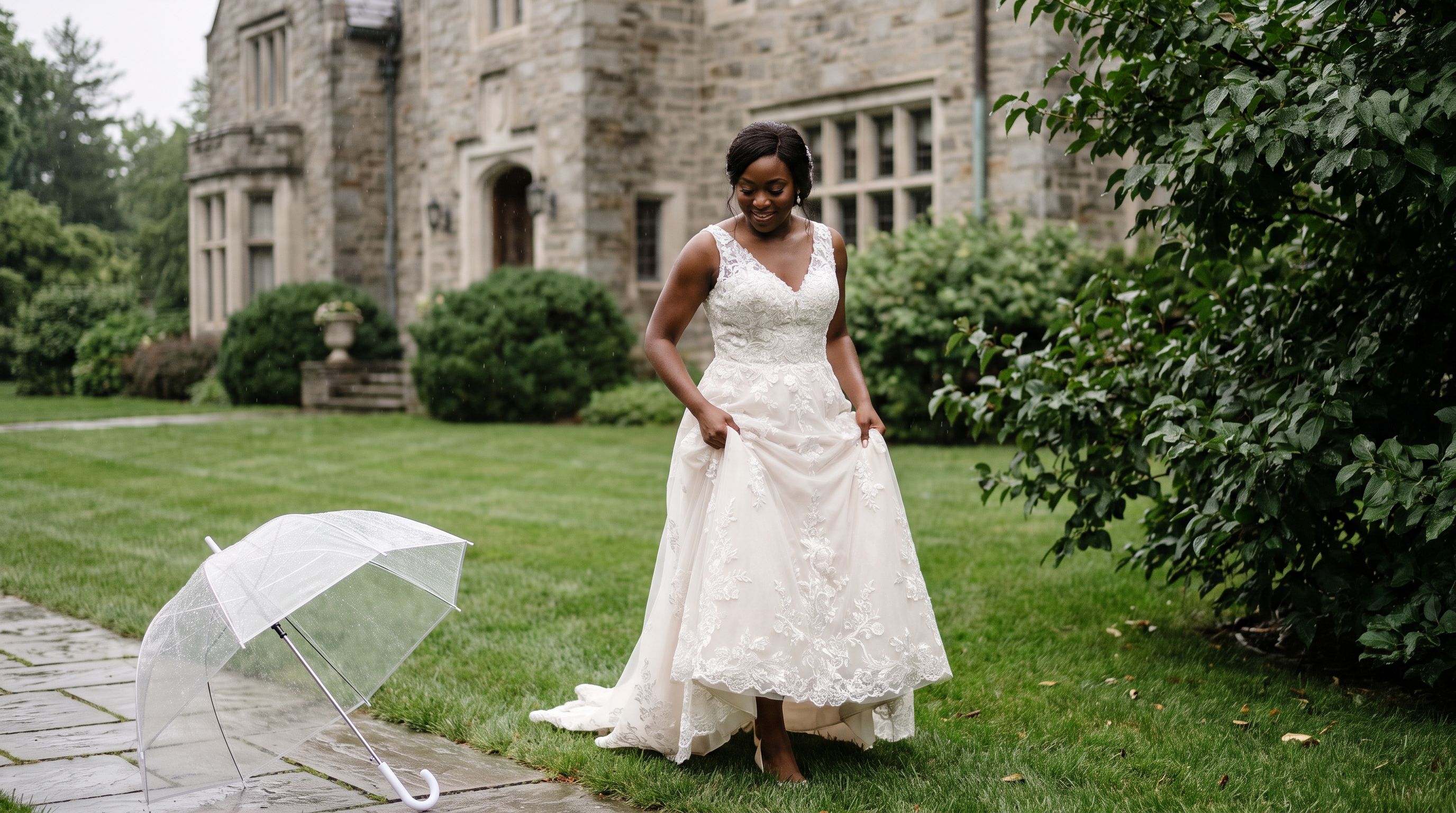
Outdoor Wedding Dress: Rain, Grass, and Humidity Guide
How to choose a custom outdoor wedding dress that survives rain, grass, wind, and humidity — fabric picks, hem strategy, and what weatherproofing costs.
Read guide →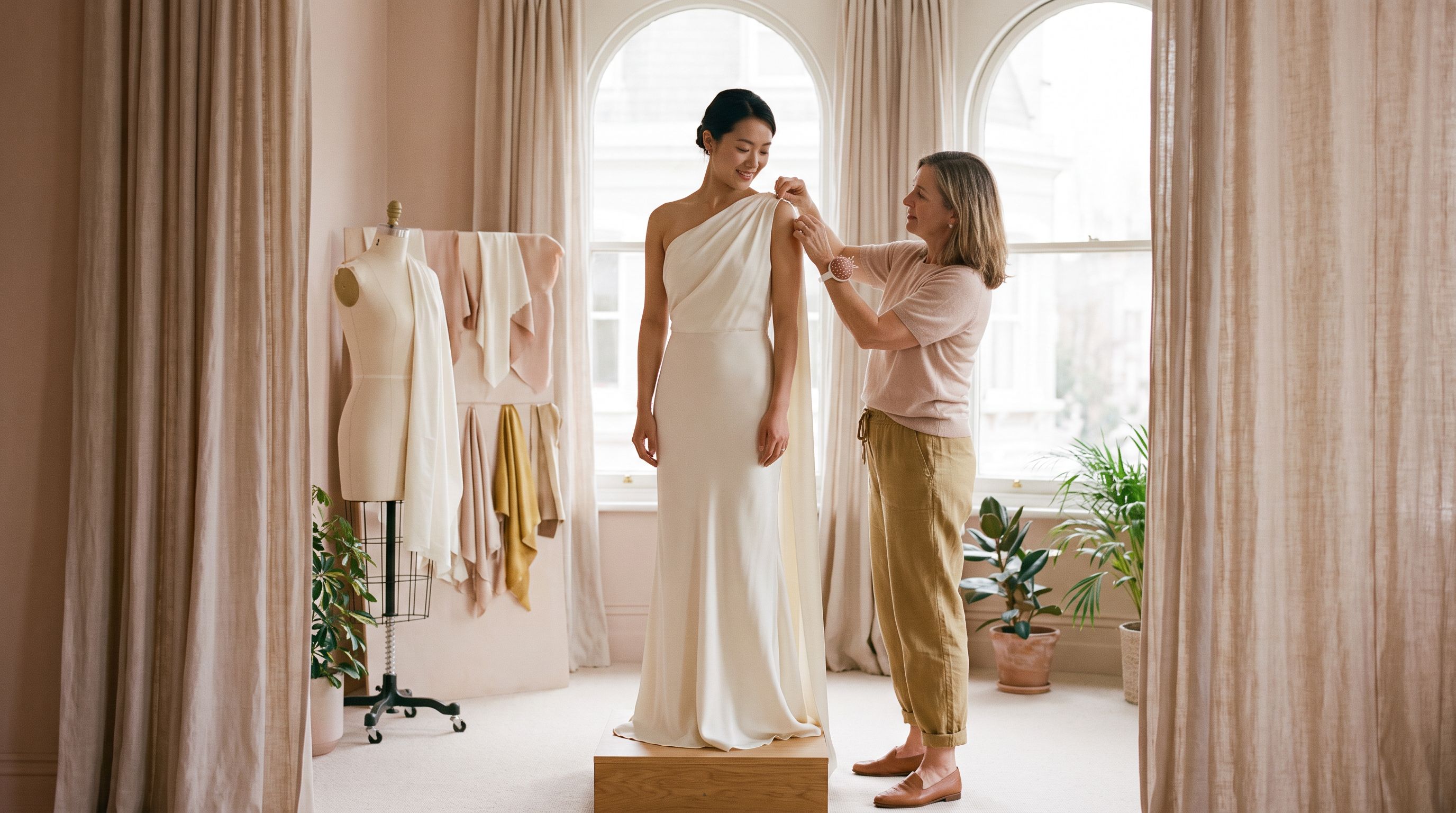
Halter vs One-Shoulder vs Asymmetric Gown: Fit & Cost
Halter vs one-shoulder wedding dress: how each neckline carries weight, flatters different shoulders and busts, what it costs custom, and what to ask your maker.
Read guide →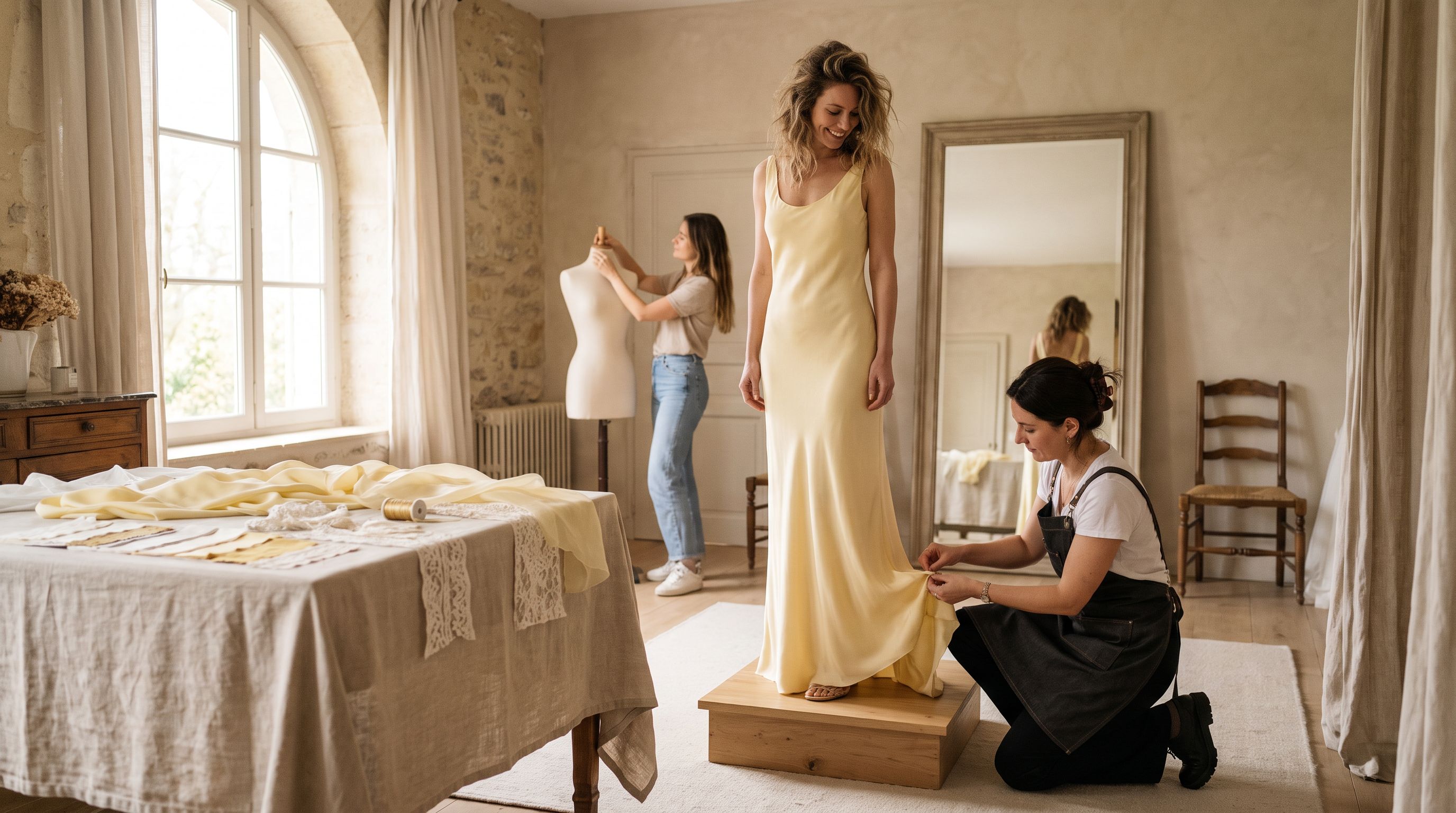
Butter Yellow Wedding Dress: Custom Color, Fit, Cost
Butter yellow is bridal's softest new neutral. Here's how custom dyeing works, which fabrics hold the shade, what it costs, and how to pick your tone.
Read guide →