 Custom
 Corset vs Built-In Bra: Wedding Dress Support Explained
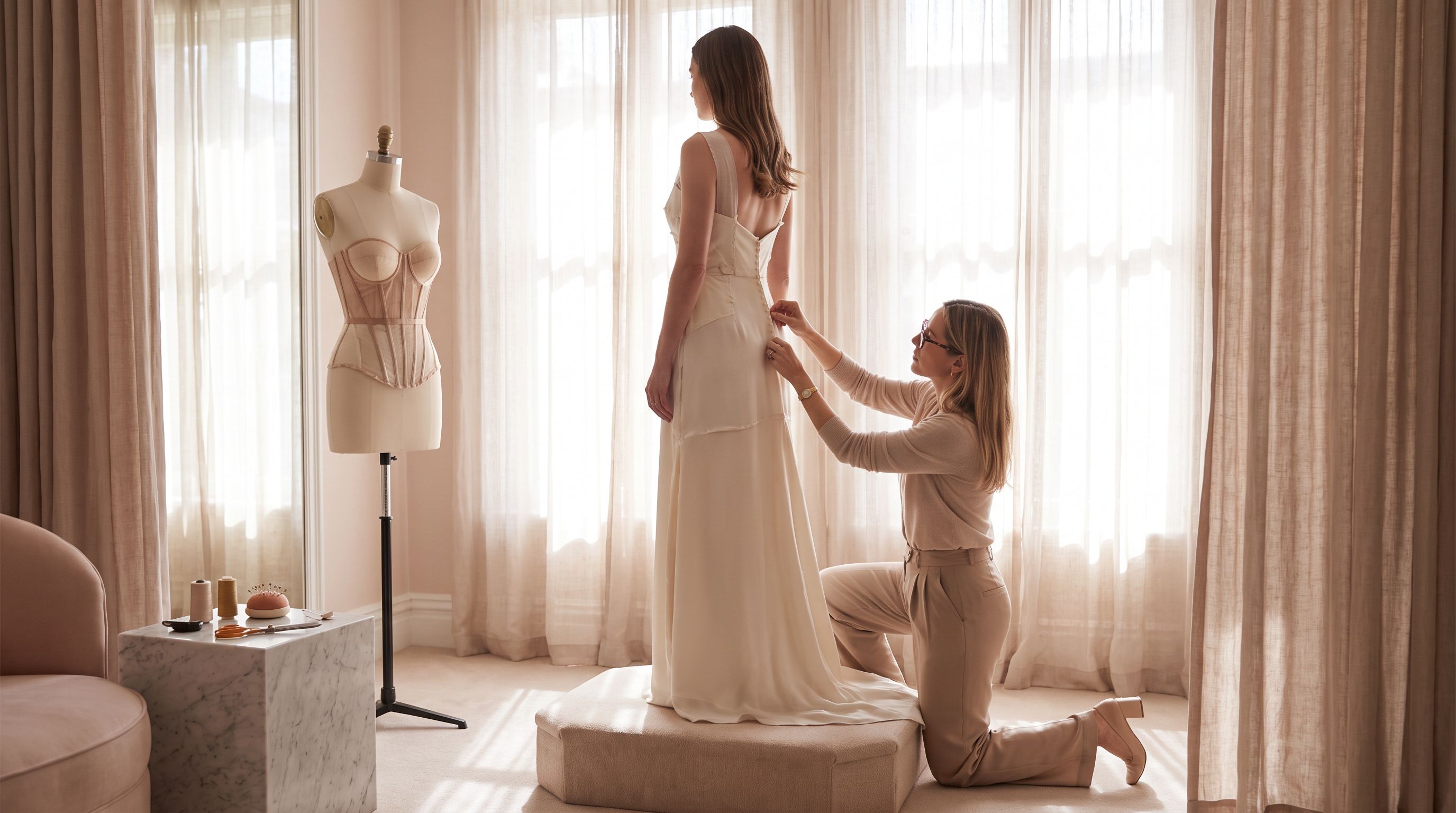
Anyone who has ever hitched up a strapless neckline during a first dance already knows the truth: a wedding dress is an engineering project wearing a pretty face. The seed beading and the illusion sleeves are what you fall in love with. The structure underneath is what decides whether you spend the reception dancing or discreetly tugging. (We say “bride” here for brevity — everything below applies equally to anyone wearing a gown, whatever your gender, ceremony, or tradition.)
This is one of the clearest advantages of going made-to-measure. Off-the-rack gowns are built to an average torso with a generic amount of internal support, and alterations can only adjust so much of that. A custom maker builds the foundation to your body first, then hangs the beautiful part on top of it.
What “support” actually means inside a gown
People use “boning,” “corset,” and “built-in bra” almost interchangeably, and they do completely different jobs. Understanding the difference is what lets you ask for the right thing at your consultation.
Bra cups are foam or molded shapes sewn into the bodice lining. They give shape, modesty, and a smooth line — but on their own they support nothing. A cup floats on the fabric; if the fabric slides down, so does the cup.
Boning is flexible plastic or steel in narrow channels along the seams. Its job is to stop fabric from collapsing, wrinkling, or rolling at the waist. Boning shapes the dress, not the body.
An inner corset (corselette) is a separate, tightly fitted layer inside the gown — usually a firm coutil or double-layer cotton, boned, and fastened independently at the back or side. It grips your ribcage and takes the weight of the skirt and bust off your shoulders. This is real support.
An exterior corset back is the visible lace-up closure. It is a closure and adjustability feature, not automatically a support feature — a laced back over an unstructured bodice still won’t hold up a heavy strapless gown.
Built-in bra versus inner corset: how to choose
Best for: lightweight silhouettes — slip dresses, soft A-lines, crepe columns, gowns with sleeves or straps that carry the weight.
Feels like: almost nothing. Breathable, easy to sit and eat in, no compression.
Trade-offs: minimal lift, limited shaping, and on a fuller bust the cup edge can show through fine fabric. Provides no help against a heavy skirt.
Typical add-on in a custom build: often a modest cost, sometimes included in the base price.
Best for: strapless and off-shoulder necklines, ball gowns and heavy trains, fuller busts, long reception days, anyone who wants a defined waist.
Feels like: firm and held — snug like a good handshake, not crushing. In our experience most wearers stop noticing the compression within the first hour, but tell your maker immediately if it restricts your breathing.
Trade-offs: warmer, more construction time, and it must be fitted precisely (a badly fitted corset is worse than none). Less forgiving if your measurements shift.
Typical add-on in a custom build: frequently in the $150–$600 range depending on materials and complexity.
Many of the best custom gowns use both: a boned corselette for load-bearing, with light cups mounted onto it for shape. If you have a full bust and a smaller waist, this combination is usually the answer — the corset holds, the cups shape, and the two don’t fight each other.
What structure adds to the price, and why it varies
Support is labour, not fabric. That is why two gowns in identical silk can differ by hundreds of dollars underneath. The figures below are illustrative ranges in USD, based on typical North American and UK studio rates — expect meaningful variation by region, and use them as a starting point for your own quotes rather than a benchmark.
The drivers are consistent: how many bones and channels, whether the corset is a full separate layer or integrated into the lining, whether your fabric is delicate enough to need hand-finishing, how heavy the skirt is, and your maker’s experience level. A dressmaker who builds true corsetry charges for a genuine skill — and it shows in photographs from the side, which is where unsupported bodices always give themselves away.
If you’re weighing this against buying off the rack and altering, be honest about the ceiling: adding real internal structure to a finished gown means opening the bodice, and there are limits to what alterations can achieve before you’re rebuilding the dress at custom prices anyway.
How your fabric and silhouette change the answer
Structure and cloth are a package deal. Fluid fabrics like crepe and charmeuse reveal everything — a bone channel or cup seam can telegraph through the surface, so makers often use fewer bones, softer cups, and an extra layer of underlining. Structured fabrics like mikado and duchesse satin hide construction beautifully and can hold a strapless line with less internal help; our fabric comparison guide goes deeper into how each behaves.
Modest, sleeved and high-neck gowns are engineered differently, because the shoulders and sleeve seams already carry some of the load — the foundation there is usually lighter, focused on smoothing and waist definition rather than gripping the ribcage, with careful attention to armhole comfort so you can raise your arms to pray, dance, or lift a child. The same logic applies to cultural attire: a lehenga choli distributes weight through a fitted, often self-boned blouse and a waist-anchored skirt, while a jacket-layered or kimono-influenced gown lets the outer layer share the structural work, so the inner build can be quieter than a Western strapless bodice would demand.
Skirt weight matters just as much as bust size. A cathedral train in heavy satin pulls downward all night. Without a corselette gripping your ribs, that weight travels straight to your neckline. For plus-size and curvy wearers, a well-built foundation is often the difference between a gown that fits and a gown that feels engineered for you — smoothing, lifting, and closing the gaping at the back of the arm that’s a common issue when a standard-size bodice is simply graded up rather than redrafted.
Where support gets decided during the fitting process
-
Consultation
Say out loud what you want: “I want to be able to raise my arms,” “I don’t want to think about my neckline,” “I want a visible waist.” A good maker translates those sentences into construction choices. -
The toile or muslin
The mock-up is where support is tested, not guessed. Move in it. Sit, hug someone, lift your arms overhead, walk. If the bodice creeps or the waist rides up, it gets corrected here — cheaply, in cotton. -
Foundation fitting
Some makers fit the inner corset separately before the outer gown is assembled. Expect it to feel firmer than street clothes and to leave a light mark on your skin; expect it not to pinch, dig into your underarm, or restrict breathing. -
Second and third fittings
Bones get shortened or repositioned, cup placement is adjusted, and the closure is refined. Ask your maker to check the profile view in a mirror — support problems show in silhouette long before they show head-on. -
Final fitting
Wear everything. Dance a little in the studio. This is your last honest chance to say “it slips when I do this.”
A gown you never adjust all night doesn’t look effortless by accident — someone built it that way, from the inside out.
What to ask before you commit
These questions quickly separate an experienced maker from someone who mostly sews:
- What kind of internal support are you planning for this design, and why that one?
- Is the foundation a separate boned layer, or boning in the lining?
- Will the structure be visible through this fabric from the side or in flash photography?
- Can I move, sit and dance in the toile before we cut the real fabric?
- If my measurements change slightly before the wedding, how much adjustment does this construction allow?
One red flag to listen for: if you’ve asked about a heavy strapless ball gown and the answer is “we’ll just add some boning to the lining,” that’s a sign the maker is shaping fabric rather than carrying weight — press for a separate boned foundation, or keep looking. Answers that are specific, unhurried, and occasionally cautionary — “I’d steer you away from strapless in this fabric unless we build a full corselette” — are the sound of expertise. Vague reassurance is not.
If you’re ready to talk to a maker, three things make that first conversation genuinely productive: bring inspiration photos that show the side view, not just the front, so structure can actually be assessed; bring the shapewear and bra you expect to wear, along with your venue, season and how long you’ll be on your feet; and ask directly what foundation they’d recommend and what it adds to the quote. Even if you book nowhere, you’ll leave knowing what your fabric, silhouette and body actually need — and that’s information you can carry into any fitting room.
Ready to bring your dream dress to life?
Tell us what you're picturing — style, timeline, and budget — and we'll connect you with custom dressmakers who can make it. Free, no obligation.
Get matched with a dressmakerRelated guides
How to Measure Yourself for a Custom Wedding Dress
A step-by-step guide to taking wedding dress measurements at home: the exact list, tools, common mistakes, and how makers use them for a custom gown.
Read guide →
Adaptive Custom Wedding Dresses: Seated Fit and Access
How an adaptive custom wedding dress is drafted for a seated fit, easy closures, and real mobility needs — plus realistic cost ranges, fittings, and what to ask a dressmaker.
Read guide →
Custom Wedding Dress When Your Body Is Changing
Weight loss, pregnancy, IVF or surgery before the wedding? How a custom wedding dress can be built to adjust — fittings, timing, fabrics and real costs.
Read guide →