 Custom
Church Wedding Dress Code: Shoulders, Sleeves, Coverage
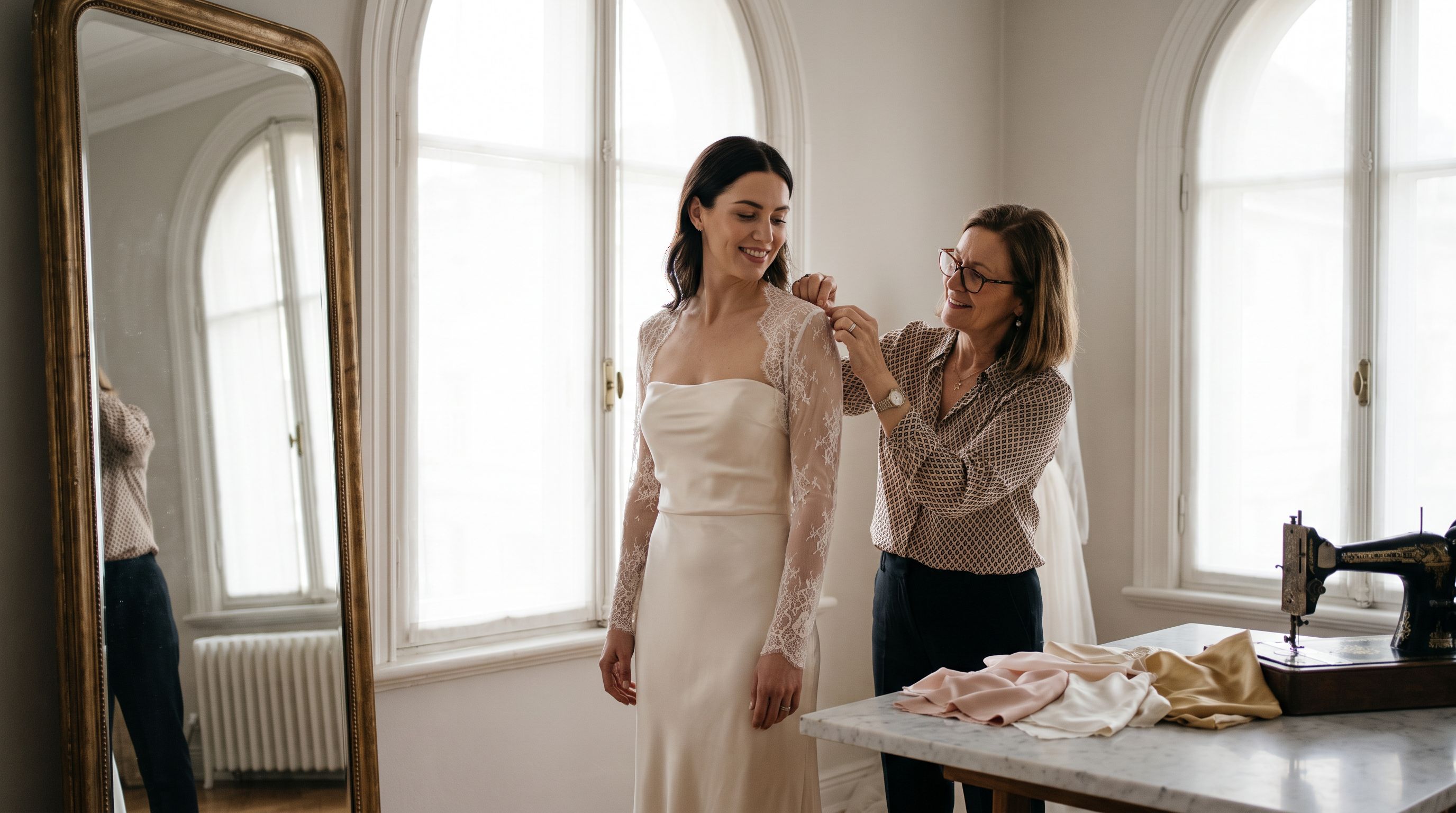
The only dress code that matters is the one your officiant gives you
There’s a whole genre of wedding anxiety built on hearsay: a cousin says the church “doesn’t allow strapless,” a forum post says shoulders must be covered, someone’s aunt remembers a priest turning a bride away in 1994. Meanwhile, the rule at your actual ceremony site may be stricter, looser, or simply nonexistent. Strangers have opinions; the venue has the answer.
It’s also worth asking who the rule applies to. Many ceremony dress codes extend to the wedding party and to anyone wearing a gown — including a partner in a gown, a parent, or attendants — so ask once and share the answer with everyone who needs it.
So before you design anything, get the answer from the source — ideally by email, so you have it in writing.
Some churches have no rule at all. Some ask only for shoulders covered during the ceremony itself. Orthodox parishes, LDS temples, mosques, gurdwaras, and synagogues each have their own expectations, and family tradition may matter as much as written policy. If you’re navigating full coverage rather than shoulder coverage specifically, our guide to modest custom wedding dresses with sleeves and coverage goes deeper on necklines, linings, and opacity.
Two ways to solve it: build it in, or take it off
Once you know the requirement, the design question is simple. Do you want the coverage to be the dress — or a layer over it?
Best when the covered look is the look you want in every photo, or when you want sleeves that genuinely fit your arms with no gapping.
Sleeves cut as part of the bodice sit better: the armhole is shaped to your frame, the sleeve cap is set for your shoulder slope, and nothing shifts when you hug people. Fabric and lace match perfectly because it’s all one build. Downside: no costume change, and in a hot church a lined long sleeve is warmer than you think.
Best when you love a strapless or spaghetti-strap silhouette and need to satisfy the ceremony only.
A cape, bolero, jacket, or detachable sleeves lets you honour the rule and then reveal a different dress at the reception. Downside: a removable layer is a second garment. It must be drafted, fitted, and anchored properly or it reads like a borrowed shrug.
Our comparison of bridal capes, detachable sleeves, and boleros breaks down which removable option flatters which neckline — worth reading before your design consultation.
What added coverage typically costs
These are illustrative ranges to budget against, not quotes. Price moves with fabric (silk georgette versus beaded Alençon lace changes everything), hand-finishing, your maker’s experience level, and your local market.
None of this requires a gown built from scratch. If you already have an off-the-rack or secondhand dress you love, a skilled local seamstress can often add sleeves, straps, or a cape to it for considerably less than a full custom build — and many bridal shops and costume hire services rent or lend boleros and capelets for the ceremony hour alone. Borrowing a cover-up from a friend or family member and having it taken in to fit you is a perfectly legitimate solution, and photographs just as well.
The cost drivers worth understanding: lace is the big one — a few metres of fine French lace can cost more than the labour. Placement matters too; matching a lace motif across a shoulder seam so the pattern appears continuous is slow, skilled work. Linings add up — opaque sleeves need underlining or a separate sleeve lining to avoid a pinkish cast on camera. And fastenings (covered snaps, hooks and bars, a hidden placket) are small details that take real time to execute invisibly. For more on sleeve styles and what each one does for your frame, see our breakdown of custom wedding dress sleeves: types, fit, and cost.
How to make removable coverage look intentional
The difference between a cape that looks designed and one that looks apologetic comes down to four things.
-
Buy the fabric at the same time
Ask your maker to cut the overlayer from the same bolt or dye lot as the gown. Ivory is not one colour — two “ivory” silks bought three months apart can read noticeably different in daylight photos.
-
Match the weight, not just the shade
A stiff organza cape over a fluid crepe gown fights the silhouette. Your dressmaker should drape the cape fabric over the skirt fabric at consultation so you can see how they move together.
-
Anchor it so it stays put
Capes and sleeves need discreet anchoring — snaps at the shoulder seam, loops over buttons, hooks into the bodice edge. Without anchors, a cape creeps backwards all through the vows and detachable sleeves slide down your arms.
-
Rehearse the removal
At your final fitting, take the layer off yourself, then with one helper, in under thirty seconds. If it requires two people and a mirror, redesign the closure now.
Coverage that was planned on day one looks like design. Coverage added in month ten looks like a compromise — and everyone can tell the difference.
Fit details that make sleeves comfortable, not just compliant
Sleeves are where fit gets technical, and where custom genuinely outperforms alterations. Arm circumference, shoulder slope, and bust shape vary enormously from person to person — fuller upper arms, broader or more sloped shoulders, and a fuller bust are ordinary fitting cases, not problems to solve. A good maker drafts the sleeve and armhole from your own measurements rather than grading a standard pattern up or down, which is exactly why custom sleeves tend to feel better than off-the-rack ones. Ask about these at the toile stage:
- Range of motion. You need to raise your arms to hug, dance, and hold a bouquet. A well-cut sleeve has a higher, closer armhole than you’d expect — counterintuitively, a tight armscye with a roomier sleeve gives you more movement than a low, loose one.
- Bicep and forearm ease. A good fitter measures bicep, elbow, and wrist separately rather than scaling from a size chart.
- Opacity in daylight. Illusion mesh photographs differently than it looks in a dim fitting room. Ask to see it near a window, and ask whether your venue counts mesh as “covered.”
- Breathability. Church in July with lined long sleeves is a real consideration. Lightweight silk georgette, fine tulle, or an unlined lace sleeve will carry you through a long ceremony far more comfortably than lined satin.
What to look for in a maker when there’s a dress code involved
Sleeves, capes, and convertible designs separate confident makers from cautious ones. In a consultation, ask directly: Have you drafted set-in sleeves before? Can I see a gown you made with a detachable element? How do you anchor it? A strong answer is specific — they’ll describe the closure type and show you photos or a sample.
Also ask how many fittings they’d expect. A gown with a removable layer realistically needs the layer fitted at least twice: once in toile or a rough version, once near the end with your shoes, undergarments, and hair trial in place, because a cape’s neckline sits differently once your hair is up.
When you do sit down with a dressmaker, bring three things: your officiant’s written dress code, two or three inspiration photos, and your wedding date. With those in hand, a maker can usually tell you within twenty minutes which route suits you, roughly what it adds to the budget, and whether your timeline allows for the extra fitting. Most ceremony dress codes can be met with either an integrated sleeve or a removable layer — a consultation will tell you which route fits your silhouette.
Ready to bring your dream dress to life?
Tell us what you're picturing — style, timeline, and budget — and we'll connect you with custom dressmakers who can make it. Free, no obligation.
Get matched with a dressmakerRelated guides
Bridal Seamstress vs Regular Tailor: Who to Trust
Can a regular tailor alter a wedding dress? Here's how a bridal seamstress differs, what each job costs, and when to hire a custom dressmaker instead.
Read guide →
Custom Wedding Dress After a Mastectomy: Fit & Support
A practical guide to a custom wedding dress after mastectomy or breast surgery: prosthesis pockets, support without underwire, scar coverage, timing, and real costs.
Read guide →
Custom Wedding Dress for Scoliosis or Uneven Shoulders
A custom wedding dress for scoliosis or uneven shoulders: how makers balance hems, straps and bust asymmetry — plus realistic costs, fittings and timelines.
Read guide →