 Custom
 Wedding Dress After a Mastectomy: Fit & Support
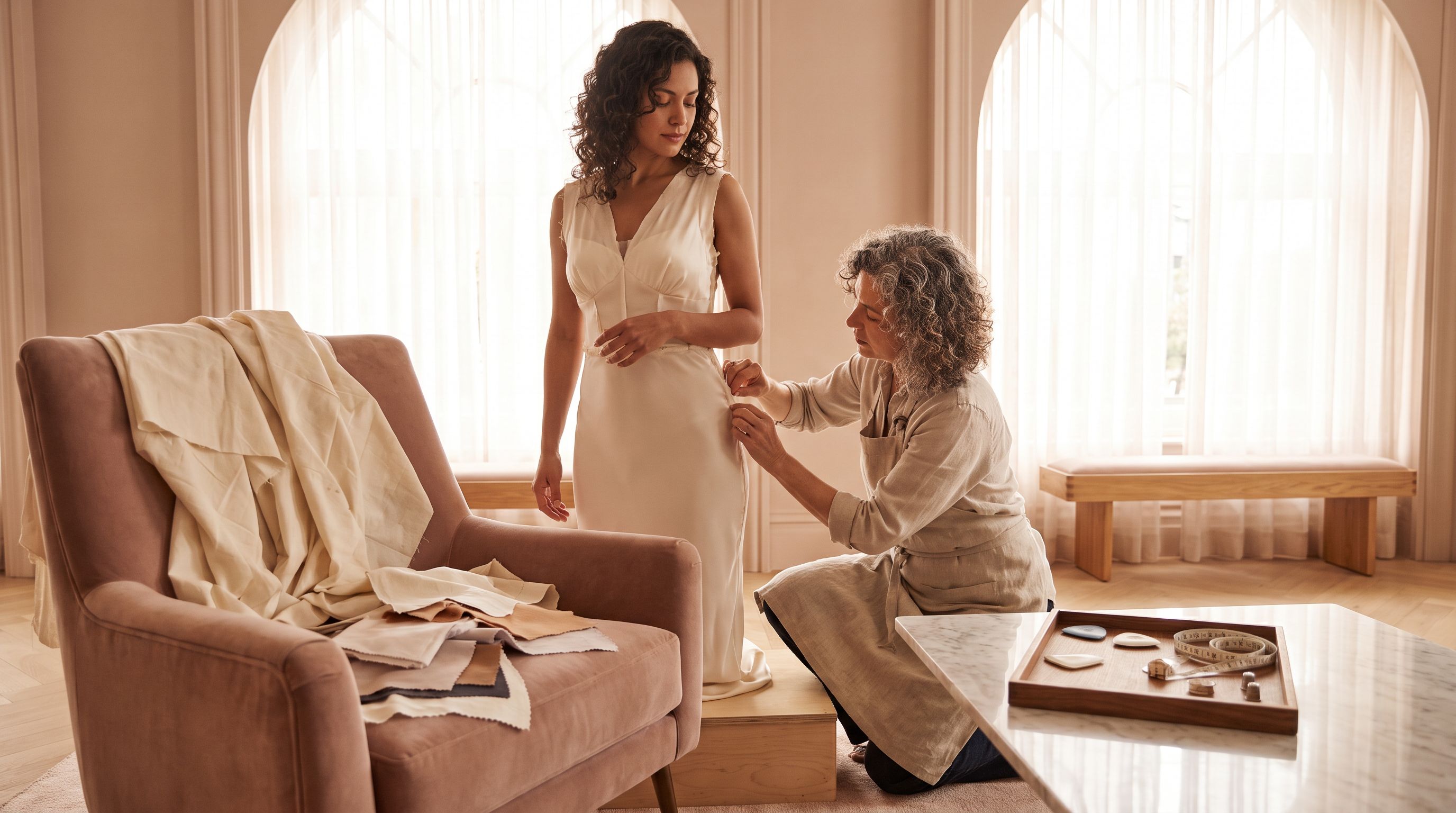
Why sample gowns rarely work after breast surgery
One note before we start: not everyone commissioning a gown like this is a bride. Nonbinary and trans clients, grooms who wear gowns, people marrying for the first time at sixty, and people dressing for a nikah, a Hindu ceremony, or a Tuesday at the courthouse all arrive with the same bodice questions. Everything below is about construction, and it applies regardless of the ceremony or what you call yourself on the day.
A bridal sample is built on a fit model’s body, then graded up and down. Almost every strapless bodice in a salon assumes two things: a specific bust projection, and enough tissue to grip. After a mastectomy — unilateral or bilateral, with or without reconstruction — one or both of those assumptions may no longer hold.
What people notice in the fitting room is usually one of these:
- The bodice gapes at the top of the cup on one side, or on both.
- A strapless gown slides down because there’s nothing for it to anchor against.
- Boning sits directly on a scar line, radiation-sensitive skin, or a reconstruction site.
- A soft prosthesis shifts during the day, or won’t stay put without a dedicated pocket.
- Anyone with a flat closure is swimming in a cup that was never meant to lie flat.
None of that is a flaw in your body. It’s a drafting mismatch, and drafting is exactly what custom work fixes.
Support that doesn’t depend on underwire
Many people assume support means a bra. In couture construction, support lives in the gown itself. A skilled dressmaker has several tools, and most of them work beautifully post-surgery:
- An internal corselette or bodice foundation — a separate structured layer inside the gown that carries weight at the ribcage and waist rather than the bust. This is the single most useful element after a flat closure, and for anyone who can’t tolerate pressure at the chest.
- Soft boning placement that routes around scar tissue instead of across it. Spiral steel, plastic, or even channel-stitched twill can be positioned seam by seam.
- Wider straps or sleeves that take the vertical load off the body. If you’ve been told strapless simply isn’t realistic for you, know that sleeve and strap options range from a barely-there illusion strap to a full lace sleeve — and all of them help.
- Built-in cups, foam, or molded shaping sewn to the lining, so nothing has to be held in place by your own tissue.
If you want to understand how these layers differ, our guide to corset construction versus a built-in bra explains what each one actually does under a gown.
Prosthesis pockets, asymmetry, and the details worth requesting
These are the specific asks that make a gown feel settled. Bring this list to your consultation:
- Secure prosthesis pockets in the lining — fitted to the exact prosthesis or lightweight foam form you plan to wear, not a generic square. Ask for a top closure or snug knit opening so nothing migrates during dancing.
- Deliberate asymmetry. After a unilateral mastectomy, the gown can be drafted with two different cup volumes, a shifted side seam, or a slightly different strap length — invisible from the outside, transformative in the mirror.
- A flat-front bodice if you’ve chosen flat closure — sometimes called going flat or aesthetic flat closure, meaning the chest wall is closed smoothly after mastectomy with no implant or tissue reconstruction. Princess seams can be drafted straight, with the waist emphasis moved downward and the shaping created by the skirt instead.
- Scar- and port-aware necklines. Bateau, high-neck, square, illusion mesh, or a softly draped cowl all give coverage without reading as “covered up.” If a chemo port or expander is still in place, your maker can leave extra ease over that area and keep hardware (zips, hooks) off the line.
- Room for a compression sleeve. If you wear a lymphedema sleeve or gauntlet — or may need one — say so at the first meeting. Sleeve width, armhole depth, and cuff opening all change, the fabric needs enough give or bias to slide over compression without dragging, and your maker can choose a sleeve fabric whose tone sits close to the garment’s so the two read as one deliberate layer.
- Access if surgery lands close to the date. If you may still have drains, a port, or a healing incision, ask for a side-opening bodice, a generous lace-up back, or a discreet lining opening so you can dress without lifting your arms overhead.
- Breathable linings. Silk crepe de chine, cotton batiste, or bamboo jersey against the skin is kinder than polyester for anyone with radiation-sensitive or healing skin.
Timing your gown around surgery and recovery
This is the part that genuinely differs from a typical bridal timeline. Reconstruction often happens in stages; expanders are exchanged; swelling settles over months. A gown fitted at the wrong point can need to be rebuilt.
-
Consultation and honest disclosure
Tell your maker where you are medically — procedures done, procedures planned, any dates that might move. A good dressmaker will treat this as ordinary information, not a complication. -
Measurements and a plan with flex
Expect them to build adjustable features in from the start: wider seam allowance at the side seams, a lace-up or hook-and-eye back panel, or a bodice they intend to re-cut later. -
The toile (muslin)
A test garment in cheap fabric is where prosthesis pockets, boning routes, and neckline height get decided. Wear the prosthesis, form, or bra you’ll wear on the day. Sit, raise your arms, and hug someone. -
First fitting in real fabric
Bodice structure is confirmed, cup volume and asymmetry fine-tuned, strap length set. -
Final fitting, close to the date
Last tweaks for any swelling or change, hem with your shoes, and a bustle rehearsal. Bring whoever will help you dress.
If your body may still shift between now and the wedding, our guide to planning a gown while your body is changing covers the construction tricks that preserve flexibility.
What it costs — and whether altering a salon gown is cheaper
Honest answer: off-the-rack gowns usually have a lower sticker price, but post-surgery bodice work is some of the most labor-intensive alteration there is, and that gap narrows fast.
So what’s a realistic budget? The useful question isn’t a national average — it’s what your gown requires. A simple crepe sheath with a structured internal bodice and two prosthesis pockets sits at the affordable end. Heavy beading, silk, a cathedral train, or long sleeves in hand-placed lace move you up quickly. Restrained fabric and clean lines keep a custom gown meaningfully cheaper than an elaborate one, in any market.
If those numbers feel out of reach, there are real lower-cost paths. A pre-loved or sample gown bought inexpensively and rebuilt by a local seamstress gives you a trained hand on the bodice without paying for new fabric. Separates are often the smartest move of all: a structured top that carries all the specialized work, paired with a simple gathered or A-line skirt that costs a fraction to make. Non-bridal eveningwear fabrics — crepe, satin-back crepe, fine twill — frequently cost less per yard than anything labeled “bridal” and sew up beautifully. And several nonprofit and charity programs provide gowns at no or low cost to people in or after cancer treatment; your treatment center’s social worker or patient navigator usually knows which ones operate near you.
The decision point is usually how much of the original gown survives. If a seamstress has to rebuild the entire front of a bodice, you’re paying custom prices for someone else’s pattern — our guide to where alterations stop and custom begins walks through that math.
How to tell you’ve found the right maker
You don’t need someone who specializes in post-mastectomy bridal — there aren’t many. You need someone who listens well and understands structure. Ask:
- Have you built internal corselettes or prosthesis pockets before? Can I see photos or the inside of a sample?
- How would you support this neckline without underwire?
- Where would the boning sit relative to my scar line?
- How many fittings are included, and what happens if my shape changes after reconstruction?
- Can we delay the final bodice decision until [date]?
If a consultation feels rushed, or someone tells you that what you’re asking for “isn’t done,” keep looking. Plenty of dressmakers do this work thoughtfully and without making it a big deal — which is usually exactly the tone you want. Bring your prosthesis or form, a photo of the neckline you love, and the questions above to a no-obligation consultation. You’ll learn more from how they answer the boning-and-scar question than from anything on their website.
Ready to bring your dream dress to life?
Tell us what you're picturing — style, timeline, and budget — and we'll connect you with custom dressmakers who can make it. Free, no obligation.
Get matched with a dressmakerRelated guides
Bridal Seamstress vs Regular Tailor: Who to Trust
Can a regular tailor alter a wedding dress? Here's how a bridal seamstress differs, what each job costs, and when to hire a custom dressmaker instead.
Read guide →
Church Wedding Dress Code: Shoulders, Sleeves, Coverage
Does your church require covered shoulders? Here's how to confirm the dress code and design a custom wedding dress with sleeves, a cape, or removable coverage.
Read guide →
Custom Wedding Dress for Scoliosis or Uneven Shoulders
A custom wedding dress for scoliosis or uneven shoulders: how makers balance hems, straps and bust asymmetry — plus realistic costs, fittings and timelines.
Read guide →