 Custom
Bridal Seamstress vs Regular Tailor: Who to Trust
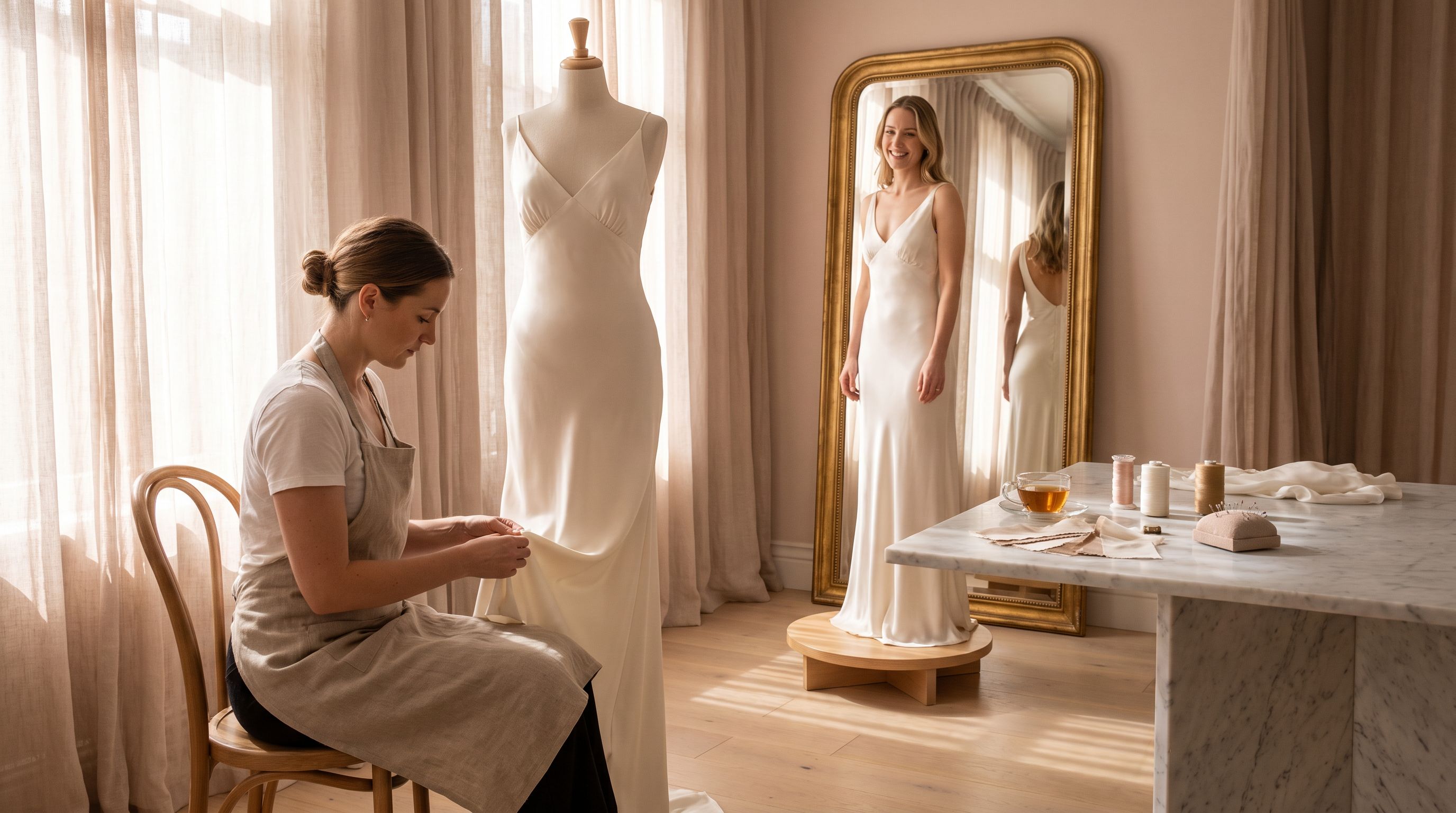
There’s a moment in almost every dress plan. You’ve found the gown — off the rack, online, a sample sale, a hand-me-down — and someone says, cheerfully, “just take it to a tailor.”
Sometimes that’s perfect advice. Sometimes it’s how a gown gets ruined six weeks out. The difference isn’t talent or kindness. It’s what each professional was trained to do, and whether your particular dress is a hemming job or a reconstruction job.
Why bridal work is a different trade
A good alterations tailor spends their days on suits, trousers, work dresses, and coats: garments with one or two layers, stable woven fabric, and seams designed to be let out or taken in. That’s real craft, and it isn’t easy.
A bridal seamstress is working on something closer to a small building. A structured gown can have an inner corselet with boning channels, a bust cup layer, a lining, an underlining, an outer fabric, a lace overlay, and three tiers of tulle — all of which have to move together when you take in half an inch at the waist. Change one layer and the others buckle.
Then there’s the fabric. Silk crepe shows pin holes. Satin shows every needle mark and water spot. Chantilly lace has no stable grain and shreds if you press it wrong. Beading has to be cut away, saved, and hand-restitched over the new seam, or the pattern stops mid-stitch.
The jobs a good local tailor can genuinely handle
Don’t let anyone scare you into overpaying for simple work. A skilled general alterations tailor is often a fine choice when your gown is:
- Unlined or single-layer — a crepe sheath, a linen or cotton civil-ceremony dress, a simple slip style.
- Hemming only, with no horsehair braid, lace edge, or train to rebalance.
- Taking in or letting out side seams by a modest amount through an unboned bodice.
- Shortening plain straps on a dress with no illusion mesh or appliqué across the shoulder.
- A second look or after-party outfit where stakes and structure are lower.
Ask anyway whether they work on bridal. A tailor who says “I do two or three gowns a year and I’d be careful with that beading” is being honest. One who waves it off as “same as any dress” is also telling you something useful.
The jobs that need specialist hands
Bustles look simple and aren’t — pick-up points have to be mapped to the seams that carry weight, or the skirt sags after an hour of dancing. (There’s real craft to choosing between a French, American, or ballroom bustle.) Strapless support is a structural problem — boning placement, a waist stay, cup shaping — not a matter of pulling side seams tighter. And lace needs to be cut apart at the motif, the seam taken in underneath, and the lace hand-appliquéd back over the join. That’s hours of handwork, and the most common place a well-meaning general alteration goes visibly wrong.
The same logic applies well beyond the white gown. A lehenga choli, a hanbok, a cheongsam, or a sari blouse each carries its own internal structure, cutting conventions, and finishing traditions — and a bridal seamstress trained on Western gowns may know less about them than a tailor who works in that garment every week. Seek out a specialist in the specific garment. Likewise, if you’re wearing a suit, a jumpsuit, or separates, a skilled menswear or bespoke tailor will almost always handle the jacket canvas, shoulder, and trouser line better than a bridal shop will.
When the gown needs to get bigger, not smaller
Most alterations advice assumes taking in, which quietly leaves out anyone who needs more room — through the bust, the ribcage, the hips, or everywhere at once. Letting out is a real option, but it has hard limits worth knowing before you fall for a sample.
Seam allowances are finite: many ready-to-wear gowns leave only 1/2” to 1” per seam, so a dress may yield an inch or two total, sometimes less if the seams are serged or the lace is cut to the edge. Beyond that, a good seamstress has three moves. She can insert side or back panels in matching or deliberately contrasting fabric; she can replace a zipper with a corset back, which adds several inches of adjustable room and is genuinely beautiful; or she can harvest fabric from a long train or an inner layer to build new panels in the original material. Fuller busts often need the cup and boning rebuilt rather than the seams moved — a separate skill, and a fair question to ask about up front.
What each route tends to cost
These ranges reflect what alterations specialists in US metro areas commonly quote — roughly the hourly rate skilled hand-finishing commands, multiplied by the hours a job of that type typically takes. Fabric, city, and the amount of handwork move them a lot; readers outside the US should scale to local labor rates.
The drivers are consistent: number of layers, beading or lace crossing seams, whether the bodice is boned, how large the size gap is, and how much hand-stitching the fabric demands. A gown two sizes off in beaded lace can cost more to alter than a plain crepe gown cost to buy. We break the line items down in what wedding dress alterations cost, line by line.
The tipping point: when altering stops being smart
Here’s a heuristic, not a rule. Count the structural decisions your dress needs: resize the bodice, add sleeves, change the neckline, shorten the train, replace the back closure. One or two? Alter it. Once you’re at three or more on a structured gown, many makers will quote close to custom prices — because each change compounds the last, adding pattern risk and fitting hours rather than just sewing time, and because an existing pattern can only absorb so much before the balance shifts. We go deeper on where alterations hit their limits.
How to vet whoever you hire, in one conversation
-
Ask what they work on weekly
”How many gowns like mine do you do in a season?” A specific number — even a small one — beats a vague reassurance. -
Show them photos before you book
Send pictures of the bodice interior, the hem, the seam allowances, and any lace or beading. A pro will name the parts that concern them immediately. -
Ask how they'll handle the hard part
If lace crosses your side seam, ask how they’ll rejoin the motif. You want to hear about cutting at the motif and hand-appliqué. -
Get the plan and price in writing
A quote after the first fitting, itemized by job, with fitting dates. Vagueness about money is a reliable warning sign. -
Ask who does the sewing
In larger shops, the person pinning you may not be the person stitching. That’s fine — but you should know, and the fitter should be present at the final.
The same instincts apply when choosing someone to build a gown from scratch; our guide to vetting a custom dressmaker covers contracts, deposits, and portfolio reading.
A simple way to decide
If the shape is right and only the measurements are off, an alterations specialist is your answer — and a general tailor may be perfectly capable on simple fabrics.
If you keep saying “I love it, but” — but the neckline, but the sleeves, but the back, but it needs three inches I don’t think it has — that’s a design brief, not an alterations brief.
The fastest way to find out which camp you’re in is to ask someone who does this weekly. That might be an independent alterations specialist, the shop that sold you the gown, a local tailor if the fabric is simple, a specialist in your particular garment, or a made-to-measure dressmaker who can price both paths honestly. A short, free consultation is not a commitment to anything — bring photos, your timeline, and your real budget, and expect a good maker to tell you plainly when altering is the smarter spend.
Ready to bring your dream dress to life?
Tell us what you're picturing — style, timeline, and budget — and we'll connect you with custom dressmakers who can make it. Free, no obligation.
Get matched with a dressmakerRelated guides
Church Wedding Dress Code: Shoulders, Sleeves, Coverage
Does your church require covered shoulders? Here's how to confirm the dress code and design a custom wedding dress with sleeves, a cape, or removable coverage.
Read guide →
Custom Wedding Dress After a Mastectomy: Fit & Support
A practical guide to a custom wedding dress after mastectomy or breast surgery: prosthesis pockets, support without underwire, scar coverage, timing, and real costs.
Read guide →
Custom Wedding Dress for Scoliosis or Uneven Shoulders
A custom wedding dress for scoliosis or uneven shoulders: how makers balance hems, straps and bust asymmetry — plus realistic costs, fittings and timelines.
Read guide →