 Custom
French vs American vs Ballroom Bustle: How to Choose
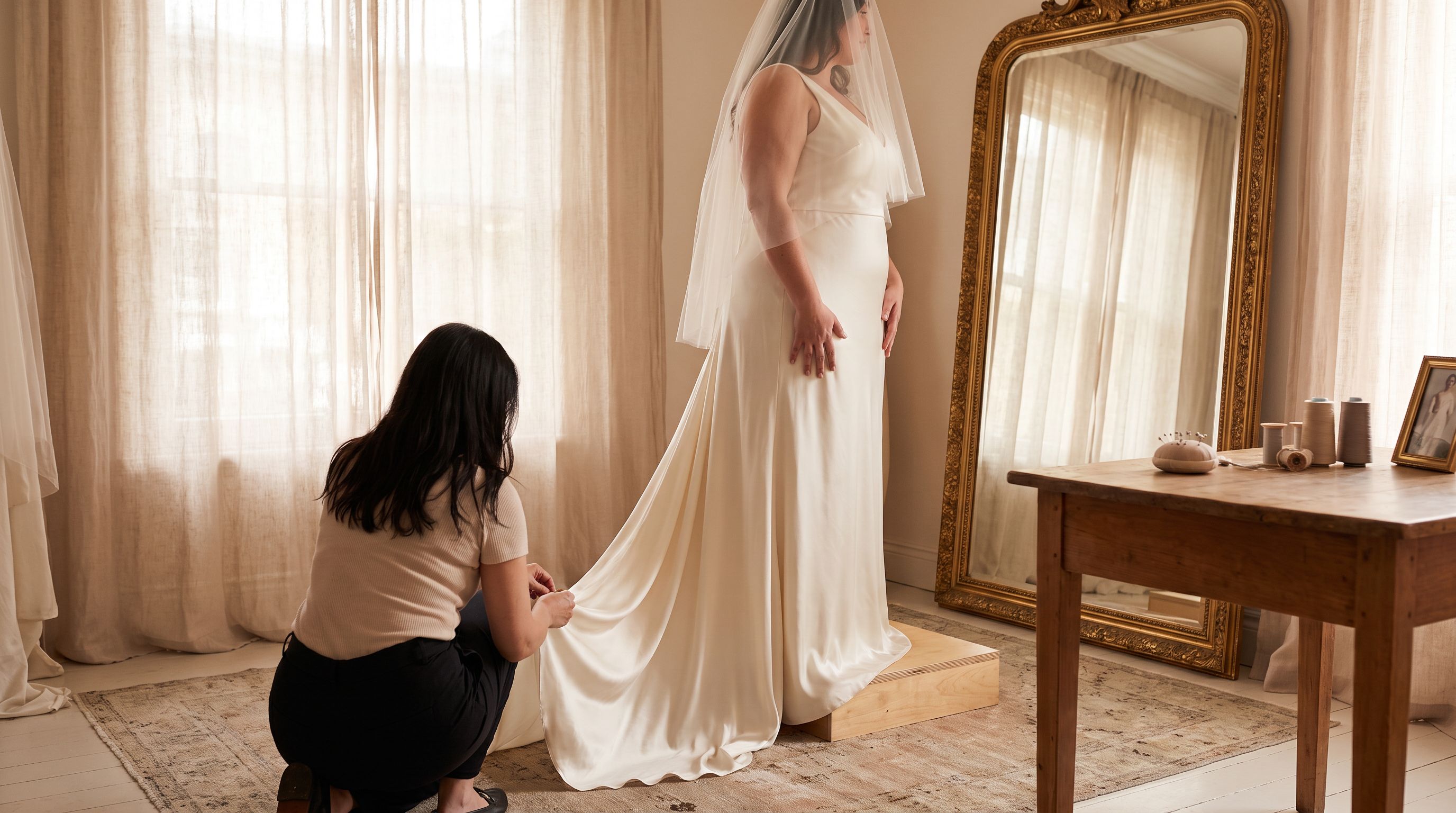
The train is the part of your gown that makes people look up as you walk in. It’s also the part that gets stepped on, dragged through grass, and soaked in champagne by 9pm — unless someone has built you a proper bustle.
This is one of the most under-discussed parts of the custom process, and one of the most practical. Here’s how the main wedding dress bustle types work, how to choose between them, and what to expect to pay.
What a bustle actually does — and why no gown arrives with one
A bustle is a system of fastenings sewn into the gown that gathers and lifts the train so the person wearing it can dance, sit, and move without fabric trailing behind. It might be thread loops and buttons, hooks and eyes, ribbon ties, or a combination.
Here’s the part that surprises people: a bustle can’t be designed on paper. It has to be pinned on the body, in the real shoes, with the gown finished to its final hem length. Lift a train two inches higher or lower and the whole drape changes. That’s why bustling is a fitting-room decision, not a sketch decision — and why it usually happens at the second-to-last or final appointment. (Our final fitting checklist covers what else belongs in that session.)
The three bustles you’ll be choosing between
American bustle (also called an over bustle or pick-up bustle). The train is lifted and fastened on top of the outer skirt, usually at the natural waist or just below, showing a soft cascade of gathered fabric. It’s the most common, the quickest to tie, and the most forgiving on fabrics with body.
French bustle (under bustle or Austrian bustle). The train tucks underneath the skirt and fastens to the inner layers with ribbons or hooks, creating a rounded, lifted silhouette with no visible pickup points. It reads more formal and romantic — a soft bubble rather than a cascade.
Ballroom bustle (hem bustle or floor-length bustle). Multiple small lifts around the hem bring the train up level with the front of the dress, so the gown looks as though it never had a train at all. Cleanest look, most labour — often five, seven, or nine points.
A train loop or wristlet isn’t really a bustle: it’s a ribbon that lets you carry the train by hand. Charming for photos, exhausting for a reception.
How fabric and train length quietly make the decision
In our fitting room, it’s common for a client’s initial preference to change once the finished gown is on the body. The fabric has opinions.
- Stiff, structured fabrics (mikado, duchesse satin, taffeta) hold a pick-up shape well and look sculptural in an American bustle. Forced underneath, they bulge.
- Fluid fabrics (crepe, charmeuse, chiffon, soft silk) collapse under their own weight in an over bustle and usually look better in a French bustle, where the inner layers carry the load.
- Multi-layer tulle generally wants a ballroom bustle — gathering that volume into two or three points creates a lump.
- Heavily beaded trains are heavy, sometimes dramatically so. Lift points need reinforcement, and the point count goes up to spread the weight.
- Train length drives point count. A sweep or chapel train may need one to three points; a cathedral train frequently needs five or more. Our guide to chapel vs cathedral trains walks through the trade-offs before you commit.
What a bustle typically costs
Pricing varies enormously by region, by how many points are needed, and by how much hand-finishing the fabric demands. Treat these as starting ranges to adapt to your own situation, not quotes:
The cost drivers are straightforward: the number of lift points, whether beading has to be removed and re-applied around each fastening, whether loops must be hand-stitched invisibly into delicate lace, and how much weight the structure has to carry. A nine-point ballroom bustle on a beaded cathedral train is genuinely an afternoon of skilled handwork. If you’re weighing a purchased gown against one made from scratch, our breakdown of where alterations stop and custom starts is a useful companion.
A bustle is the one piece of engineering in your gown that has to survive a dance floor. Pay for it properly, and practise it once.
How your bustle gets built, step by step
-
Hem first, always
Nothing can be bustled until the front hem is finalised in the actual shoes. If the shoes change later, tell your maker immediately — the whole balance shifts. -
Test lifts with pins
Your dressmaker will pin the train in several configurations while you look from every angle. Walk. Sit. Turn. Say so if the drape reads bulky from the side. -
Choose style and point count
Fewer points means faster tying but a heavier pull on each one. More points means a smoother result and a longer process on the day. -
Reinforcement goes in
Loops and hooks anchor to a structural layer — a seam, waistband, or added stay tape — never a single layer of delicate face fabric. -
Practise at the final fitting
Bring whoever will tie it. Have them do it twice, unassisted. Film it on your phone.
Make it easy for the person tying it on the day
The most common bustle failure isn’t a construction problem — it’s that nobody could find the loops in a dim venue hallway. A few fixes that cost nothing:
- Ask your maker to colour-code the fastenings with matching thread or small ribbon tags (left inner, right inner, centre) so the pairs are obvious.
- Number them if there are more than three points, and tie in order.
- Take close-up photos of the fastened bustle from behind, plus a short video of the sequence, and send both to your helper.
- Teach two people, not one. Your attendant may be pulled away exactly when you need them.
- Pack a small emergency kit: safety pins, spare ribbon, and a needle and thread in your gown’s colour. If a loop tears, a safety pin set horizontally through a seam allowance — never through a single layer of face fabric — will hold until the end of the night.
When a bustle isn’t the right answer
Sometimes it isn’t. A detachable train — hooked or snapped to the waist under a covered placket — gives a dramatic ceremony silhouette and a completely clean reception outfit. It usually costs more than a bustle and less than a second gown, and it’s often the better call for very long, heavy, or heavily beaded trains. Plan the logistics with the same care: practise the unhooking once at the final fitting, decide who carries the train off (one named person, not “someone”), and agree where it will live — a garment bag in a locked room beats a coat check or the back of a chair. Most people remove it straight after formal photos or just before the first dance.
Trains don’t only belong to white gowns, either. A lehenga dupatta trail can be pleated and pinned at the shoulder or wrist rather than bustled; a cheongsam or qipao overskirt is often made to unhook at the waist so the fitted dress stands alone for dinner. If you’re wearing one outfit for a church ceremony and changing into another for a cultural reception, tell your maker the full running order at the first consultation — it changes what needs bustling, what needs to be removable, and how much changing time to build into the day.
A short train or sweep length may need nothing at all. And for an outdoor or beach ceremony, some clients skip the train entirely and put the drama in a sleeve, a back detail, or a veil.
A good maker will tell you honestly which of these your gown wants rather than defaulting to the easiest option. That kind of candour — recommending a detachable train over a profitable nine-point bustle because it genuinely suits your fabric — is one of the clearest signs you’re working with someone thinking about your wedding day rather than their invoice. Ask any maker you’re considering what they’d do about your train, and listen for whether they ask about your fabric and your venue before they answer.
Ready to bring your dream dress to life?
Tell us what you're picturing — style, timeline, and budget — and we'll connect you with custom dressmakers who can make it. Free, no obligation.
Get matched with a dressmakerRelated guides
Bridal Seamstress vs Regular Tailor: Who to Trust
Can a regular tailor alter a wedding dress? Here's how a bridal seamstress differs, what each job costs, and when to hire a custom dressmaker instead.
Read guide →
Church Wedding Dress Code: Shoulders, Sleeves, Coverage
Does your church require covered shoulders? Here's how to confirm the dress code and design a custom wedding dress with sleeves, a cape, or removable coverage.
Read guide →
Custom Wedding Dress After a Mastectomy: Fit & Support
A practical guide to a custom wedding dress after mastectomy or breast surgery: prosthesis pockets, support without underwire, scar coverage, timing, and real costs.
Read guide →