 Custom
 Chapel vs Cathedral Train: Length, Cost, and Bustles
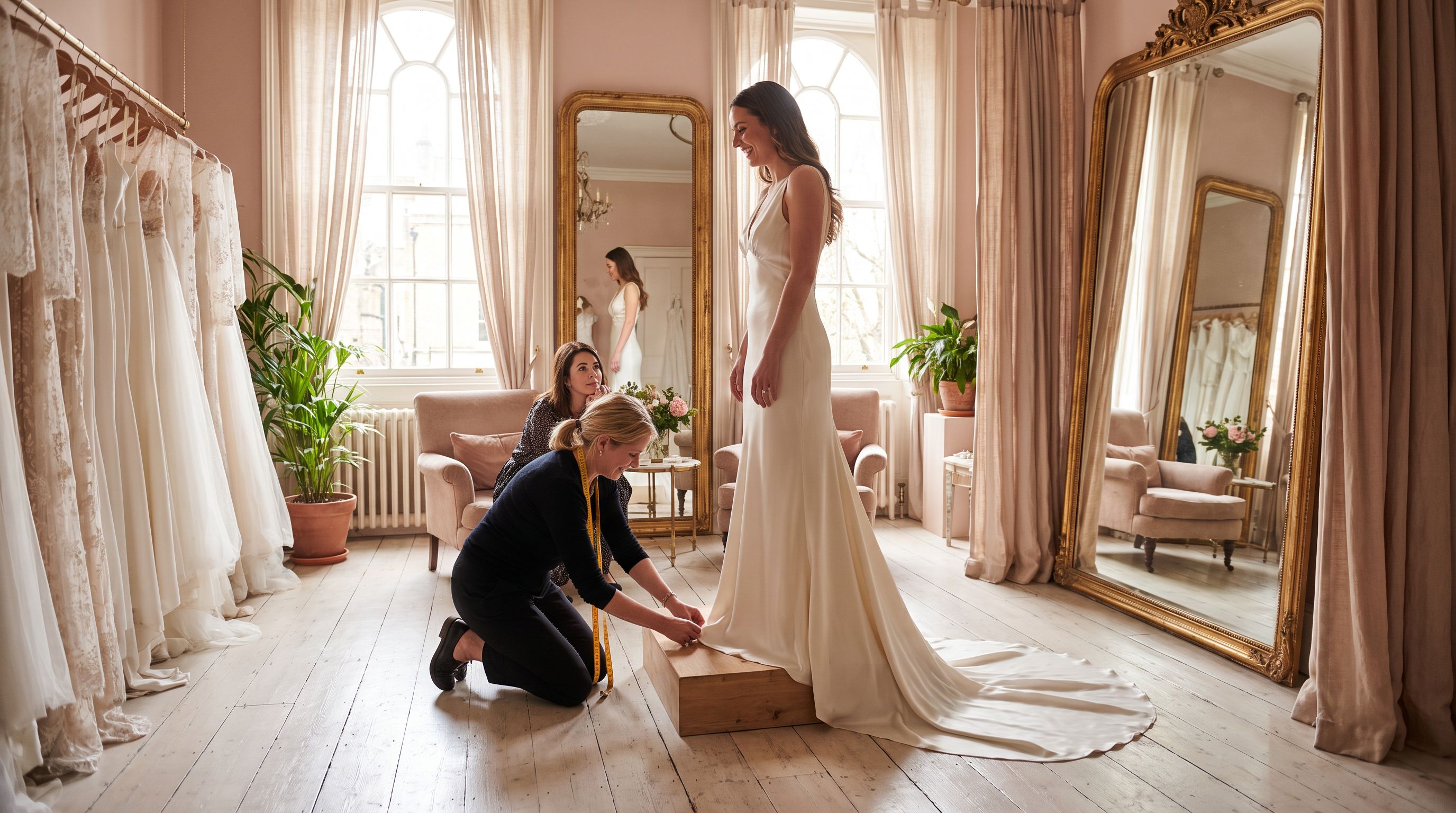
Train length is one of those decisions that sounds purely romantic and turns out to be deeply practical. It affects your fabric budget, how you move through a ceremony, how your photographs read from behind, and whether you spend cocktail hour holding a fistful of silk. The good news: when you’re having a gown made, train length isn’t a fixed feature you inherit from a sample — it’s a number you choose, refine at a fitting, and can adjust right up until the final hem.
What each train length actually measures
Bridal vocabulary is inconsistent between designers, so always ask your maker for inches, not adjectives. That said, these are the commonly used ranges, measured from the natural waist to the tip of the train:
- Sweep (brush) train: just skims the floor, extending roughly 6–12 inches behind the heel. Almost no drag, no bustle needed for most.
- Court train: about 2–3 feet from the waist — a soft trail that reads elegant in photos but stays easy to manage.
- Chapel train: about 3½–4½ feet from the waist, trailing roughly a foot to a foot and a half on the floor. Long enough to read clearly as a train in photographs, short enough to bustle in three to five points and still dance.
- Cathedral train: roughly 6–7½ feet from the waist, extending 5–6 feet or more behind you. Genuinely dramatic, genuinely a commitment.
- Monarch/royal train: 10 feet and beyond. Reserved for grand venues, long aisles, and a plan for who carries it.
These numbers are absolute, not proportional, so the same train reads differently on different bodies. On a petite frame, a cathedral train behind a 5’1” wearer reads even longer — which can be gorgeous or can swallow you, depending on the silhouette; our guide to proportion for petite and short wearers goes deeper on scaling details to your frame. If you’re tall, the upper end of each range usually keeps proportion — a 3½-foot chapel train can look almost hesitant at 5’11”. If you carry width through the hip or you’re wearing a full skirt, remember the fabric has to travel over that curve before it reaches the floor: volume eats length, so you may need a few extra inches to get the same trailing effect, and your bustle points will sit differently than they would on a slim column. And if you use a wheelchair, walker, or cane, or you’ll be seated for much of the day, train length needs a plan rather than a guess — a long train pools and catches in wheels, so many wearers choose a sweep or court length with a detachable cathedral overskirt for the aisle, plus a bustle engineered to lift fabric clear of wheels and footplates.
Chapel or cathedral: the honest trade-offs
One more factor people forget: fabric weight. A cathedral train in featherweight tulle or organza floats and forgives; the same length in duchesse satin or mikado has real heft and will pull on your shoulders or waist over a long day. If you love drama but not weight, talk to your maker about a lighter train fabric than the bodice, or a detachable piece. Our tulle, organza, and chiffon comparison is a useful starting point for how each moves.
What extra train length costs in a custom gown
There’s no flat “train fee.” The price moves with four things: how many extra yards of face fabric and lining you need, whether the train is lined or floated, how the edge is finished (a rolled hem versus horsehair braid versus lace appliqué following the curve), and whether embellishment continues down the train.
Use those as a framework, not a quote. A cathedral train in polyester crepe may add a modest amount; the same train in silk at $60–$150 a yard, with beaded lace motifs hand-placed along the edge, can add well over a thousand. If your gown has appliquéd lace, ask specifically whether motifs will be scattered down the train — that hand-placement labor is often the real cost, not the yardage. The differences between lace types and how they’re applied are covered in our Chantilly, Alençon, and guipure guide.
How bustles actually work
A bustle is how your train gets lifted off the floor after the ceremony. It’s a set of hidden hooks, loops, buttons, or ribbon ties, positioned so the fabric folds into a deliberate shape. The main styles, and when each one is the right call:
- American (over) bustle: the train lifts and attaches on top of the skirt. Choose it when your fabric is crisp and largely unembellished — satin, mikado, structured crepe — and you’re happy for the folds to read as a visible design line.
- French (under) bustle: the train is tucked and tied underneath into soft swags. Choose it when the hem or train edge is beaded or appliquéd, so the fastenings pull from below and nothing crushes the beadwork; it’s also the near-invisible option on lace.
- Austrian (ballroom) bustle: gathered vertically with ribbon or cording into a puffed shape. Choose it for tulle and layered soft skirts with no defined edge detail to protect.
- Train flip: the end flips under and hooks once or twice. Choose it when the train is sweep or short court length and the fabric is light enough for one or two points to hold all day.
A chapel train often bustles well with 3–5 points; a cathedral train usually needs more, and sometimes a two-stage lift. The number of points matters practically: whoever bustles you has to do it in a dim hallway while you’re holding a bouquet.
Deciding your length at a fitting, not on a screen
-
Bring your real shoes and any headpiece
Heel height changes hem length, and a cathedral veil over a chapel train reads very differently than the reverse. Bring both to the fitting where train length is finalized. -
Describe your venue floor and your ceremony honestly
Grass, sand, gravel, cobblestone, a barn, an outdoor terrace, chancel steps you’ll climb, a temple or mosque floor where you’ll remove shoes or kneel, a mandap you’ll circle — say it out loud, and your maker may suggest a shorter train or a sturdier edge finish. Mention outfit changes too: if you’re switching looks between ceremony and reception, as is common at South Asian, Nigerian, and many other weddings, a detachable train lets one gown carry both moments. Coverage requirements belong in that conversation as well, since a cape or overskirt can serve modesty and drama at once. -
Walk, turn, and sit in the toile
At the muslin or first fitting, do a full lap. Turn around twice. Sit down. A train that feels romantic standing still can feel like an anchor in motion. -
Try the length long, then trim
Fabric can always come off; it’s much harder to add. Many makers will cut generously and finalize at a later fitting once you’ve seen it in the mirror. -
Rehearse the bustle with your people
At the final fitting, have your honor attendant, parent, or partner learn it. Ask for a photo of the hooks in order — phones save weddings.
A useful workroom rule: keep your veil either clearly shorter or clearly longer than your train — at least six to eight inches apart. A veil that ends within an inch or two of the train edge reads as a mistake in photos rather than a choice.
Questions worth asking before you commit
When you’re talking with a dressmaker, a few specific questions reveal a great deal about how carefully they work:
- What exact length, in inches from my waist, are you proposing — and can we see it in the toile?
- Is the train lined, and will the lining be the same length or floated shorter?
- How will the edge be finished, and will it hold up on my venue’s floor?
- Is the bustle included in the price, and how many points do you anticipate?
- If I change my mind after the first fitting, what’s the window for shortening it?
A maker who answers these easily — with numbers, not vibes — is usually the same maker who’ll handle fit and timeline well. If you’re still weighing whether to have something made at all, our comparison of alterations versus a fully custom build lays out where each one genuinely makes sense.
There is no objectively correct train length. There’s the one that fits your venue, your fabric budget, your body, and how you want to feel walking back down the aisle. A good dressmaker will help you find it — and will happily show you both lengths pinned on you before a single stitch is permanent.
Ready to bring your dream dress to life?
Tell us what you're picturing — style, timeline, and budget — and we'll connect you with custom dressmakers who can make it. Free, no obligation.
Get matched with a dressmakerRelated guides
Off the Rack Wedding Dresses: What It Means and Costs
What "off the rack" really means in bridal, how off-the-rack wedding dress costs compare to custom and made-to-measure, and how to set a realistic budget.
Read guide →
Bridal Sizing vs Street Size: Why Gowns Run Small
Bridal sizing vs street size explained: why wedding dresses run 2–3 sizes small, what off-the-rack really means, alteration costs, and when made-to-measure wins.
Read guide →
Renting vs Buying vs Custom Wedding Dress: Cost Guide
Renting a wedding dress vs buying off the rack vs going custom: real cost ranges, hidden alteration fees, fit limits, and how to pick the smartest option for you.
Read guide →