 Custom
Bought a Wedding Dress Online? Alter, Remake, or Custom
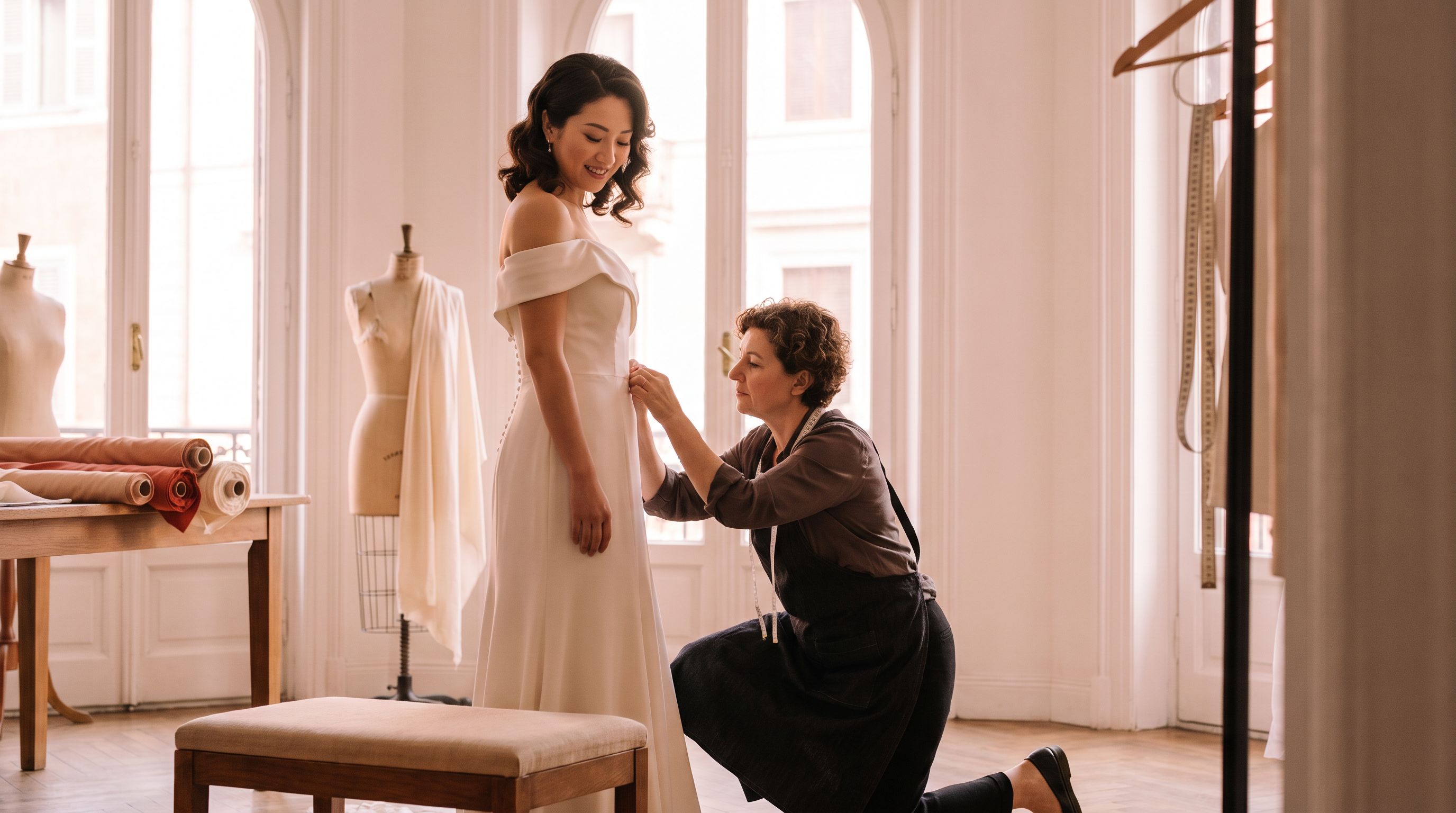
The box arrives. You unpack it on the living room floor, step into it, and something is off — the bodice gapes, the waist sits somewhere near your ribs, the hem puddles by six inches, or the whole thing simply doesn’t look like the photo. This happens constantly, and it is not a sign that you made a foolish decision. Online gowns are cut to a generic block, drafted to a size chart that may follow a different regional standard than the labels in your closet, with no consistency between sellers.
Take a breath. You have more options than you think, and the first few hours matter more than the next few weeks. The same assessment applies whether you’re wearing a gown, a suit, a lehenga, a hanbok, or a two-piece — the questions about seam allowance, bust and shoulder placement, and construction don’t change.
Why online gowns so often arrive wrong
Most online bridal sizing is based on three measurements — bust, waist, hips — and nothing else. Your torso length, shoulder width, bust position, back width, and posture never enter the equation. Two people with identical bust-waist-hip numbers can need completely different bodices.
Bridal sizing also runs small and inconsistent compared to the clothes in your closet, which is why so many people size up online and then find the bodice swimming while the hips are snug. If that’s your situation, it helps to understand why bridal sizing doesn’t match your street size before you decide anything.
There’s a second issue that matters more than size: construction. A gown built to a low price point often has narrow seam allowances, a glued rather than stitched appliqué, a thin lining, minimal boning, and an invisible zipper set into unstabilized fabric. None of that makes it unwearable — but it does limit how far a seamstress can take it.
The 20-minute assessment that tells you almost everything
-
Try it on with your real undergarments and shoes
Shapewear, bra (or no bra), and the heel height you’ll actually wear. A gown that looks hopeless barefoot can look entirely different with three inches of heel and proper support.
-
Check the side seam allowances
Turn the bodice inside out and look at the vertical seams. A generous allowance — roughly an inch or more on each side — means a seamstress can let it out. A quarter-inch overlocked edge means there is nothing to give. This single check decides whether “too tight” is fixable.
-
Look at the bust and shoulders
Is the fullest part of the cup sitting where your bust actually is? Are the shoulder seams on your shoulders? Bust position and shoulder placement are the expensive fixes, because they mean rebuilding the bodice rather than taking it in.
-
Pinch the excess and see where it falls
Have someone pinch out the extra fabric at the side seams and back. If the gown looks beautiful when pinched, you’re in alteration territory. If it still reads wrong — the waist in the wrong place, the skirt hanging oddly — the problem is the pattern, not the size.
-
Inspect the lace, lining, and support
Are appliqués stitched or glued? Is there a lining you’d be comfortable in all day? Any boning or cups? Fabric content matters too — a stiff polyester satin behaves very differently from the crepe or silk in the inspiration photo.
What alterations on an online gown typically cost
Prices vary enormously by city and by how in-demand your seamstress is, but these ranges reflect what bridal alterations specialists commonly quote:
The drivers are simple: how many layers have to be opened (lining, interlining, outer fabric, overlay), whether beading or lace must be removed and hand-reapplied, whether a zipper or boning has to be reset, and how experienced the person doing the work is. Moving a waistline seam up two inches on a lined, boned bodice means opening and re-setting every layer — that’s why it sits in a different price bracket than taking in a side seam. A beaded, lined, three-layer gown can cost three times what a plain crepe sheath costs for the identical change. Our line-by-line breakdown of alteration pricing is worth reading before you walk into a quote.
One honest note: some bridal seamstresses charge a premium for low-cost online gowns, or decline them entirely. It isn’t snobbery. Thin fabric, raw edges, and glued trim take longer and carry more risk of a visible repair, and they’d rather be upfront than hand you something they’re not proud of.
The question is rarely whether a skilled seamstress can fix it. It’s whether this particular dress is worth the hours — and whether you’ll love it when they’re done.
When to alter and when to start over
A useful rule: alterations change the size of a dress far more easily than they change its design. Moving a waistline, re-cutting a neckline, adding structure where none exists, or changing how a skirt falls are design changes. Those are exactly where alterations hit their practical limits.
Off-the-rack vs. made-to-measure: what you’re actually paying for
“Off-the-rack” means buying a gown that already exists in a shop’s stock and walking out with it, rather than ordering one to be made. It is often the fastest route, and on the lowest end it can be the cheapest — but the sticker price is never the whole number. Budget for alterations on top; almost no off-the-rack gown fits a real body without them.
Made-to-measure is the other model: a gown cut to your measurements, in fabric you chose, rather than a stock size altered toward you. Custom gowns from an independent dressmaker commonly range from around $1,500 to $5,000+, with simple crepe or linen designs at the lower end and silk, heavy beading, or long trains at the upper end.
Setting a realistic all-in budget
A realistic all-in gown budget in most of the US tends to land somewhere between roughly $1,200 and $4,000 once alterations, undergarments, and a veil or accessories are included — with plenty of people spending meaningfully less and plenty spending far more. Metro-area labor rates, silk vs. polyester, beading, train length, and how many fittings a gown needs are what move this number most.
Is $5,000 a good budget? For most people, it’s generous — and in many markets it sits firmly in made-to-measure territory.
Give yourself enough runway
If you’re altering: most bridal seamstresses want the gown 8–12 weeks out, with two or three fittings. Rush work, where available, usually carries a surcharge.
If you’re starting over with a made-to-measure gown, a comfortable timeline is roughly 4–8 months, which allows for a toile (a test garment in cheap fabric), fittings, and finishing. Shorter is often possible — many makers can work in 10–12 weeks with simpler designs — but it narrows your fabric and detail options.
What to ask before you hand over your gown
Bring the dress to a consultation, not a drop-off, and ask:
- What exactly would you change, and what will the result look like?
- Which of my concerns can’t be fixed on this dress?
- Is there enough seam allowance to let out if my body changes?
- What’s the total estimate, and what would push it higher?
- How many fittings, and when do you need it by?
- Can I see photos of gowns you’ve reworked that started like mine?
A seamstress who answers plainly — including “I wouldn’t do this to this dress” — is the one to trust. Anyone who promises everything is fixable, sight unseen, is the one to walk away from.
If the honest answer turns out to be that this gown was never going to be your gown, that’s useful information, not a loss. Many dressmakers offer a free or low-cost first consultation — ask when you book — and an hour there will tell you whether a made-to-measure gown is within the budget you’ve already set. Many people walk in expecting to be priced out and walk out with a realistic number — and a dress that finally fits the body they actually have.
Ready to bring your dream dress to life?
Tell us what you're picturing — style, timeline, and budget — and we'll connect you with custom dressmakers who can make it. Free, no obligation.
Get matched with a dressmakerRelated guides
Getting a Wedding Dress Made Abroad: Is It Worth It?
Thinking of having your wedding dress tailored in Bangkok, Hoi An or Bali? Real costs, timelines, risks and how it compares to a custom dressmaker at home.
Read guide →
Custom Veil vs Heirloom Veil: Cost, Length, and Fit
What a custom wedding veil costs, how to choose a length, and when wearing (or restoring) an heirloom veil is the smarter, more meaningful choice.
Read guide →
Custom Bridal Jumpsuit vs Gown: Fit, Cost, Comfort
A custom bridal jumpsuit vs wedding dress: honest costs, the fit details that make or break a jumpsuit, fabrics, timelines, and how to decide.
Read guide →