 Custom
What Wedding Dress Alterations Cost, Line by Line
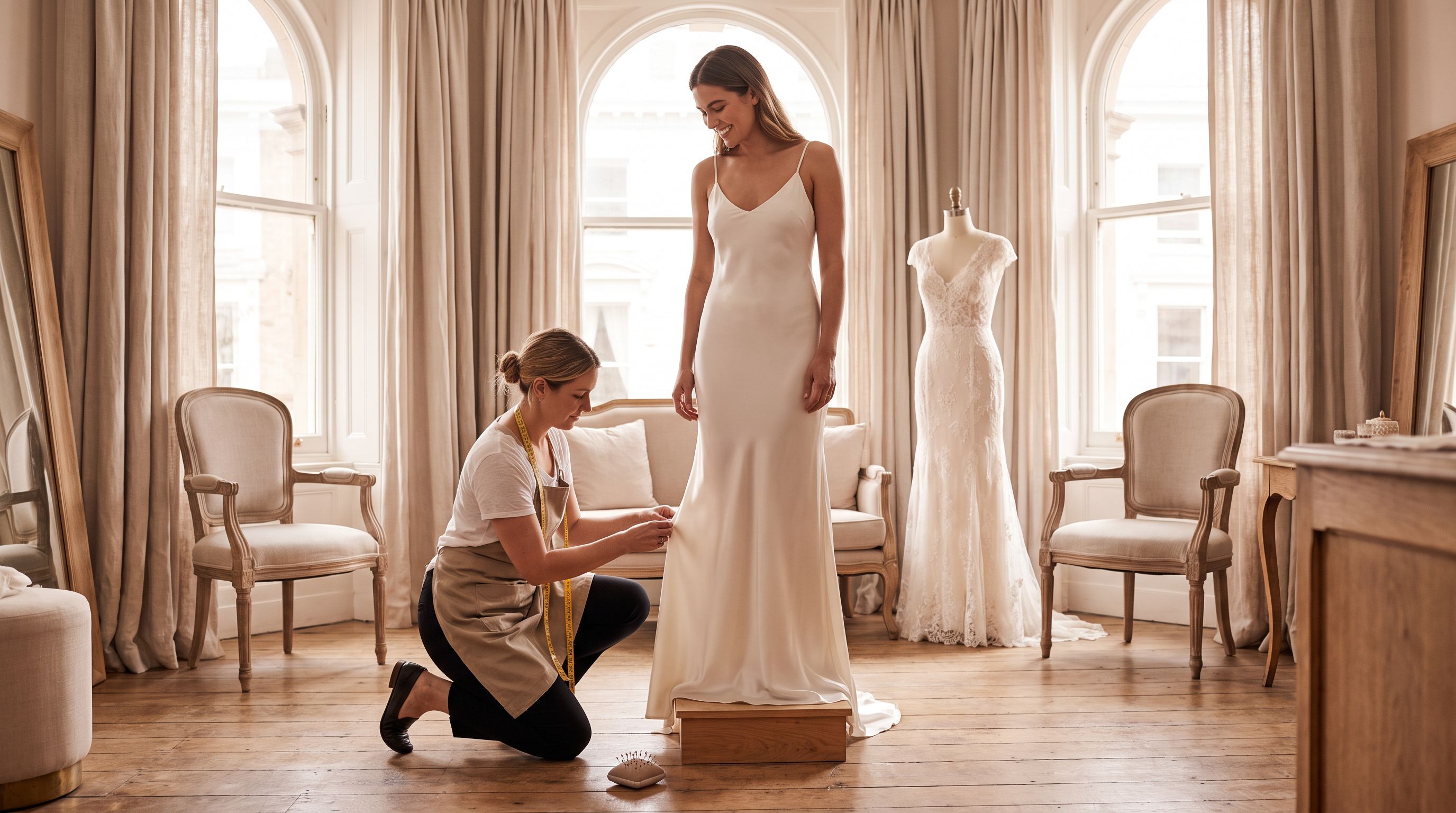
Why one quote is $250 and another is $2,000
Alterations pricing confuses people because it isn’t really a service with a set price. It’s labor, priced by how long the work takes and how much skill it demands. Shortening a plain crepe sheath is an afternoon. Shortening a beaded lace ballgown with a horsehair-hemmed tulle underlayer means unpicking the beading, cutting four layers at four different lengths, re-hemming each one, and hand-sewing the beads back on so the scalloped edge still reads as an edge. Same word — “hem” — wildly different bills.
So when you see a number online, ask what dress it was attached to. The honest answer to “how much are wedding dress alterations?” is: it depends on your fabric, your gown’s construction, how far your body is from the sample size you bought, and what alterations specialists charge where you live. A major metro with a strong bridal market will nearly always quote higher than a small town.
The line items, and what each usually runs
These are general ranges to help you sanity-check a quote, not fixed prices. Plain fabrics sit at the low end; lace, beading, and multiple layers push toward the top or beyond it.
- Hem. A single-layer crepe or satin hem is often $100–$250. Add a tulle or organza skirt with a horsehair edge and you’re commonly at $250–$500. Beaded or appliquéd lace hems frequently run $400–$700+ because the trim has to be lifted and reapplied.
- Taking in the bodice (side seams). Often $120–$350 for one or two sizes on a lined, boned bodice. If the gown has an interior corset, each layer has to be adjusted separately, which is where the hours go.
- Letting out. Priced similarly, but capped by the seam allowance the factory left — usually very little. This is the single most common place alterations fail.
- Bustle. Commonly $100–$300. A simple one-point American bustle is at the bottom; a multi-point French or ballroom bustle on a cathedral train sits at the top, because each tie point is placed and stitched by hand.
- Strap and shoulder adjustments. Often $60–$200 — one of the best value-per-dollar fixes there is, because lifting the shoulders corrects a surprising amount of bodice wrinkling.
- Adding cups or built-in support. Usually $60–$180 for sewn-in cups; more if boning or an internal corselet is being added from scratch.
- Adding sleeves or straps. Commonly $200–$600+, and it depends entirely on whether matching fabric or lace exists. Sourcing a close match is often the hard part, not the sewing.
- Zipper replacement or converting to a corset back. Often $150–$450.
- Shortening the bodice (hollow-to-waist). This is the fix for a shorter torso and it’s real surgery on a structured gown — frequently $300–$700, because the bodice is rebuilt from the neckline down.
- Final press and steam. Often $50–$150, and sometimes folded into the package.
What actually drives the number
Fabric is first. Crepe, satin, and mikado are relatively cooperative. Chiffon and bias-cut silk shift under the needle and demand slow, careful work. Beaded lace multiplies everything.
Layers are second. A soft A-line might have three layers. A dramatic ballgown can have seven, each needing its own hem.
Structure is third. Boning, built-in corsets, and cup linings all have to come apart and go back together when a seam moves.
And distance from the original size is fourth — and this is the one you can influence. Most bridal gowns come in sample sizes that run small compared with street sizing, which is why so many shoppers are told to size up “and we’ll take it in.” One size up is routine. Three sizes up means re-cutting the bodice, and the gown’s proportions — where the waist sits, how wide the straps are, where the lace motifs land — were drafted for a different body and will never fully relocate.
A dressmaker can make a dress smaller. Making it yours is a different job entirely.
The point where custom becomes the better math
Here’s the comparison most people don’t run until it’s too late.
A useful rule of thumb: when alterations are quoted at more than about a third of what you paid for the dress, or when the work required is structural rather than cosmetic, get one custom quote for comparison before you say yes. Our custom vs off-the-rack cost breakdown runs the full numbers side by side.
How the alterations timeline usually runs
-
Book the first fitting 8–12 weeks out
Bring your exact shoes and the undergarments you’ll actually wear. Hem length is decided by your shoes — changing them later means paying for the hem twice. -
Get the itemized quote at that appointment
Most of the pinning and pricing happens here. Ask what’s included and what would be extra. -
Second fitting, 4–6 weeks out
Structural changes are in. This is the moment to speak up about anything that feels off — gaping, pulling, length. -
Final fitting, 1–2 weeks out
Bustle lesson with whoever will be tying it on the day. Have them practice twice.
Deciding with clear eyes
Alterations are worth every dollar when you love the dress and the work is finishing work — a hem, a nip at the waist, a bustle. That’s a gown being perfected.
They’re worth questioning when you’re paying someone to substantially redesign a dress that was never built for your proportions. That’s frequently the case if you wear a size above the range most shops carry as samples; if your torso is notably longer or shorter than the pattern assumes; if you need a fuller bust accommodated without the waist swimming; if you want real sleeves rather than illusion mesh; if you need a seated fit for a wheelchair user — shorter front hem, back-seam access for transfers, no bulk gathering under the hips; if you want discreet internal pockets for a prosthesis or post-mastectomy support; or if your coverage requirements are specific rather than generically “modest” — wrist-length sleeves, a high and fully lined neckline, a skirt that stays opaque under photography lights, or a design that works with a hijab, tichel, or temple garments.
If you’re in any of those situations, talk to a dressmaker before you commit to a redesign. A consultation is free and carries no obligation. Ask for a written quote that states clearly how many fittings are included, then set it beside your itemized alterations estimate — that’s a genuine like-for-like comparison you can make at your kitchen table. A good dressmaker will also tell you plainly when altering the gown you already own is the smarter choice.
Ready to bring your dream dress to life?
Tell us what you're picturing — style, timeline, and budget — and we'll connect you with custom dressmakers who can make it. Free, no obligation.
Get matched with a dressmakerRelated guides
Affordable Custom Wedding Dress: How to Cut the Cost
An honest guide to getting an affordable custom-made wedding dress: where the money really goes, 9 ways to lower the price, and what you should never cut.
Read guide →
Buying Your Own Fabric for a Custom Wedding Dress
Can you supply your own fabric to a dressmaker? Here's how much yardage a gown takes, what bridal fabric costs per yard, and whether it actually saves money.
Read guide →
Custom Mother-of-the-Bride Dress: Cost, Fit, Timeline
What a custom mother-of-the-bride dress really costs, how it compares to off-the-rack plus alterations, and the fittings and timeline to expect.
Read guide →