 Custom
Affordable Custom Wedding Dress: How to Cut the Cost
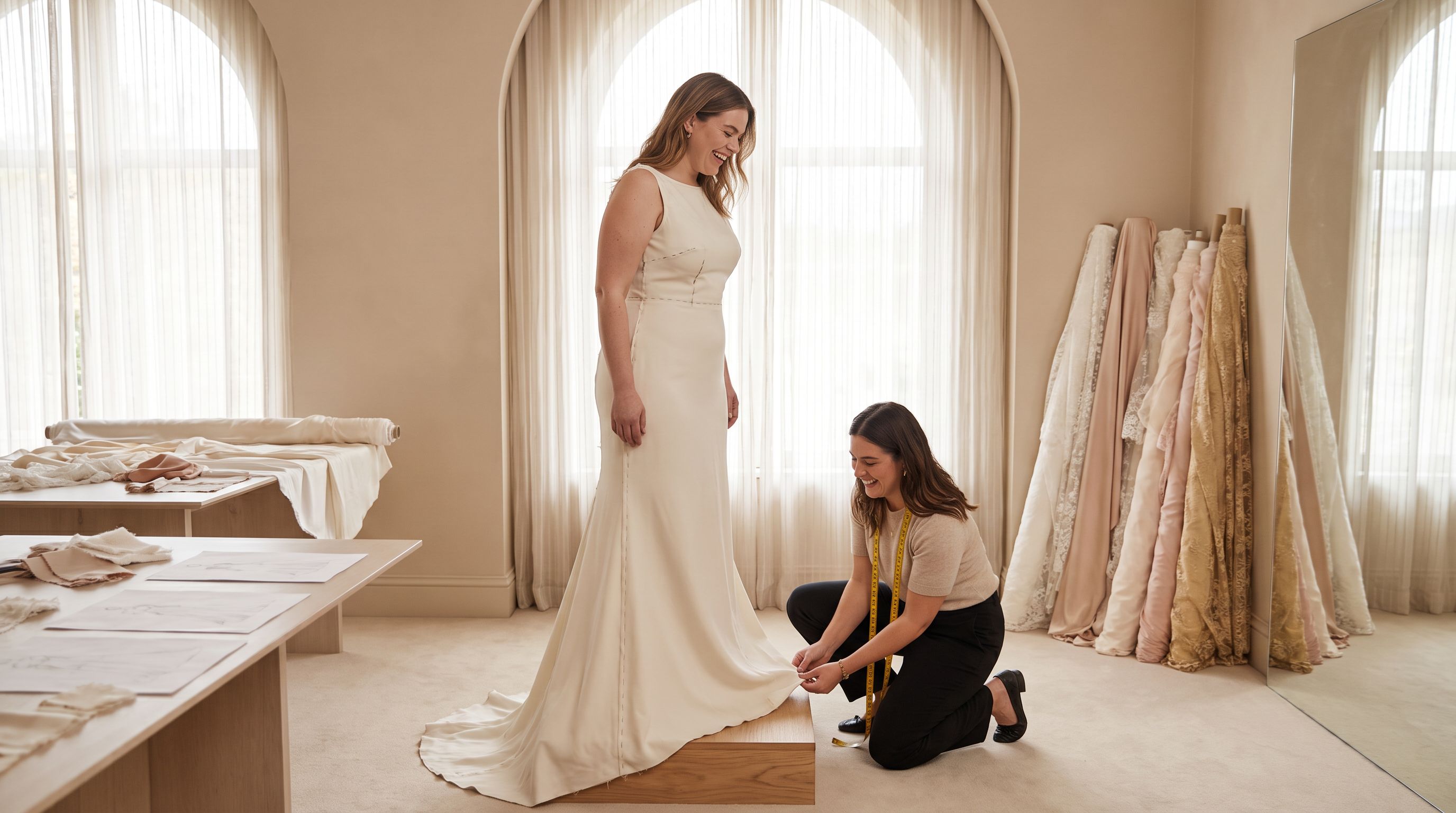
If the words “custom wedding dress” make you brace for a number with too many zeros, take a breath. Custom pricing isn’t a mystery, and it isn’t a fixed menu. A made-to-measure gown is essentially materials plus hours plus the maker’s expertise — and nearly every line of that equation is something you and your dressmaker can shape together.
This guide walks through where the money actually goes, the levers that genuinely lower a quote, and the three places where saving money will cost you more later.
What “affordable custom” really means
Affordable is relative, so let’s anchor it. In many U.S. and U.K. markets, a clean, unembellished custom gown — think crepe, a well-cut bodice, modest train, quality lining and structure — often starts in the low four figures. Add lace, heavy beading, silk, boning-intensive corsetry, or an elaborate skirt and you move into the mid and upper four figures quickly. Couture-level work with hundreds of hand-finished hours is a different category entirely.
Those numbers are a starting point to adapt, not a benchmark. A dressmaker working from a home studio in a small town and an atelier with a storefront in a major city can both be excellent and quote very differently — overhead is real, and so is cost of living.
Is it cheaper to buy a wedding dress off the rack?
Sometimes, yes — and anyone who tells you custom is always cheaper is selling something. A sample sale gown or a true off-the-rack purchase can be remarkable value, especially if your measurements sit close to the sample size.
But the honest comparison isn’t sticker price to sticker price. An off-the-rack gown frequently needs alterations — hem, bodice, straps, cups, bustle — and that bill can run several hundred to well over a thousand depending on how much reconstruction is involved. If your measurements fall outside standard bridal sample ranges — at either end of the size spectrum, with a fuller bust, a long or short torso, or a significant difference between your bust, waist and hip measurements — custom is often the better value route, because you’re paying for a pattern cut to you rather than paying a specialist to rebuild something that was never cut for you. Ask any maker upfront whether they apply size-based upcharges, and what those cover: extra fabric yardage is a genuine material cost, while charging more for pattern work alone is worth a polite question. We break the arithmetic down properly in the real math of custom versus off-the-rack cost.
The general rule: the further your body sits from a standard bridal fit chart, and the more specific your vision, the more custom competes on price — not just on outcome.
Where your money actually goes
Five things drive almost every quote:
Fabric and notions. Silk charmeuse, double-faced satin, and French lace are expensive per yard, and a full skirt multiplies that cost. Linings, boning, horsehair braid, zippers, and buttons add up quietly.
Pattern drafting and the toile. Your maker drafts a pattern to your measurements and sews a test garment in cheap cotton. This is skilled time, and it’s the reason the final gown fits.
Construction hours. Seams, structure, hand-finishing, linings. A bias-cut slip and a boned ball gown take wildly different amounts of time.
Embellishment. The single biggest swing factor. Hand-beading, appliqué placement, and embroidery are measured in hours, not inches.
Your timeline. Lead time is a real cost driver and the one most people overlook. Rush builds typically carry a surcharge — often quoted as a percentage uplift on the total, varying by maker — because your gown has to displace other work or require overtime. Booking roughly 8–12 months out is one of the cheapest levers you have: it buys unhurried fittings, time to source fabric at a sensible price, and room to adjust rather than remake.
Cultural and modesty requirements belong in this conversation too. Sleeves, a higher neckline, full coverage, a non-white or richly coloured fabric, or a second reception outfit all shift the numbers — usually upward in fabric and construction hours — so raise them at the very first consultation rather than as a later addition.
The cheapest change you will ever make to a custom gown is the one you make before the fabric is cut.
Ten ways to lower the price without lowering the quality
-
Lead with your number
Tell your maker your all-in budget at the first consultation, out loud, without apology. A good dressmaker will design toward it. Without a number, they’ll quote the dress you described — which may be a very different dress. -
Book early
Giving your maker 8–12 months avoids rush fees entirely and leaves room for calm problem-solving. Time is the one discount that costs you nothing. -
Simplify the skirt
Fullness costs fabric and hours. A soft A-line in a mid-weight crepe reads just as elegant as a layered ball gown at a fraction of the yardage. -
Shorten the train
A chapel train costs less in fabric, less in bustling labor, and less in hemming time than a cathedral. It also photographs beautifully. -
Place beading strategically
Beading concentrated at the bodice, neckline, or a scattered hem gives you the sparkle of an all-over design for a fraction of the hours. -
Swap fabric, not silhouette
A high-quality polyester or viscose crepe drapes gorgeously. Save silk for the pieces that touch the light — or for the lining, where it feels incredible. -
Use lace as an accent
Full lace overlays are costly. A lace yoke, sleeve, or back panel delivers the same romance with a yard or two. -
Choose machine appliqué where it won't show
Hand-applied beading at the bust reads differently up close than at the hem. Spend where the eye goes. -
Keep fittings efficient
Arrive with your actual shoes and undergarments, don’t change the design mid-build, and bring one decisive person. Design changes after the toile are the most common source of surprise invoices. -
Consider semi-custom, or source your own fabric carefully
A semi-custom or made-to-measure gown — an existing design cut to your measurements with limited changes — often lands below full bespoke while still fitting your body. Supplying your own fabric can also save money, but it shifts risk to you: read what to know before buying your own fabric first, because ordering too little of a dye lot is an expensive mistake.
What a realistic wedding dress budget looks like
A realistic budget isn’t a national average — it’s your number, plus the things that always get forgotten. Alongside the gown, plan for undergarments and shapewear, a veil or hair piece, shoes, final pressing, and often a bustle. As a rough planning rule, expect those extras to add somewhere around 10–25% on top of the gown price — more if you want a statement veil, custom shoes, or a second outfit for the reception.
If you want to see what different numbers genuinely buy — in fabric, construction, and hours — our breakdown of what a $2k, $5k, or $10k custom budget gets you is the most concrete place to start.
Where you should not cut
How to tell you’ve found a good affordable maker
Affordable and excellent are not opposites. Look for a maker who asks about your venue, your comfort, your coverage preferences, and how you want to move — not just your Pinterest board. Who shows you finished gowns on real clients across a range of sizes, not only mood boards. Who quotes in writing, with the fabric allowance, number of fittings, lead time, rush policy, and change policy stated. Who says “that detail will push you over budget — here’s what I’d do instead” rather than nodding at everything.
If you want a full checklist of questions and red flags before you commit a deposit, our guide to vetting a custom dressmaker covers what to ask and what good answers sound like.
The most useful next step is usually the simplest one: sit down with a maker, say your budget out loud, and let someone experienced tell you honestly what’s possible at that number in your market. Many makers offer a free or low-cost first consultation — confirm before booking — and you’ll leave with real figures instead of guesses, which is a far better place to plan from than a search results page.
Ready to bring your dream dress to life?
Tell us what you're picturing — style, timeline, and budget — and we'll connect you with custom dressmakers who can make it. Free, no obligation.
Get matched with a dressmakerRelated guides
What Wedding Dress Alterations Cost, Line by Line
A realistic wedding dress alterations cost breakdown — hems, bustles, taking in, adding sleeves — plus the point where custom becomes the smarter buy.
Read guide →
Buying Your Own Fabric for a Custom Wedding Dress
Can you supply your own fabric to a dressmaker? Here's how much yardage a gown takes, what bridal fabric costs per yard, and whether it actually saves money.
Read guide →
Custom Mother-of-the-Bride Dress: Cost, Fit, Timeline
What a custom mother-of-the-bride dress really costs, how it compares to off-the-rack plus alterations, and the fittings and timeline to expect.
Read guide →