 Custom
 Mother-of-the-Bride Dress: Cost, Fit, Timeline
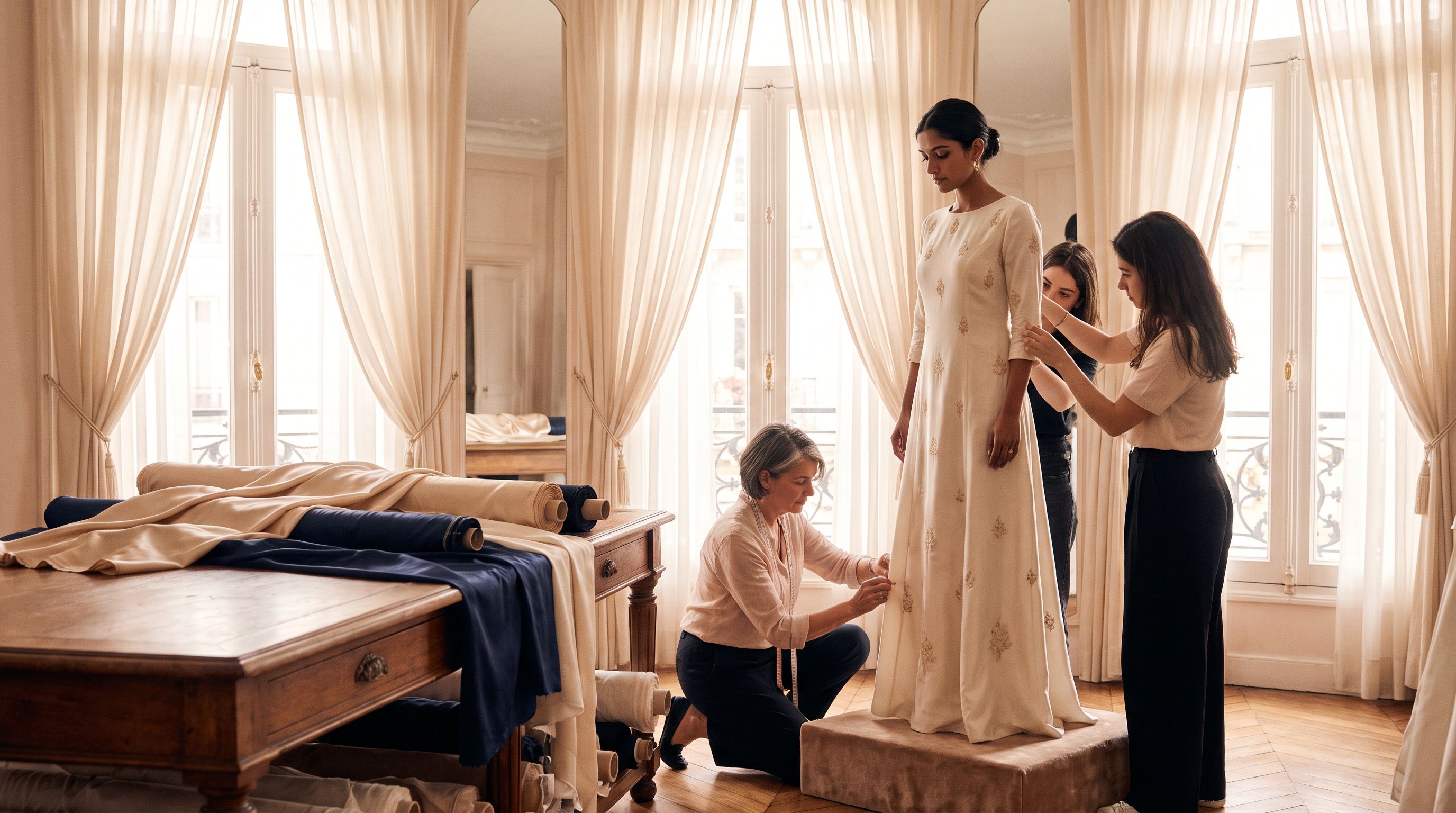
Why this is quietly the hardest dress in the wedding
The bride gets a whole industry built around her. The mother of the bride — or the mother of the groom, the stepmom, the grandmother, the aunt who raised you — gets a rack near the back of the store, two color options, and a sales associate who says “we can take that in.”
The requests we hear most often are remarkably consistent: sleeves that cover the upper arm without looking like a jacket, a neckline that’s flattering but not low, a waist that sits where your waist actually sits, a hem that works with the shoe you can stand in for six hours, and a color that doesn’t wash you out in photos. Off-the-rack formalwear rarely delivers more than two of those at once. That’s the real argument for custom here — not luxury, but solving a specific fit and coverage problem.
What a custom mother-of-the-bride dress typically costs
Prices vary enormously by region, by the maker’s experience, and most of all by fabric and labor hours. Treat these as starting points to adapt, not benchmarks:
For rough comparison, off-the-rack formal dresses at department stores and online retailers are often listed somewhere around $150–$600, and bridal-salon mother’s labels frequently sit in the $400–$1,200 range before alterations. Those are typical listed prices we see rather than sourced market data — they vary considerably by region and retailer.
Where off-the-rack still wins — and where it quietly costs more
The pros are real: you can try it on today, see the color on your skin, and leave with it. If the shape already suits you and you need only a hem and a side-seam nip, buy it. That’s a genuinely good outcome and nobody should talk you out of it.
The cons surface later. Most formalwear is graded around a mid-range cup and roughly average height, which is why bust and waist placement are usually the first things to go wrong — seams land high on long torsos and low on short ones, and sleeves are often drafted for a narrower upper arm. The fixes aren’t equal in difficulty, either: taking in a side seam is routine, while moving a waist seam, re-cutting an armhole, or adding sleeves to a strapless dress is major surgery that sometimes isn’t possible at all.
Before committing to alterations, it helps to understand what alterations can and can’t realistically change. A skilled alterations specialist can transform fit; they can’t redesign a garment never cut for your proportions.
The decisions that actually move your quote
- Fabric. The biggest lever. A good polyester crepe might be $15–$30 a yard; silk crepe, Mikado, or beaded lace can be $60–$200+. Most long dresses need 3–5 yards. Our guide to crepe, satin, and Mikado applies to mother’s dresses too.
- Sleeves. They add pattern work, fabric, and fitting time — and they’re the number one reason people go custom. See sleeve types, fit, and cost to help you name what you want.
- Internal structure. Boning, built-in support, underlining that keeps crepe from clinging — invisible, all labor.
- Embellishment. Hand-beading is priced by the hour. Beaded lace yardage is usually the cheaper route to shimmer.
- A second piece. A jacket, bolero, or overlay is effectively a second garment; price it accordingly.
- Rush. Under roughly 10–12 weeks, many makers add a fee or decline.
What the process looks like
-
Consultation (5–7 months out)
Bring photos of what you like and what you’ve tried and hated — the second is more useful. Bring the wedding palette, venue, and season. -
Measurements and fabric
Full measurements taken in the undergarments you’ll wear. You’ll choose fashion fabric, lining, and finishes from swatches. Expect a deposit here, often 40–50%. -
Toile or first fitting (8–12 weeks out)
Many makers build a muslin test garment for anything structured. Neckline height, sleeve shape, and waist placement get decided on your body, not on paper. -
Second fitting in the real fabric
Sleeve ease so you can lift a glass, bodice fit, how the skirt moves when you sit. Bring your shoes. -
Final fitting (2–4 weeks out)
Hem set with shoes on, closures finalized, press and pickup. Leave a buffer — bodies shift in the last month, and that’s normal.
Color, coverage, and the group-photo question
Get a physical swatch of the bridal party color if you can, and look at it in daylight and warm indoor light — many fabrics shift dramatically. The old etiquette rules about mothers avoiding certain colors have relaxed enormously; what still holds is a friendly text to the other mother so nobody is surprised.
If your ceremony has coverage requirements, say so at the consultation, not at the second fitting. A church, synagogue, or mosque ceremony may call for covered shoulders, elbow-length or longer sleeves, a higher neckline, or fabric opaque enough that nothing reads sheer under photographers’ lighting — those are pattern decisions, not trim. Dressmakers also regularly make a custom blouse to wear with a saree, or a fitted jacket to pair with another family garment you already own; bring that piece to the consultation so color and weight can be matched.
The dress you’ll remember fondly isn’t the one that photographed well for ten minutes. It’s the one you forgot you were wearing by the toasts.
How to tell you’ve found the right maker
Ask to see finished work on bodies like yours, not just flat-lay photos. Ask how many fittings are included and what happens if your measurements change. Ask whether alterations after the final fitting are billed separately, and get the payment schedule and completion date in writing. Then ask the question most people are afraid to ask: if the finished dress isn’t right, what counts as a remake at their cost versus a paid fix at yours — and is any part of the deposit refundable if you change your mind before the fabric is cut? Many makers draw that line at cutting; a good one will tell you plainly where theirs falls. For a fuller checklist, we walk through how to vet a dressmaker question by question.
Many makers offer a free or low-cost initial consultation — ask when you inquire. It costs little to describe what you want and hear a real quote for your fabric, your silhouette, and your timeline. That conversation alone often clarifies whether custom or a well-altered off-the-rack dress is the smarter path for you — and either answer is a good one.
Ready to bring your dream dress to life?
Tell us what you're picturing — style, timeline, and budget — and we'll connect you with custom dressmakers who can make it. Free, no obligation.
Get matched with a dressmakerRelated guides
What Wedding Dress Alterations Cost, Line by Line
A realistic wedding dress alterations cost breakdown — hems, bustles, taking in, adding sleeves — plus the point where custom becomes the smarter buy.
Read guide →
Affordable Custom Wedding Dress: How to Cut the Cost
An honest guide to getting an affordable custom-made wedding dress: where the money really goes, 9 ways to lower the price, and what you should never cut.
Read guide →
Buying Your Own Fabric for a Custom Wedding Dress
Can you supply your own fabric to a dressmaker? Here's how much yardage a gown takes, what bridal fabric costs per yard, and whether it actually saves money.
Read guide →