 Custom
 Custom Wedding Dress Budget: What $2k, $5k, $10k Buys
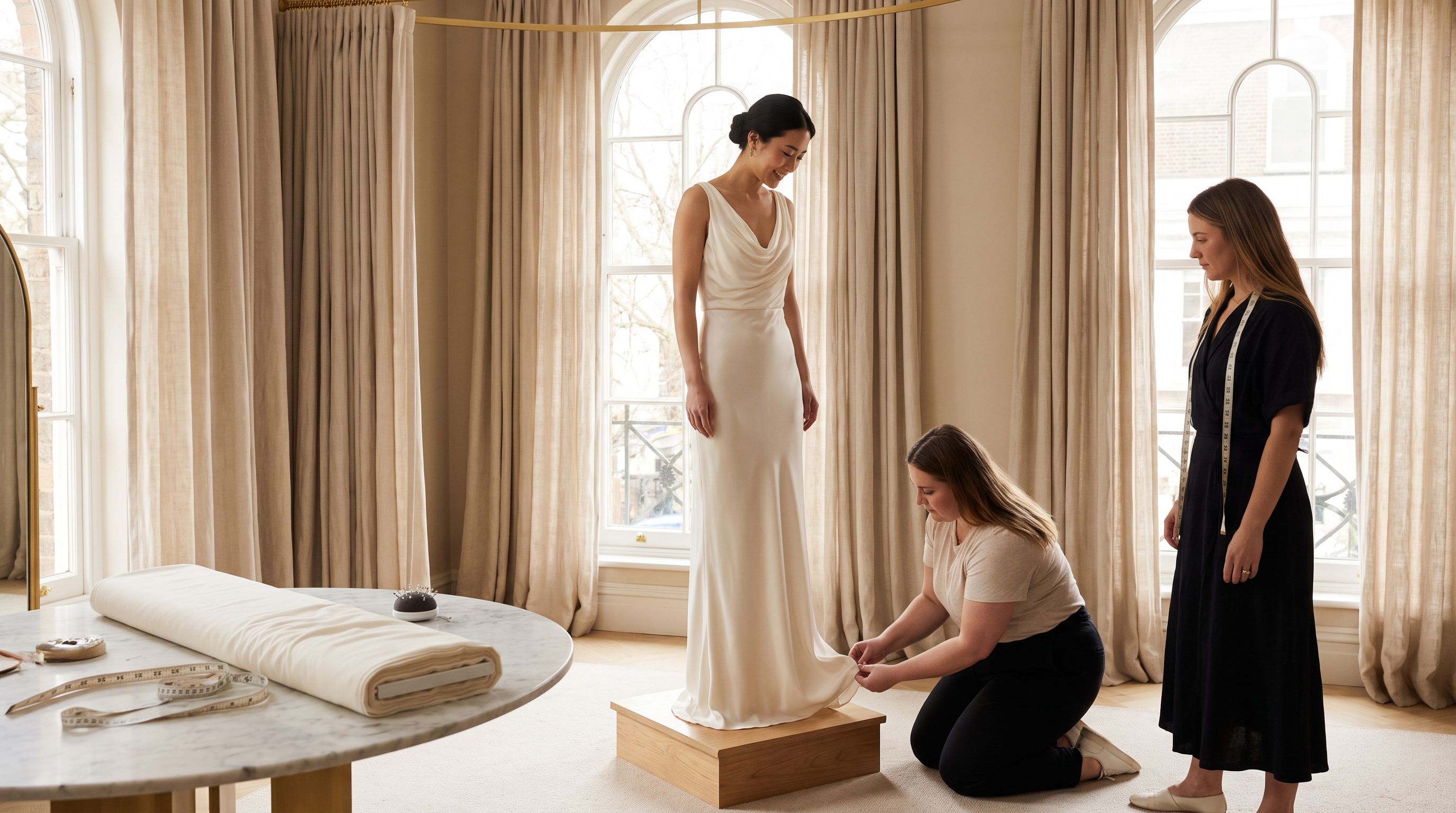
Almost every conversation about wedding dresses starts in the wrong place: a photo. Someone sends you an image of a gown with a cathedral train and hand-set crystals, you ask what it would cost to have something like it made, and you get an answer that feels either terrifyingly high or suspiciously low.
A better starting point is your budget — a real number you can say out loud without flinching — and then asking what that number genuinely buys. This guide walks through what tends to be possible at three common budget levels, why prices vary so much between makers, and how the same money behaves when you spend it off the rack instead.
One housekeeping note before the numbers: every figure here is in US dollars, and all of them shift with local market rates. A quote in a high cost-of-living city and a quote in a smaller town can differ by half for identical work.
What a “Realistic” Wedding Dress Budget Actually Means
A realistic budget reflects three things: what you can comfortably spend, what your local market charges, and what your design actually requires. Those three have to meet.
A client in a major city commissioning silk with hand-finished seams and a client in a smaller town asking for a clean crepe slip are having two completely different financial conversations — and both are legitimate. There is no correct amount to spend on a wedding dress. There is only the amount that lets you enjoy the rest of your wedding.
What’s not realistic is asking for six weeks of hand-beading on a budget that covers two days of sewing. Makers hear this daily, and the good ones will tell you kindly and early.
Where the Money Actually Goes
Understanding cost drivers is more useful than any average, because it lets you price your dress rather than someone else’s.
The biggest levers are:
- Fabric. Polyester crepe and silk crepe can look similar in a photo and differ enormously per yard. A full skirt eats fabric — a fishtail in the same cloth might use half as much. Our fabric comparison guide breaks down how the choice ripples through both cost and drape.
- Hand-work. Beading, appliqué, hand-rolled hems and covered buttons are priced in hours, not materials. This is where budgets quietly double.
- Internal construction. A boned, self-supporting bodice with a built-in bra takes far longer than a lined bodice worn with your own underpinnings.
- The maker’s experience and overhead. A studio with a fitting room, insurance and a small team charges differently from a solo maker working from home. Neither is automatically better value.
- Where you live. Labor rates track local cost of living, which is why price threads online rarely resolve anything.
Around $2,000: Clean Lines, Done Properly
At the entry point of custom, you’re buying fit and simplicity. Think a bias-cut slip in a beautiful mid-weight crepe, a soft A-line in crisp cotton or linen for a garden wedding, a two-piece with a separate skirt, or a straightforward long-sleeved gown with minimal surface detail.
What you generally won’t get: silk throughout, heavy beading, elaborate corsetry, a cathedral train, or endless design revisions. What you do get — and this matters more than people expect — is a dress cut to your actual measurements, with a toile fitting, so it hangs correctly on your body from day one.
This tier suits elopements, city hall ceremonies, second weddings, reception dresses, and anyone whose dream dress is genuinely minimal.
Around $5,000: Where Most Custom Gowns Land
Somewhere in the $3,000–$6,000 band is where custom starts to feel expansive. Budgets here often cover a considered fabric (including some silks), a properly structured and lined bodice, some lace or beaded detail, a train, and a fitting process with real room for adjustment.
It’s also the range where you can meaningfully change the design: sleeves added to a strapless silhouette, a neckline reworked, coverage adjusted for comfort or faith, a shape drafted for a body that off-the-rack sample sizes have never served well.
That last point is worth being concrete about. A plus-size gown may add real cost in fabric — more yardage, sometimes a wider lace — but the pattern work itself is no harder, so the increase should look like materials, not a size surcharge. Very petite frames need a bodice re-proportioned rather than simply shortened, and very tall frames may need extra length in both the bodice and the skirt. Adaptive requests — a seated fit that doesn’t bunch, a discreet side or back closure, sleeves cut for crutches or a wheelchair push rim — usually cost pattern time in the toile stage rather than a premium, and they’re where custom’s value is clearest.
So Is $5,000 a Lot to Spend on a Wedding Dress?
Honestly? It depends entirely on your total wedding budget and your priorities — but it is not an outlandish number, and it is not a bargain-basement one either. In most US markets, $5,000 sits comfortably in the middle of both the custom and the bridal-boutique worlds.
The more useful question is what proportion of your overall spend it represents. Some couples happily put a large share into the gown because it’s the thing they’ll see in every photograph for the rest of their lives. Others would rather spend it on food and music and wear something $1,500 that fits beautifully. Both are correct.
The right budget isn’t the biggest one you can justify. It’s the one that still feels good to you the week after the wedding.
$10,000 and Up: Hours, Silk, and Hand Detail
Above this point you’re mostly buying time. Hand-set beading across a full gown, French lace appliquéd seam to seam by hand, layered silk tulle, boned couture-style underpinnings, multiple toiles, an overskirt or a second look for the reception. Lead times stretch accordingly — often nine months or more, as we cover in how long a custom gown really takes.
This tier is worth it when the detail is the point. It is not worth it if you’re paying for prestige you can’t see in the finished dress.
What the Same Money Buys Off the Rack
“Off the rack” simply means a gown made in standard sizes and sold as finished stock — you try on a sample, order your closest size, and alter from there. (At a sample sale, you buy the try-on gown itself.)
So are off-the-rack wedding dresses cheaper? Sometimes yes, sometimes no — the sticker price is only half the story.
We run the full arithmetic — alteration costs, boutique markup, and how to decide which route fits your body, timeline and temperament — in custom vs off-the-rack: the real math. The short version: for standard sizes and simple changes, off-the-rack often wins on total cost. For anyone needing significant reshaping, added sleeves, height adjustments, or a size outside the sample range, custom frequently closes the gap or beats it.
The Line Items Almost Everyone Forgets
- Alterations after delivery (yes, even on custom, if your body changes)
- Undergarments, cups, shapewear or a bra built into the bodice
- Veil, belt, cover-up or a second reception look
- Steaming, pressing and travel garment bags
- Rush fees if your timeline compresses
- Shipping and duties if your maker is overseas
Build these in from the start and your “dress budget” stops drifting.
How to Set Your Number and Say It Out Loud
-
Decide your all-in ceiling
Include alterations, accessories and undergarments — not just the gown. -
Subtract 10–15% as a buffer
Something almost always comes up: an extra fitting, a change of heart about the sleeves. -
Rank your three non-negotiables
Fabric? Sleeves? A train? Knowing your priorities lets a maker protect them and economize elsewhere. -
Tell your maker the real figure at the first consultation
Good makers design to a budget. They’d far rather know now than redesign later. -
Get the quote broken down in writing
Materials, labor, fittings, and what triggers an extra charge.
When you’re ready to test your number against reality, a first consultation is the fastest way to find out what’s genuinely possible for whoever’s wearing the gown. Most makers offer that initial conversation free and with no obligation; a few charge a modest design fee, and if they do, ask whether it’s credited against your order. Bring three or four inspiration images (including one you don’t like, and why), any fabric you’ve fallen for, the shoes or heel height you expect to wear, and your real all-in figure. Then ask four things: what this design would cost in your budget’s fabric, how many fittings are included, what the payment schedule looks like, and what happens if your measurements change before the wedding. Ask them to be straight with you. The best ones always are.
Ready to bring your dream dress to life?
Tell us what you're picturing — style, timeline, and budget — and we'll connect you with custom dressmakers who can make it. Free, no obligation.
Get matched with a dressmakerRelated guides
Wedding Dress Budget: The Hidden Costs Beyond the Gown
A realistic wedding dress budget includes more than the gown. Here's what alterations, undergarments, veils, rush fees and cleaning really cost — custom or off-the-rack.
Read guide →
Beaded Wedding Dress Cost: Hand-Beading vs Appliqué
What beading really adds to a custom wedding dress cost — hand-beading vs beaded lace appliqué vs pre-beaded fabric, with realistic price ranges and cost drivers.
Read guide →
Silk vs Polyester Wedding Dress: Is Silk Worth the Cost?
Silk vs polyester wedding dress fabric, honestly compared: real price ranges per yard, how much fabric a gown needs, drape, sweat marks, and when to splurge.
Read guide →