 Custom
 Veil vs Heirloom Veil: Cost, Length, and Fit
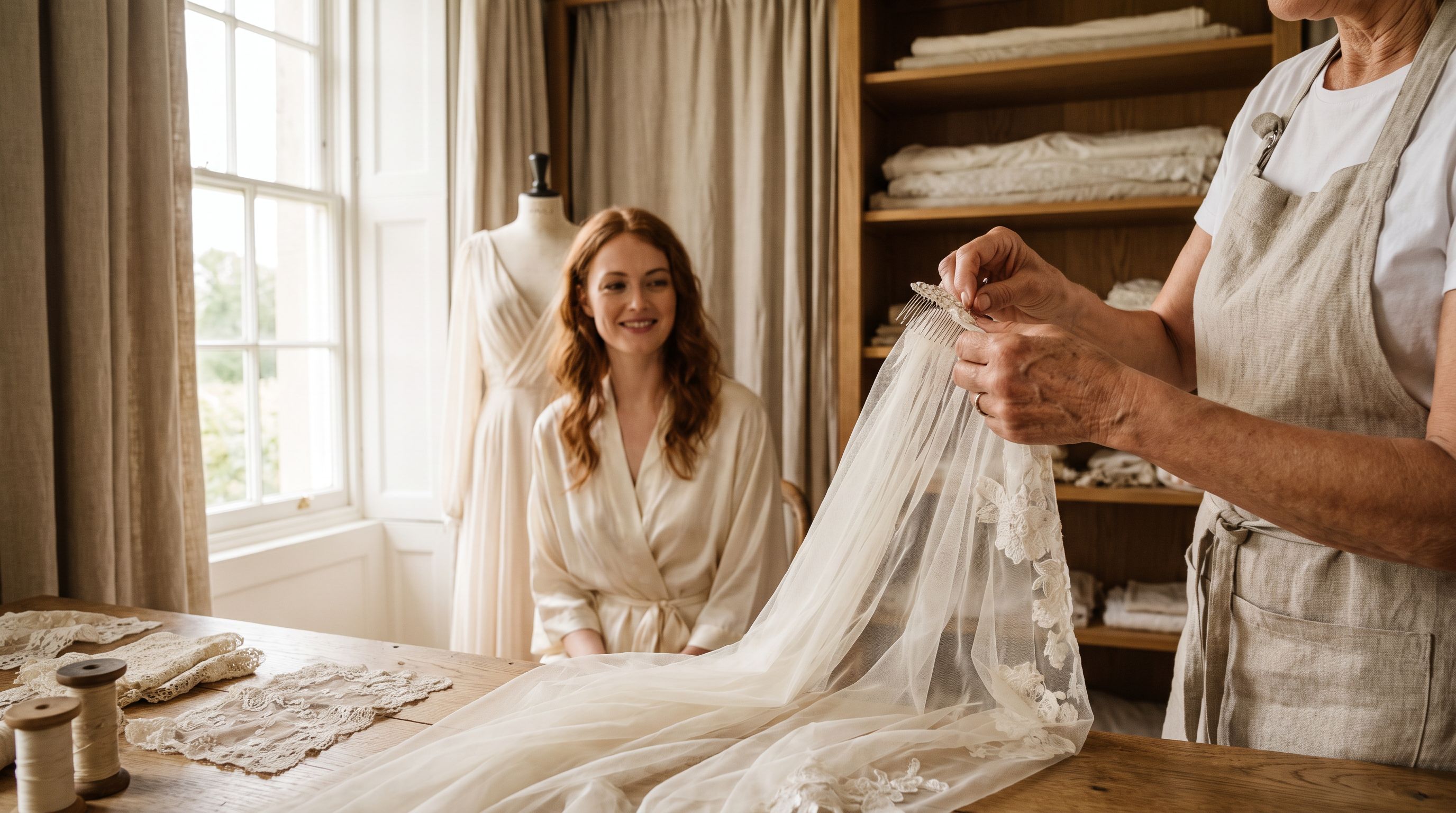
Heirloom veils are having a real moment — people walking down the aisle under lace that belonged to a grandmother, a great-aunt, or in a few remarkable cases, lace that’s centuries old. It’s a lovely instinct. It’s also a slightly more complicated one than Instagram suggests, because a veil has to work with your gown, your hair or head covering, and your venue’s wind.
So let’s talk honestly about both paths: having a veil made for you, and wearing one that’s already in the family.
Why the veil deserves more thought than it usually gets
The veil is the single accessory that changes every photograph of the ceremony. It frames the face in the aisle shots, it softens the background, and it’s often the first thing the person you’re marrying sees. It’s also the piece most often bought last, in a rush, from whatever the salon has on a hook.
That’s a shame, because a veil is unusually well suited to being made to measure. It’s a small amount of fabric, the construction is relatively simple, and the variables that matter — length, width, fullness, where the gather sits — are exactly the things a ready-made veil can’t accommodate. Someone who is 5’1” and someone who is 5’11” wearing the same “fingertip” veil are wearing two completely different looks. And height isn’t the whole story: fingertip length is measured from the comb, so a long torso pushes that hem well past the hip while a shorter torso lands it closer to the high hip.
What a custom veil actually costs
Prices vary enormously by region, by maker, and above all by lace. Treat these as starting points to adapt, not as quotes:
The cost drivers are easy to understand once someone names them:
Tulle quality. Standard bridal illusion (nylon or polyester) is crisp, inexpensive, and photographs cleanly. Silk tulle is softer, drapes like smoke, and can cost several times as much per yard — it’s why two veils that look similar in a photo can be hundreds of dollars apart.
Length and width. Cathedral and royal lengths use far more fabric, and a veil wide enough to drape over the shoulders takes more than a narrow one. Doubling the length more than doubles the material cost once you need extra-wide tulle.
Edge finish. A raw or cut edge is nearly free. A narrow satin ribbon, a horsehair hem, or a rolled hem adds labor. Lace trim adds yardage cost plus the hours to ease it around curves without puckering.
Appliqué work. This is where veils become genuinely expensive. Cutting individual lace motifs from yardage and hand-placing them so they scatter organically — denser at the hem, dissolving upward — is slow, skilled work. The same logic that drives beaded gown pricing applies here: you’re buying hours, not materials.
Lace type. A soft Chantilly edge reads romantic and costs differently than a dimensional corded Alençon or a bold Guipure motif. If you’re matching your gown’s lace, it helps to know what you’re actually looking at before you ask.
Veil lengths, decoded
Lengths are measured from the comb down, not from the floor up — which is why the same label gives different results on different bodies.
- Flyaway / shoulder (around 20–25”): playful, modern, shows off a back detail.
- Elbow (around 30”): often lands near the natural waist on petite frames. Good with fuller skirts.
- Fingertip (around 36–40”): the most versatile length; works with almost every silhouette.
- Waltz / ballet (around 55–60”): mid-calf drama without a train to manage.
- Chapel (around 90”): pools slightly on the floor, usually matching or just past a chapel train.
- Cathedral (around 108–120”): the aisle-shot veil. Needs a processional long enough to earn it.
- Royal / monarch (120”+): spectacular, heavy, and genuinely a two-person job to arrange.
The guiding principle: your veil should either match your train’s length or clearly exceed it. A veil that stops an inch or two short of the train hem looks like a mistake rather than a choice. If you’re still deciding on train length, that decision comes first.
Getting the fit right: comb, gather, and hair
Length gets all the attention, but width and attachment are what make a veil look custom.
Width should answer your body, not a size chart. As a working guide, a veil that drapes over the shoulders wants to be at least as wide as your shoulders plus a few inches on each side; a veil meant to float behind a full skirt should read at least as wide as the widest point of the skirt or your hips. A narrow 36” width can look skimpy and apologetic over a ballgown or a broader frame, like a ribbon laid on a wide canvas. Fuller hips, wider shoulders, or a dramatic skirt all call for more tulle width and a wider gather so the fabric spreads rather than funnels.
Gather width controls fullness at the head. A tight 3–4” gather stacks a lot of tulle into a small space and creates height and volume at the crown. A soft 6–8” gather lies flatter and reads more relaxed and modern. Say out loud which you want.
Comb placement and over-versus-under. Worn over the hair, the comb sits above or just behind a bun and the veil falls across the hairstyle — more traditional, more coverage. Worn under, the comb tucks beneath the bun or at the nape so the hairstyle stays fully visible and the veil floats from lower down — better for sculptural updos and for anyone who doesn’t want volume on top. Tell your maker and your hairstylist the same plan, and have the stylist build an anchor point (a small braid, a pin-curl pad, or a few crossed bobby pins) for the comb to bite into.
Mantillas, dupattas, and veils over head coverings
“Veil” isn’t one tradition, and makers fit each style differently.
A mantilla is a lace-edged circle or oval worn flat over the crown with little or no gather, framing the face with lace. It’s usually held by a small decorative comb pushed backward into the hair a few inches behind the hairline, or anchored at the temples with two fine clear-coated pins so the lace edge sits exactly where you want it against your cheekbones.
Dupatta-style draping uses wider, often heavier fabric — chiffon, georgette, organza, sometimes embroidered — pulled over the head and carried across one shoulder or both. Because the weight pulls, makers add hidden anchors: a flat comb or two at the crown, a small covered snap or hook-and-bar sewn into the gown’s shoulder seam, and sometimes discreetly weighted corners so the drape stays put through hugs and photos.
For a hijab, tichel, turban, or wig, the veil attaches to the covering rather than to hair. Practical options include a flat comb stitched onto a fabric-covered band that pins to the underscarf, snaps or hook-and-loop tabs sewn to both veil and cap, or hand-tacking the veil at the back of the crown on the morning itself so the drape falls behind the covering. Match the tulle’s undertone to the covering fabric as well as to the gown, and ask for lightweight hardware — heavy combs slide on smooth jersey and silk.
When the heirloom is the right answer
An inherited veil carries something no new one can buy, and the sentiment is real. But go in with clear eyes about three things.
Condition. Old silk tulle and cotton net become brittle. Hold it up to a window: look for uneven yellowing, small tears at the comb line, and areas where the net has gone powdery. A textile specialist — not a corner dry cleaner — is the right call. A bridal-specialist cleaner typically charges an illustrative $75–$250 for cleaning and pressing a delicate veil, while a trained textile conservator handling fragile antique lace often starts in the illustrative $250–$600+ range. Both numbers vary widely by city and by condition.
Color. This is the one that surprises people. A hundred-year-old veil is rarely bright white; it’s usually a warm ecru or deep ivory. Against a stark white gown it can read dingy rather than antique. Against a champagne or ivory gown it can look intentional and gorgeous. If you haven’t ordered your dress yet, bring the veil along and let it influence your gown’s shade — matching the dress to the veil is far easier than the reverse.
Reimagining it. A skilled maker can lift original lace off failing net and remount it on fresh tulle, lengthen a short veil by adding new netting behind the lace, or cut lace from an heirloom gown and build a new veil from it. Expect this to land roughly in the $250–$1,200 range depending on how much lace needs releasing and re-securing — the same conservation logic that governs restyling a mother’s gown.
Custom versus heirloom, side by side
Plenty of people do both: the heirloom for the ceremony and portraits, a simple short custom veil or none at all for dancing. That’s a genuinely good answer when the family piece is delicate.
How to commission one, step by step
-
Lock the gown silhouette first
Veil decisions follow dress decisions. Back detail, train length, and neckline all change what works. -
Bring a fabric swatch — always
Color-match in daylight, against your actual gown fabric. White-on-white mismatches are the most common veil regret. -
Try lengths and widths with a mock-up
A good maker will pin plain tulle at your fitting so you can see the proportion on your frame, not on a model’s. -
Discuss attachment and hair
Share your hairstyle or head-covering plan in detail. A low bun, an under-versus-over placement, a hijab, and a half-up style each need a different gather and anchor. -
Plan the removal
If you’re taking it off at the reception, practice it. Ask for a secure but releasable comb, and show one person how it comes out.
Timing is gentler than for a gown. A simple custom veil can often be made in two to four weeks; an appliquéd one may need six to ten. Aim to commission around three to five months out, after your first or second dress fitting — early enough to catch problems, late enough that your gown’s details are settled.
If you can’t tell whether a family veil is salvageable, take it to any textile specialist and ask four plain questions: Can the original net be replaced without harming the lace? Is the lace releasable, or is it stitched through in a way that would damage it? What here is reversible, and what isn’t? And what would cleaning realistically do to the color? Many bridal-specialist cleaners, conservators, and custom makers will look at a piece for free or a small assessment fee, and an honest answer in ten minutes can save you from an expensive mistake in either direction.
Ready to bring your dream dress to life?
Tell us what you're picturing — style, timeline, and budget — and we'll connect you with custom dressmakers who can make it. Free, no obligation.
Get matched with a dressmakerRelated guides
Getting a Wedding Dress Made Abroad: Is It Worth It?
Thinking of having your wedding dress tailored in Bangkok, Hoi An or Bali? Real costs, timelines, risks and how it compares to a custom dressmaker at home.
Read guide →
Bought a Wedding Dress Online? Alter, Remake, or Custom
Your online wedding dress arrived and the fit is wrong. Here's how to tell what's fixable, what alterations cost, and when going custom is the smarter buy.
Read guide →
Custom Bridal Jumpsuit vs Gown: Fit, Cost, Comfort
A custom bridal jumpsuit vs wedding dress: honest costs, the fit details that make or break a jumpsuit, fabrics, timelines, and how to decide.
Read guide →