 Custom
 Chantilly vs Alençon vs Guipure Lace for Wedding Dresses
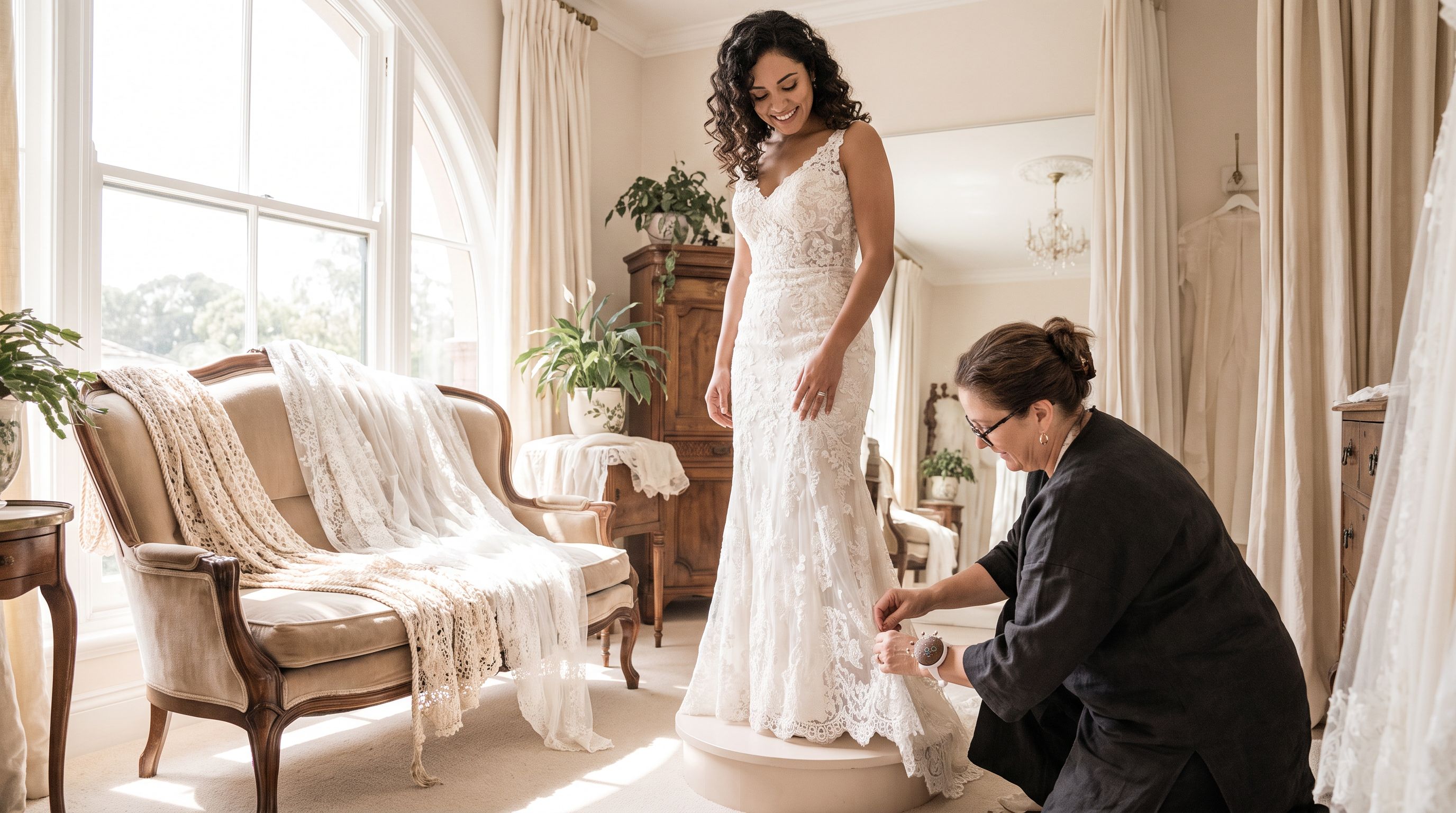
If you’ve saved a dozen lace gowns to a folder and can’t work out why they all look so different, the answer usually isn’t the silhouette — it’s the lace. Two people can ask for the same “lace A-line with sleeves” and end up with gowns that share almost nothing visually, because lace is less a single fabric than a family of very different textiles.
This applies to anyone wearing a gown — brides, non-binary clients, and anyone planning a second look or reception outfit — and it isn’t an ivory-only conversation. These laces come in champagne, blush, black and deep jewel shades, and gold-work, zari and metallic laces are central to South Asian, Nigerian and many other wedding wardrobes. Everything below about dye lots and ordering applies to every one of those colors.
Chantilly: fine, fluid and quietly romantic
Chantilly sits on a delicate net ground, with fine outlined motifs and no cording. It gathers, drapes and floats: sheer sleeves that move when you lift your arm, an overlay skimming a slip, a veil edged in scallops.
It’s forgiving in movement and lovely in candlelight, but subtle — in a big room or a wide-shot photo it can quietly disappear. It’s fragile too, so expect stabilized seams and a repair plan. Scale matters: Chantilly’s motifs are usually small, which is beautiful up close but can read busy and restless stretched across a broader bodice. A slightly larger, more open motif often settles it.
Alençon: corded, defined, the lace most people picture
Alençon is re-embroidered — motifs outlined in fine cord, often with sequins or beads, on a net ground. The cording catches light, holds an edge and photographs well at distance.
Because the motifs are outlined, Alençon cuts apart cleanly. A skilled maker can lift motifs and re-place them so the pattern flows across seams instead of stopping at them, and scallop a hem with the pattern rather than slicing straight through it. That’s why it dominates “lace matched” bodices where you can’t find the side seams.
Guipure: graphic, matte, unmistakably modern
Guipure — often called Venise — has no net ground; motifs connect to each other with bars, so it’s heavier, opaque and sculptural. It reads as pattern rather than texture and holds shape rather than draping. It suits columns, fitted sleeves, jackets and a bodice over crepe, and stays legible from across a garden.
Watch the scale. Guipure repeats run large, and a bold motif can swallow a petite frame — on a shorter torso, a smaller repeat or a partial placement usually reads better than allover.
Two others worth knowing by name: point d’esprit, a dotted net that reads sweet and vintage for far less than corded lace, and embroidered or beaded tulle, often sold by the panel rather than the yard.
What lace realistically adds to the cost
Learn the drivers rather than memorizing a number. The figures below are illustrative US dollars as of 2025, and reflect retail cut-yardage counters; wholesale or direct-from-mill pricing, usually with minimum orders, can sit well below them.
The drivers: fiber (silk and cotton nets cost more than polyester), cording and re-embroidery, beading, width (a 51-inch lace covers far more ground than a 36-inch one), and mill provenance. Yardage also scales with the body — an allover lace gown with sleeves and a train in a larger size needs meaningfully more lace than a bodice over a plain skirt, so ask for a quote calculated from your measurements, not a generic per-dress figure.
On a tight budget there are real levers. Use lace only where it shows — a bodice or sleeves over plain crepe. Buy a single embroidered panel instead of yardage. Choose machine appliqué over hand placement. Ask your maker about mill overstock and remnant lengths, which turn up regularly. And consider a mid-tier corded lace: many photograph within a whisker of Alençon at conversational distance.
What lace does to your timeline
Build in more time than you would for plain fabric. Swatches from a mill or distributor commonly take one to three weeks to reach you, and longer over holidays. Imported laces frequently ship on a several-week lead time, and popular dye lots do sell out — if you fall for a specific one, reserve or buy it early rather than at your second fitting. Then allow for fittings: a lace-matched bodice often needs an extra fitting or two, because motif placement is checked and adjusted before anything is cut.
Matching the lace to your gown — and your body
Warm-weather weddings favor lighter, open laces; dense guipure holds heat. Fuller skirts need lace that gathers — stiff guipure will not soften no matter how much you want it to. Sleeves are where lace earns its keep, and lining an illusion sleeve changes the mood entirely; our guide to modest custom gowns and sleeve options goes deeper.
Placement is body-specific. On shorter legs, ask where a scalloped hem breaks — just below the knee or at the narrowest part of the calf usually lengthens the line, while mid-calf shortens it. Over a fuller bust, motifs should be mapped so a flower doesn’t land squarely on the apex; offsetting and mirroring solves it.
Working through lace with your dressmaker
-
Bring images, but name what you love
“I love how defined the flowers are” versus “I love that it looks barely there” translates directly into corded versus fine. Our guide to working from an inspiration photo covers briefing a maker well.
-
Ask cost per yard and yards needed for your size
A good maker gives you both numbers, calculated for your measurements, and usually two or three options at different price points.
-
Confirm placement work is quoted
Allover lace, seam matching, scalloped hems and appliqué over an illusion back are separate labor decisions. Get them itemized.
-
Buy the yardage in one lot
Lace runs in dye lots, and one champagne, black or ivory lot can read visibly different from another. Extra yardage covers repairs and late design changes.
-
Review placement on your toile
Before anything is cut in real lace, see motif placement mapped on the muslin — bust, hips, center back and hem.
To a swatch appointment, bring the undergarments you’ll actually wear, a shoe at your likely heel height, and both close-up and full-length reference photos. And email any maker you’re considering these three questions: What is this lace per yard, and how many yards does my design need in my size? Does your quote include lace matching, appliqué and a scalloped hem, or are those itemized separately? What is the lead time to order it, and what happens if the dye lot sells out?
Ready to bring your dream dress to life?
Tell us what you're picturing — style, timeline, and budget — and we'll connect you with custom dressmakers who can make it. Free, no obligation.
Get matched with a dressmakerRelated guides
Custom Wedding Dress for Apple-Shaped Brides: Fit Guide
How a custom wedding dress solves fit for apple-shaped brides: the best silhouettes, internal support, fabrics, fittings, and realistic costs.
Read guide →
Custom Wedding Dress for a Small Bust: A Real Fit Guide
A custom wedding dress for a small bust: how bodices get cup-sized, strapless support without heavy padding, flattering necklines, and realistic cost ranges.
Read guide →
Custom Winter Wedding Dress: Fabric, Sleeves, Warmth
How to design a custom winter wedding dress that's genuinely warm: the best fabrics, sleeve and lining choices, capes, realistic costs, and timeline tips.
Read guide →