 Custom
 Custom Wedding Dress From an Inspiration Photo: A Guide
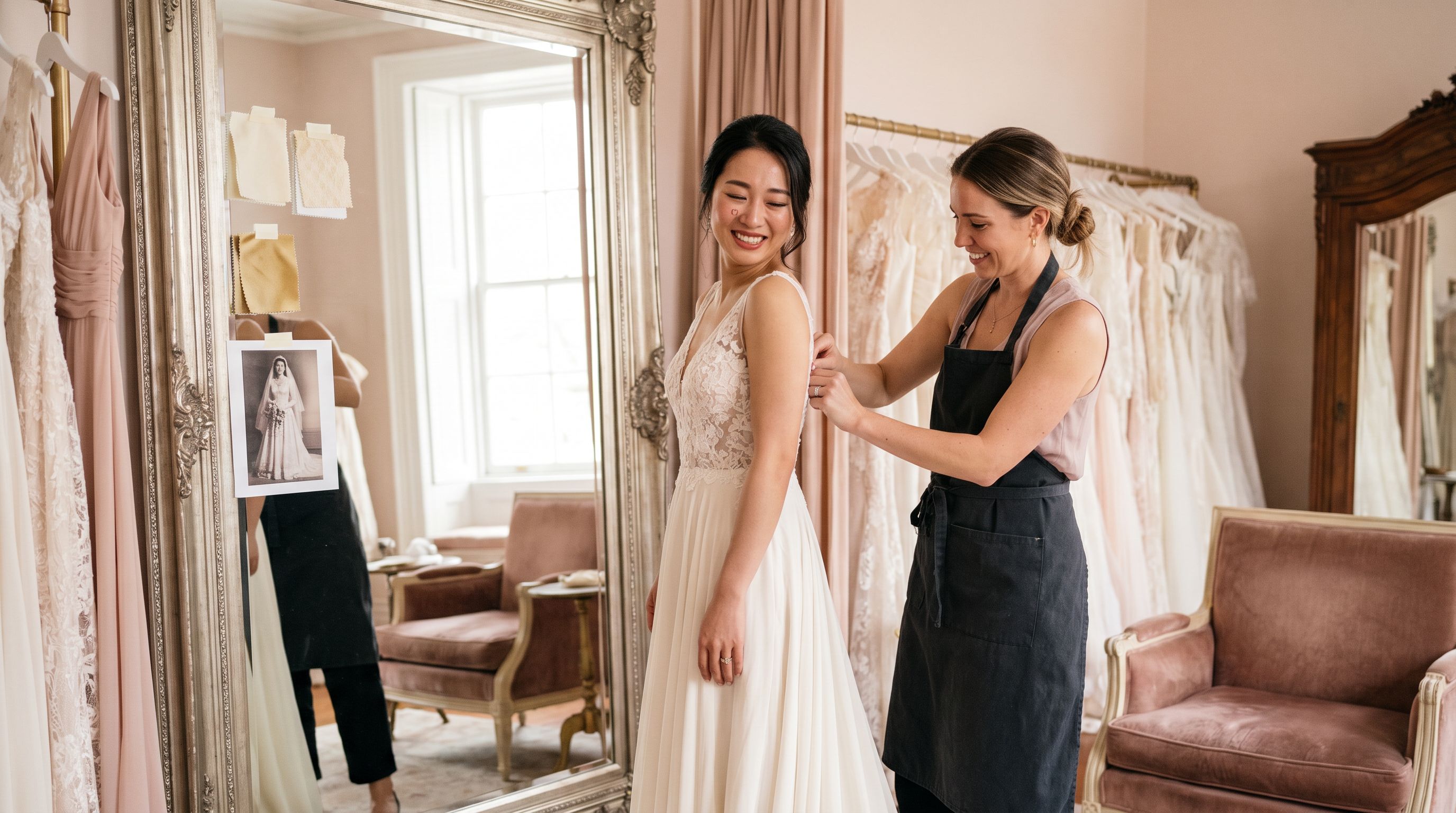
Why everyone’s inspiration board suddenly looks the same
If you’ve noticed your saved folder filling with the same handful of gowns, you’re not imagining it. Bridal trends move in waves: one high-profile dress, one viral runway moment, and within a season the same neckline is everywhere. Whether you’re a bride, a groom in a gown, or a nonbinary partner planning what you’ll wear, it’s easy to end up with twenty screenshots that are really the same three ideas wearing different fabric.
Here’s the part that matters for you. Big bridal labels typically take well over a year — depending on the label and how they produce — to translate a trend into a rack sample, and then months more for that sample to reach a boutique near you. A custom dressmaker can start next week. That’s the quiet advantage of going made-to-measure when your inspiration is fresh: you’re not waiting for the industry to catch up, and you’re not limited to whichever version of the trend happens to exist in your size on a shop floor.
Can a dressmaker legally copy a designer gown?
This is the question people are most nervous to ask, so let’s be direct. In the United States, garment silhouettes and cuts generally aren’t protected by copyright the way a photograph or a song is — but specific printed textiles, distinctive lace patterns, logos, and trademarked details can be. This isn’t legal advice, and rules differ by country.
More practically: reputable dressmakers don’t want to produce a stitch-for-stitch knockoff, and you probably don’t want one either. An exact replica of a gown originally made in a couture atelier — often in silk that can run several hundred dollars a yard — recreated on a different body in a different fabric tends to look like a photocopy of the real thing. What good makers offer instead is interpretation, and interpretation is almost always more flattering, because it’s built for your proportions rather than someone else’s.
A great custom gown doesn’t copy the photo. It gives you the feeling you had when you first saved it.
What actually changes between the photo and your gown
A seasoned maker will look at your photo and quietly translate: that dropped waist will sit differently on a shorter torso, so we’ll raise it half an inch; that sheer panel reads modern on a runway, but you’ve told me your ceremony is in a mosque, so let’s line it in matching crepe and keep the visual line. That translation work is the craft.
What it costs to have a photo made real
Prices vary enormously by region, by the maker’s experience, and above all by fabric and handwork. Treat these as illustrative starting points to adapt to your own situation, not benchmarks.
The cost drivers are consistent everywhere: fabric yardage and quality (silk mikado versus polyester satin can double a budget on its own), hours of handwork (beading is billed in labor, not glamour), structure (an internal corset or built-in cups adds pattern work), number of fittings, and your local cost of labor — a custom gown made in a major city prices differently than one made in a smaller market, and online or overseas makers price differently again. Our full breakdown of what drives a custom wedding dress cost walks through each line item.
How the process actually unfolds
-
Gather three to five photos, not thirty
Too many references confuse the brief. Choose a few, and annotate: “this neckline,” “this skirt movement,” “this color.” Add a photo of yourself in an outfit you feel wonderful in — it tells a maker more about your body and taste than a runway shot ever will.
-
Consultation and honest budget talk
A good dressmaker will ask about your venue, season, ceremony traditions, how much you plan to dance, and any coverage or modesty requirements — sleeves, higher necklines, a lined bodice — and treat them as design opportunities, not compromises. Share your true budget here. It shapes fabric choices from day one.
-
Sketch, fabric selection, and measurements
You should see a sketch or technical drawing and touch real swatches before committing. Twenty to thirty measurements are typical for made-to-measure.
-
The muslin or toile
A test garment in inexpensive cotton, fitted on your body. This is where the photo becomes your dress — necklines get raised, waists shift, straps get added. Nothing is precious yet, so speak up freely.
-
Two to four fittings in the real fabric
Expect refinement, not reinvention. Bring your actual shoes and undergarments every time.
-
Final press, steam, and pickup
Usually two to four weeks before the wedding, with a buffer for last-minute adjustments.
Most custom gowns need six to nine months comfortably, and more if heavy beadwork is involved. If your date is closer, say so immediately — some makers rush, many won’t, and a shorter runway may steer you toward simpler construction. Our realistic custom gown timeline maps out what’s possible at each stage.
How to tell you’ve found the right maker
Searching for a custom dressmaker nearby gets you a list; it doesn’t get you a match. What separates a great one:
- They push back thoughtfully. “That neckline will gap on you — here’s what I’d do instead” is a green flag, not rudeness.
- They show finished work, especially on bodies like yours. Ask specifically to see gowns made for your size range and shape.
- They quote in writing with fabric allowances, number of fittings included, and what counts as an extra charge.
- They explain what they can’t do. Honesty about a fabric they can’t source beats an enthusiastic yes that unravels in month four.
- They ask about your life, not just your measurements — the outdoor ceremony in August, the two hours of dancing, the grandmother’s lace you want incorporated.
If you’re still weighing whether custom is the right route at all versus buying a sample and altering it, our honest custom vs. off-the-rack comparison lays out where each one genuinely wins.
The trend cycle will keep spinning, and whatever silhouette dominates your feed today will likely be replaced by something else before your invitations go out. What won’t date is a gown cut to your actual body, in a fabric you chose by touch, made by someone who listened to how you want to feel and move in it. That’s the version of the photo worth chasing.
Ready to bring your dream dress to life?
Tell us what you're picturing — style, timeline, and budget — and we'll connect you with custom dressmakers who can make it. Free, no obligation.
Get matched with a dressmakerRelated guides
Custom Wedding Dress for Apple-Shaped Brides: Fit Guide
How a custom wedding dress solves fit for apple-shaped brides: the best silhouettes, internal support, fabrics, fittings, and realistic costs.
Read guide →
Custom Wedding Dress for a Small Bust: A Real Fit Guide
A custom wedding dress for a small bust: how bodices get cup-sized, strapless support without heavy padding, flattering necklines, and realistic cost ranges.
Read guide →
Custom Winter Wedding Dress: Fabric, Sleeves, Warmth
How to design a custom winter wedding dress that's genuinely warm: the best fabrics, sleeve and lining choices, capes, realistic costs, and timeline tips.
Read guide →