 Custom
Halter vs One-Shoulder vs Asymmetric Gown: Fit & Cost
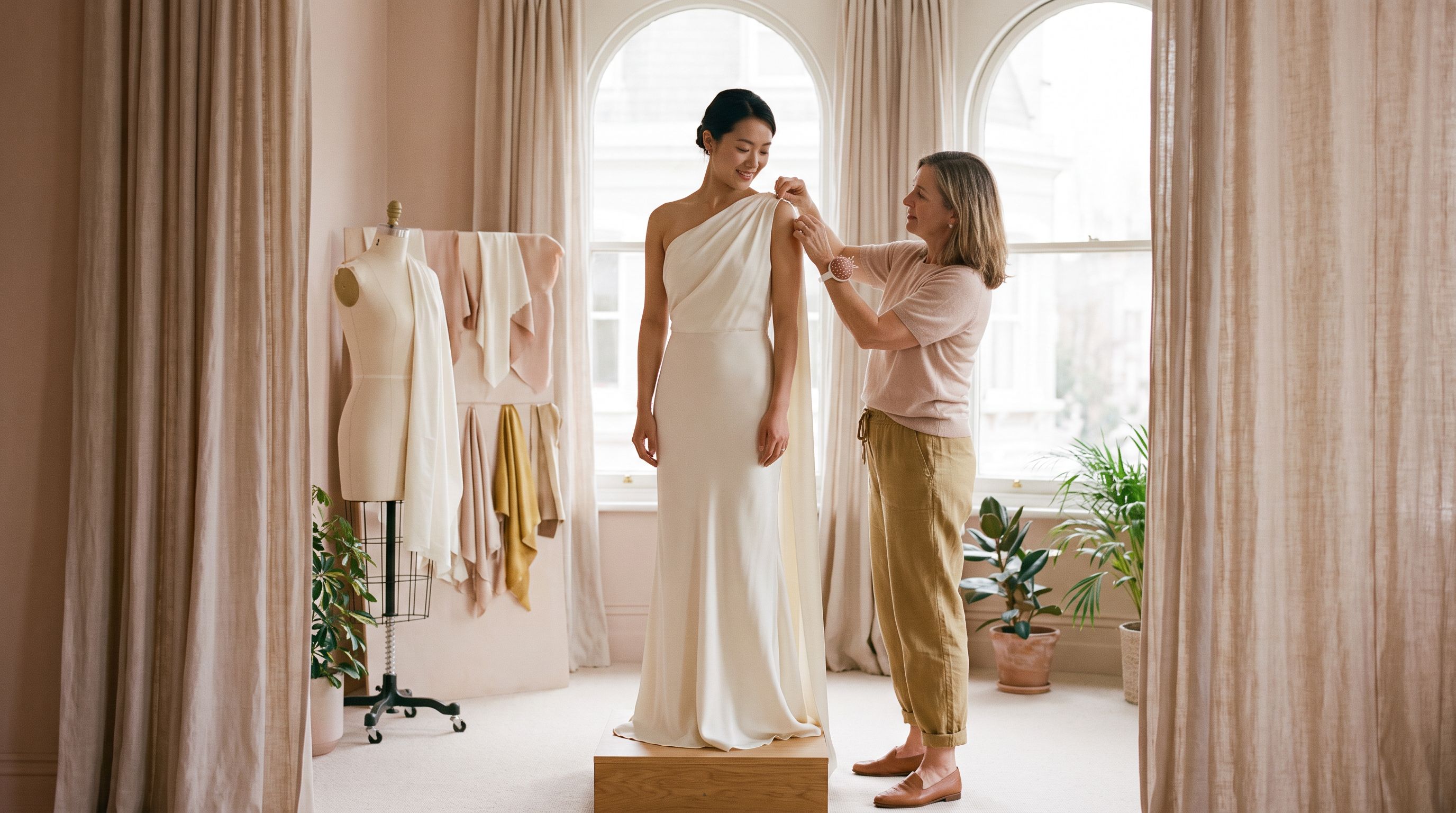
If you’ve been saving photos and keep gravitating toward gowns with something happening up top — a single draped shoulder, a tie behind the neck, a sash crossing the bodice on a diagonal — you’re in good company. These necklines photograph beautifully and read modern without being trendy. But they are three genuinely different engineering problems, and understanding that is the difference between a gown you forget you’re wearing and one you tug at all night.
What each neckline actually is
Halter. The bodice front extends up into a strap or band that fastens behind the neck — tied, buttoned, or sewn into a collar. Variations run from a thin spaghetti tie to a wide shoulder-skimming band to a high halter that covers the collarbone entirely (a lovely, elegant option if you want more coverage without full sleeves).
One-shoulder. A single strap, drape, or sleeve covers one shoulder; the other is bare. The strap can be a narrow band, a soft fold of fabric, a ruffle, a sculpted bow, or a full sleeve on one side only.
Asymmetric. The broadest category: any design where the lines deliberately don’t mirror. Think a diagonal neckline running from one shoulder to the opposite underarm, a draped sash crossing the waist, lace placed to climb one hip, or a skirt with a slit and hem that travel at different angles. Asymmetry often includes a one-shoulder bodice, but it doesn’t have to.
The question that matters most: where does the weight go?
This is the part bridal mood boards never tell you. A gown isn’t a picture — it’s real weight that has to hang from somewhere. A fluid crepe sheath is light; heavily beaded gowns with a cathedral train can run into the teens in pounds, and you feel every ounce of it by the end of the night.
This is also why internal construction deserves a conversation early — the difference between a boned corselette and a simple built-in bra changes how all three of these necklines behave. We break the options down in corset vs built-in bra support.
Choosing by your shoulders, bust, and proportions
There are no rules here, only tendencies — and a custom maker can bend any of them.
Broad or athletic shoulders. A halter narrows the visual line by pulling the eye inward to the center; a wide one-shoulder drape can also break up the horizontal span beautifully. What usually fights you is a thin horizontal strap sitting at the widest point. If this is your shape, the full fit conversation is in our guide for athletic and broad-shouldered brides.
Narrow or sloped shoulders. One-shoulder drapes can slide. The answer is a strap angled toward the neck rather than the outer shoulder, plus a discreet silicone stay — easy in custom, nearly impossible to retrofit well off the rack.
Full bust. Halters can be wonderful for lift, but a thin tie plus heavy bust tissue equals pressure. Ask for a wider band, a reinforced neck seam, and real cups. A high halter with a modest keyhole often feels more secure than a plunging one. See also our guide to a full bust and small waist.
Smaller bust. This is where one-shoulder drapes shine — the folded fabric adds soft dimension exactly where you want it, with no padding required.
Larger bodies and plus sizes. These necklines can be excellent, and custom is where they get comfortable. A wide halter band spreads the load across a fuller upper back instead of concentrating it on two narrow points, which is usually kinder over a long day — ask for the band to be shaped and lightly padded where it crosses the trapezius. A one-shoulder needs a longer, firmer underbust band than you’d see on a sample gown, with boning channels carried further around the side seams so the bodice holds its own line on the bare side. And made-to-measure removes the sample-size guesswork entirely: nothing is clipped at the back for a showroom try-on, so what you see pinned at the toile stage is genuinely what you’ll wear.
Short torso or short waist. Diagonal lines are your friend. An asymmetric neckline or crossed sash lengthens the torso visually in a way a straight horizontal neckline can’t.
Modesty and coverage. Bring your actual requirements, not a vague preference, and your maker can design to them from the first sketch. Be specific about sleeve length (cap, elbow, three-quarter, wrist), neckline height (collarbone, base of the throat, fully to the neck), and whether coverage has to be opaque fabric or whether lined illusion tulle is acceptable in your community or family. Say clearly if arms, shoulders, chest, and back must stay covered for the ceremony, and whether you want to change for the reception — a detachable cape, an overlay, or a second sleeve that buttons on gives you one gown with two levels of coverage. A high halter covers the chest and collarbone while leaving the shoulders free; a one-sided sleeve paired with a matching opaque overlay keeps the asymmetry without the skin. Asymmetry and modesty are not in conflict; they just need to be planned together.
What these necklines add to the cost of a custom gown
Prices for custom gowns vary enormously by region, fabric, and how experienced your maker is — so treat everything below as a starting point to adapt, not a quote.
The cost drivers are consistent: drape eats fabric (a soft shoulder fold in silk crepe can use an extra yard or two of expensive cloth), asymmetry eats labor (lace motifs that travel on a diagonal have to be cut apart and re-placed by hand so the pattern looks continuous instead of chopped), and support eats time (an independently self-supporting bodice under a one-shoulder gown is a garment inside a garment). A simple halter in crepe is often little to no upcharge at all. A hand-appliquéd asymmetric lace overlay is a different category entirely.
Why these styles are hard to buy off the rack and alter
It’s worth knowing what you’re comparing against. Off-the-rack gowns are made to a fit model’s proportions, and these three necklines are precisely the ones that depend on your shoulder slope, neck length, and bust position. Shortening a halter tie is easy. Moving a one-shoulder drape two inches toward the neck means rebuilding the bodice front. Re-cutting an asymmetric beaded neckline means picking off and re-laying beadwork by hand — often more expensive than having the line placed correctly from the start.
A symmetrical dress forgives a slightly off measurement. An asymmetric one tells the truth about every seam — which is exactly why it’s worth making to your body.
How the fittings should go
-
Consultation and line-drawing
Bring photos from the front, side, and back. Ask where the strap will sit relative to your collarbone and whether the diagonal line will read the same on your proportions as in the photo. -
Toile (muslin) fitting
This is where the neckline is decided, not confirmed. Expect your maker to pin the strap in two or three positions, have you sit, raise your arms, and hug someone before anything is marked. -
Lace or drape placement
For asymmetric designs, motifs get pinned onto the toile or directly on you so the pattern flows across the diagonal. Photograph it — this is your record. -
Fabric fittings
Usually two or three. Check strap pressure after ten minutes, not ten seconds. Ask for the bodice to be tested with the strap unfastened. -
Final fitting
Wear your real shoes and underpinnings, dance a little, and sit down for a full minute. Neckline problems reveal themselves when you relax.
Questions worth asking before you commit
- How will this bodice stay up on its own, independent of the strap?
- Can the halter band be widened or padded if it starts to dig?
- For a one-shoulder: what’s stopping it from sliding, and can it be adjusted at the last fitting?
- For asymmetry: will the lace pattern be cut and re-placed by hand, and is that included in the quote?
- Can I see a photo of a past gown with a similar neckline, preferably on a body shaped something like mine?
A maker who answers these easily — and who talks about your shoulder slope before they talk about price — is the kind of maker worth booking. If you’re weighing strap styles more broadly, our guide to strapless vs straps vs off-the-shoulder is a good next read. When you do sit down with a dressmaker, bring your saved photos and your current measurements: those two things turn a vague idea into a sketch on your actual proportions.
Ready to bring your dream dress to life?
Tell us what you're picturing — style, timeline, and budget — and we'll connect you with custom dressmakers who can make it. Free, no obligation.
Get matched with a dressmakerRelated guides
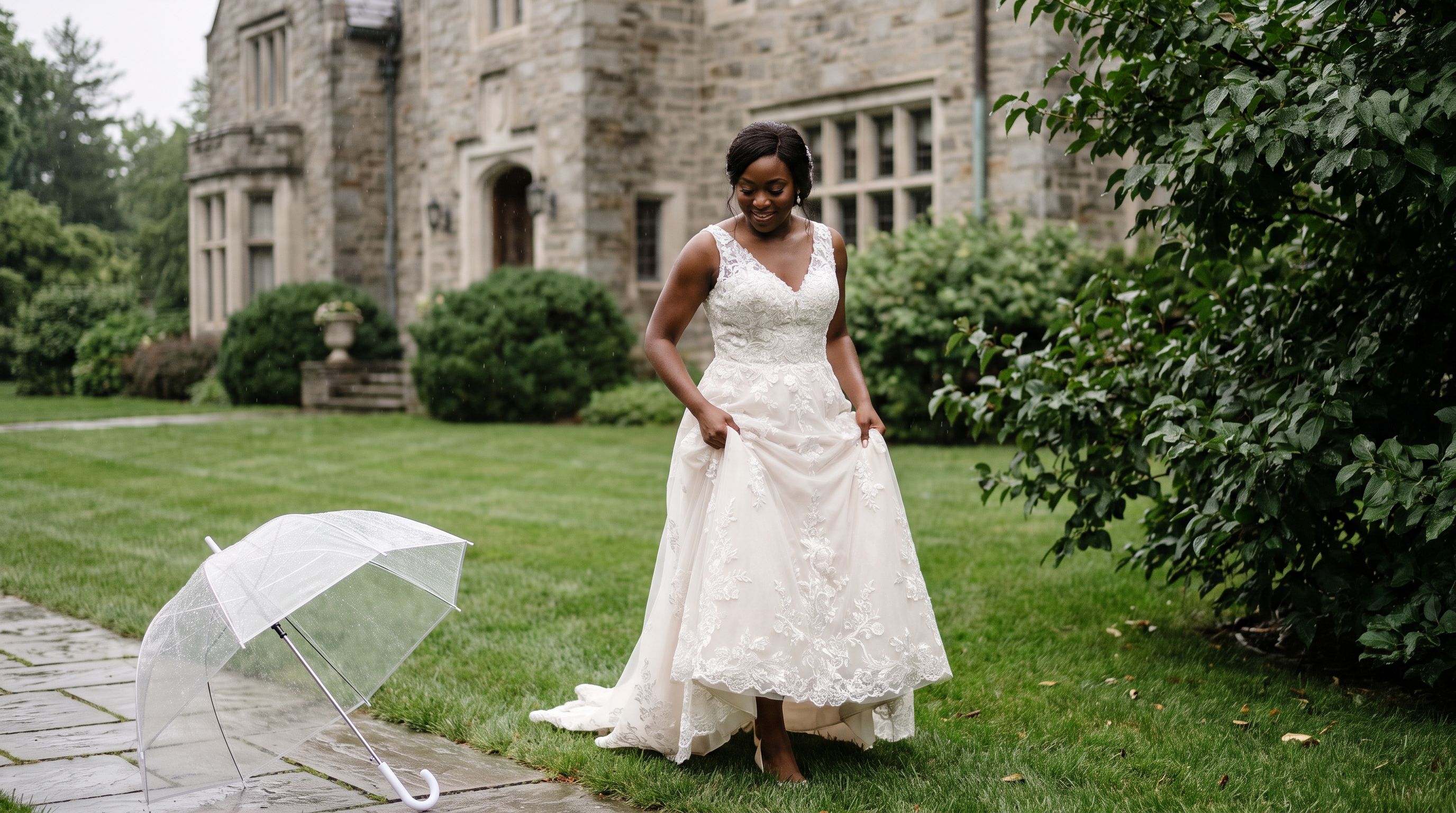
Outdoor Wedding Dress: Rain, Grass, and Humidity Guide
How to choose a custom outdoor wedding dress that survives rain, grass, wind, and humidity — fabric picks, hem strategy, and what weatherproofing costs.
Read guide →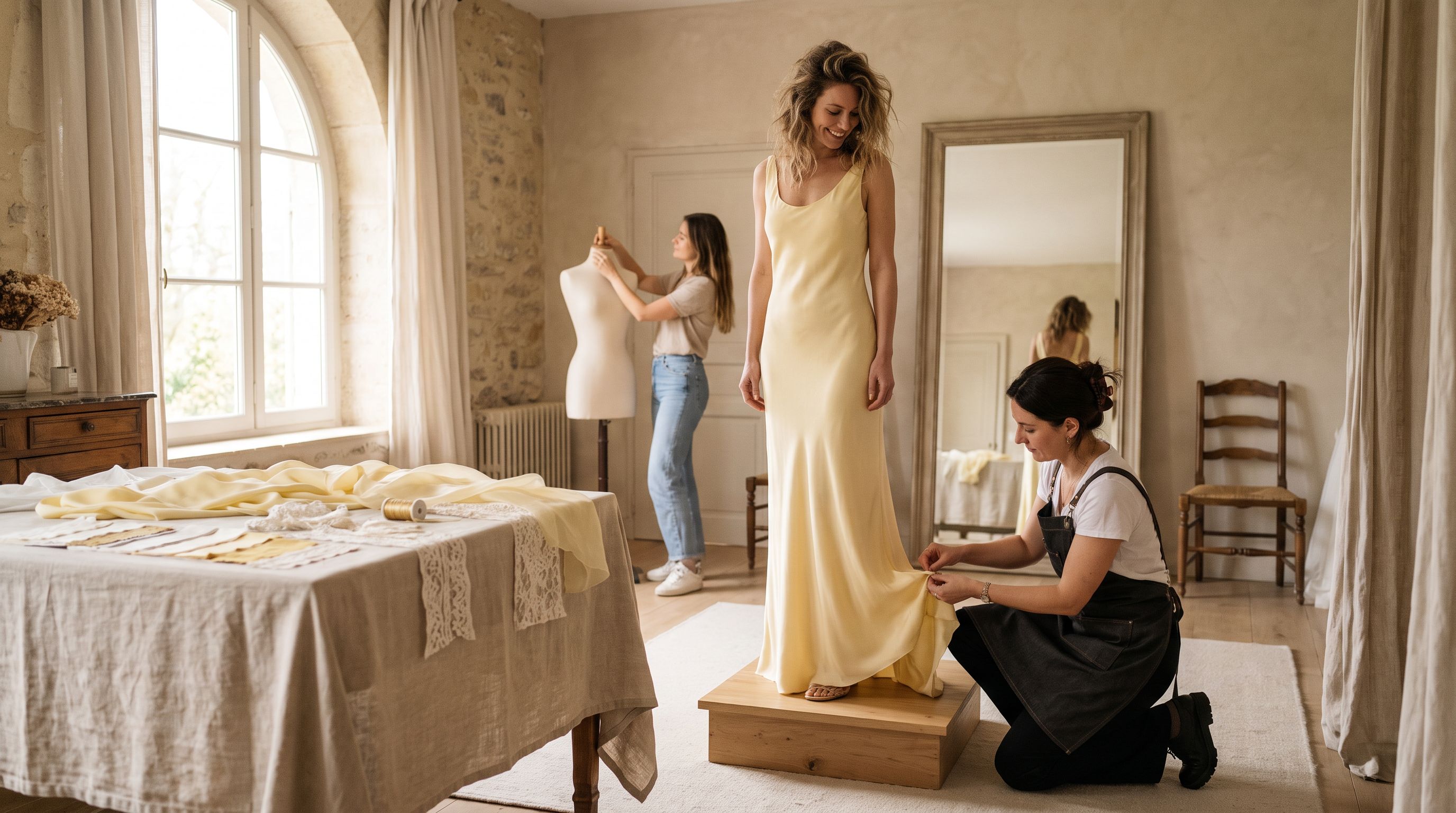
Butter Yellow Wedding Dress: Custom Color, Fit, Cost
Butter yellow is bridal's softest new neutral. Here's how custom dyeing works, which fabrics hold the shade, what it costs, and how to pick your tone.
Read guide →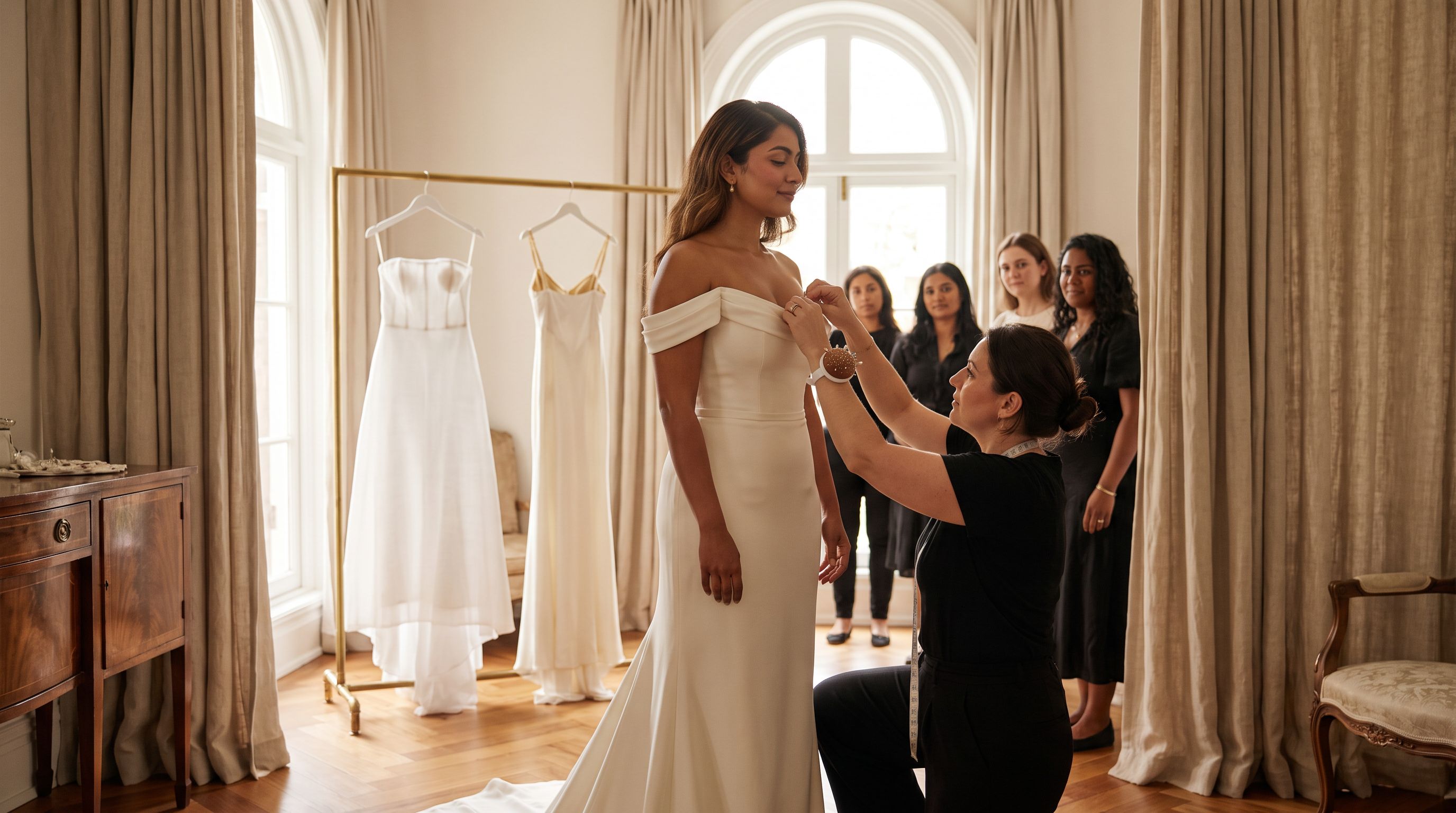
Strapless vs Straps vs Off-the-Shoulder: Fit Guide
Strapless vs straps vs off-the-shoulder wedding dress: how each one is supported, what it costs in a custom gown, and how to choose for your body and day.
Read guide →