 Custom
 Custom Wedding Dress for Athletic, Broad-Shouldered Brides
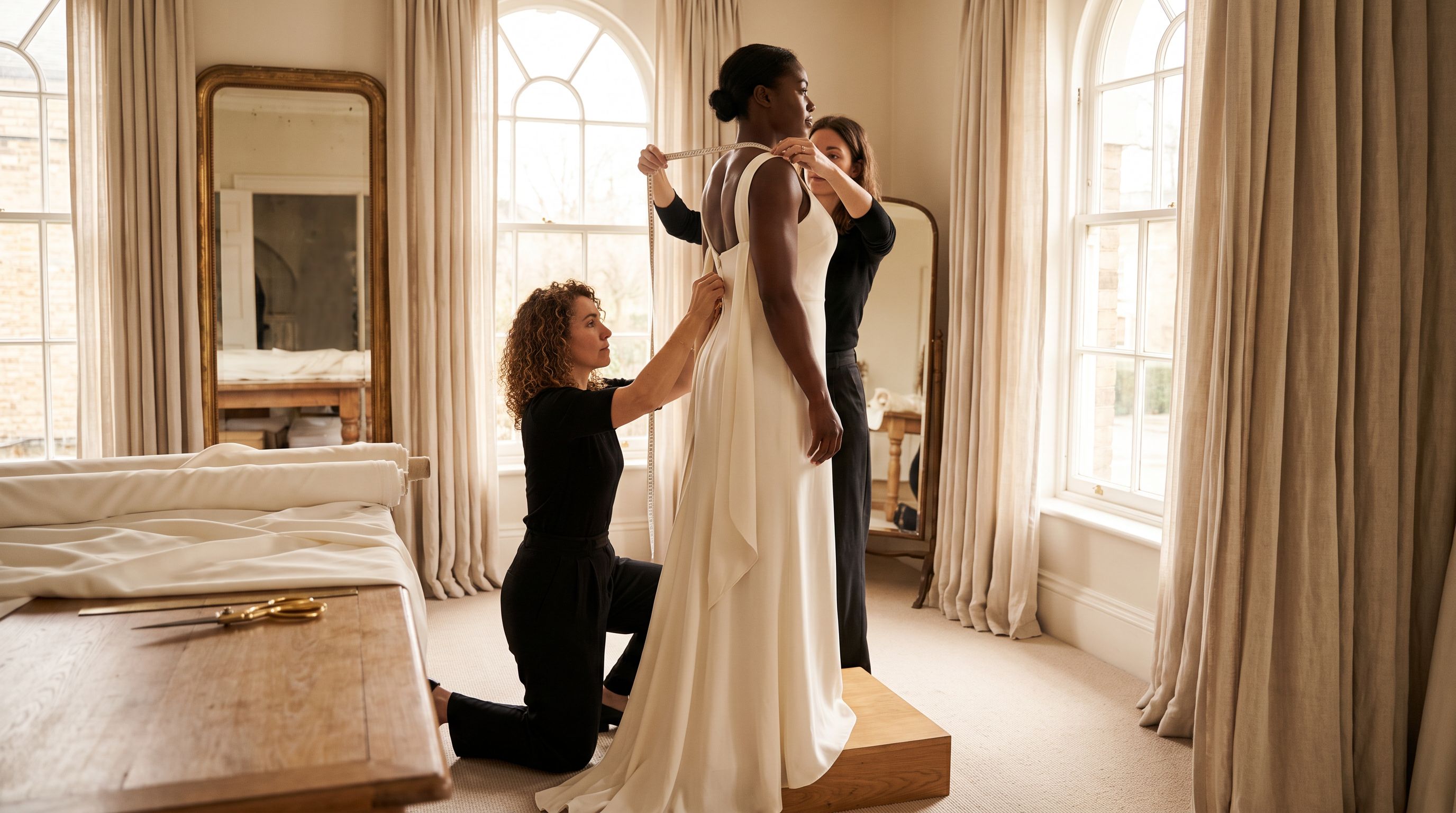
Why sample gowns fight an athletic frame
Bridal samples are graded from a single set of proportions: as the size goes up, the bust, waist, and hips all grow together, while the shoulders and armholes grow only slightly. If you swim, lift, row, dance, or simply carry width through your upper back, you end up in a familiar loop — the consultant clips you into a size that fits your ribcage, and the bodice won’t close across the back. Go up two sizes and the waist swims, the cups sag, and the neckline slides. (Whether you think of yourself as a bride or simply as the person wearing a gown that day, the mechanics are identical.)
The specific pressure points tend to be:
- Cross-back and shoulder width. A strapless bodice has to grip the ribcage, but a back that’s broader than the pattern assumes pulls the side seams forward and creates that horizontal crease under the arm.
- Armhole depth and shape. Too shallow and it cuts into the underarm; too wide and it gapes when you lower your arms.
- Bicep circumference. In our fittings, bicep circumference is the most common culprit when a sleeved sample feels like a straitjacket. A muscular arm needs meaningfully more ease than a standard sleeve pattern allows.
- A small-to-medium bust with a wide frame. Padded sample cups sit in the wrong place, and the neckline gaps because it was drafted for a fuller bust filling it out.
- Strong quads and glutes. Fitted mermaid skirts that fit the waist can bind through the thigh and shorten your stride.
The measurements that actually matter for your shape
When you meet a dressmaker, listen for whether they take these. A maker who measures only bust, waist, and hip is working from a size chart; a maker who measures the following is drafting for you.
- Across-shoulder (point to point) and cross-back (roughly 4 inches below the neck bone, armhole to armhole)
- Armhole circumference and armhole depth
- Bicep, elbow, and wrist — essential for any sleeve, even a flutter
- High bust as well as full bust, so cup size is drafted rather than assumed
- Back waist length and front waist length, which is how the waist seam lands where your waist actually is
- Posture notes — squared shoulders, a forward neck from cycling, a slight sway back
If you also have a defined waist relative to your ribcage, some of the bodice engineering in our guide to gowns for a full bust and a small waist applies to you too — the internal corselette does the shaping so the outer fabric can stay smooth.
Necklines and sleeves that flatter strong shoulders
There’s no rule that says you must “minimize” anything. Plenty of people love the way strong shoulders read in a gown and want to frame them. But if you’d like to soften or lengthen the line, these tend to work:
- A deep V or a narrow square neckline draws a vertical line and visually narrows the shoulder line.
- Straps set closer to the neck rather than at the shoulder edge instantly reduce apparent width; wide-set straps do the opposite.
- One-shoulder and asymmetric necklines create a diagonal that breaks up horizontal width — quietly one of the most flattering options for an athletic upper body.
- Halter and high-neck styles narrow the top of the frame and show off the shoulders and back.
- Set-in sleeves with generous bicep ease (a good maker builds in comfortable movement room, not a skin-tight tube), or raglan and dropped-shoulder cuts that give the arm somewhere to go.
None of this is limited to a white Western silhouette — the same cross-back, armhole, and bicep drafting decides whether a lehenga blouse, a cheongsam, an ao dai, or a colored two-piece outfit lets you lift your arms and hug your family.
Fabric matters as much as cut. Structured fabrics like mikado hold a clean architectural line across the shoulder, while crepe skims and softens — our fabric comparison of crepe, satin, and mikado is a useful primer before your consultation. Stiff cap sleeves in a crisp fabric are the one combination worth being cautious about; they add width exactly where you may not want it.
A dress that fits an athletic body isn’t a smaller dress or a bigger dress — it’s a differently shaped one.
What this typically costs, and how it compares to buying off the rack
“Off the rack” in bridal usually means buying the sample or a stock-size gown you can take home that day, rather than ordering one in your size. It’s often the cheaper sticker price — but for an athletic frame it’s also the option most likely to need serious alterations, and there’s a ceiling on what alterations can do. An alterations specialist can take a bodice in, shorten a hem, and add a cup, but they can’t add three inches of width across your upper back if the fabric isn’t there, and re-cutting a beaded bodice is skilled, expensive work. Our guide to where alterations stop and custom begins walks through those limits honestly.
If your budget sits well under four figures, you still have real options. A local independent dressmaker or tailor working from a good commercial pattern in a simple fabric is often the most affordable made-for-you route, and a stock gown with the back panel let out, a lace-up back fitted, or a modesty panel inserted can buy you the cross-back room a sample denied you. It’s also worth trying bridesmaid and eveningwear lines, which are frequently cut with wider armholes and more forgiving shoulder grading than bridal.
On timing: six to nine months is comfortable, but it isn’t a gate. Many makers can work in three to four months with a simpler fabric, less handwork, and fewer fittings. Under about eight weeks usually means a rush fee, a modified design, or both — so ask rather than assume you’re out of luck.
What a gown costs depends on five things: fabric quality and yardage, how much handwork (beading, lace appliqué, hand-finishing) you want, construction complexity, your maker’s experience and overhead, and your local cost of living. A cleanly cut crepe column with sleeves sits at the accessible end; a hand-beaded gown with a cathedral train sits at the other. For a full breakdown, see what a custom wedding dress costs and why.
A realistic budget also includes what you don’t have to spend. If off-the-rack shopping means a gown plus several hundred dollars of bodice surgery that still leaves you tugging at the armhole, made-to-measure with fittings included isn’t the extravagant choice — it’s the comparable one.
How the fittings should go
-
Consultation and design
Bring photos of what you loved and, just as usefully, notes on what failed. “Every strapless sample gaped at my underarm” tells a good dressmaker more than a Pinterest board. Discuss neckline width, sleeve style, and how much arm movement your day requires. -
Measurements and pattern draft
Expect 20–30 measurements, taken over the undergarments you’ll actually wear. Ask specifically whether armhole depth, cross-back, and bicep are on the list. -
The toile (muslin) fitting
This is your leverage. In a calico mock-up, do the movement test: raise both arms overhead, hug someone, reach across a table, sit down, and take a big step. Anything that pulls or rides up gets corrected on paper before your good fabric is cut. -
Fabric fittings
Usually two to three, refining the fit as the internal structure goes in. This is where cup placement, boning, and strap position are dialed in. -
Final fitting and steam
Bring shoes, undergarments, and any jewelry with a neckline impact. Do the movement test one last time, and practice the bustle with whoever will be handling it on the day.
How to test whether custom is right for you
If you’ve left more than one bridal appointment feeling like your body was the problem, it’s worth talking to someone who cuts to measurements rather than sizes. A short, no-pressure conversation with a custom dressmaker — describing what went wrong in the samples and what you want to be able to do in your dress — will usually tell you within twenty minutes whether custom is the right route for you, and roughly what it would cost in your area. That’s a much better foundation for your budget than another afternoon of clips and guesswork.
Ready to bring your dream dress to life?
Tell us what you're picturing — style, timeline, and budget — and we'll connect you with custom dressmakers who can make it. Free, no obligation.
Get matched with a dressmakerRelated guides
Custom Wedding Dress for Apple-Shaped Brides: Fit Guide
How a custom wedding dress solves fit for apple-shaped brides: the best silhouettes, internal support, fabrics, fittings, and realistic costs.
Read guide →
Custom Wedding Dress for a Small Bust: A Real Fit Guide
A custom wedding dress for a small bust: how bodices get cup-sized, strapless support without heavy padding, flattering necklines, and realistic cost ranges.
Read guide →
Custom Winter Wedding Dress: Fabric, Sleeves, Warmth
How to design a custom winter wedding dress that's genuinely warm: the best fabrics, sleeve and lining choices, capes, realistic costs, and timeline tips.
Read guide →