 Custom
 Custom Wedding Dresses for a Full Bust and Small Waist
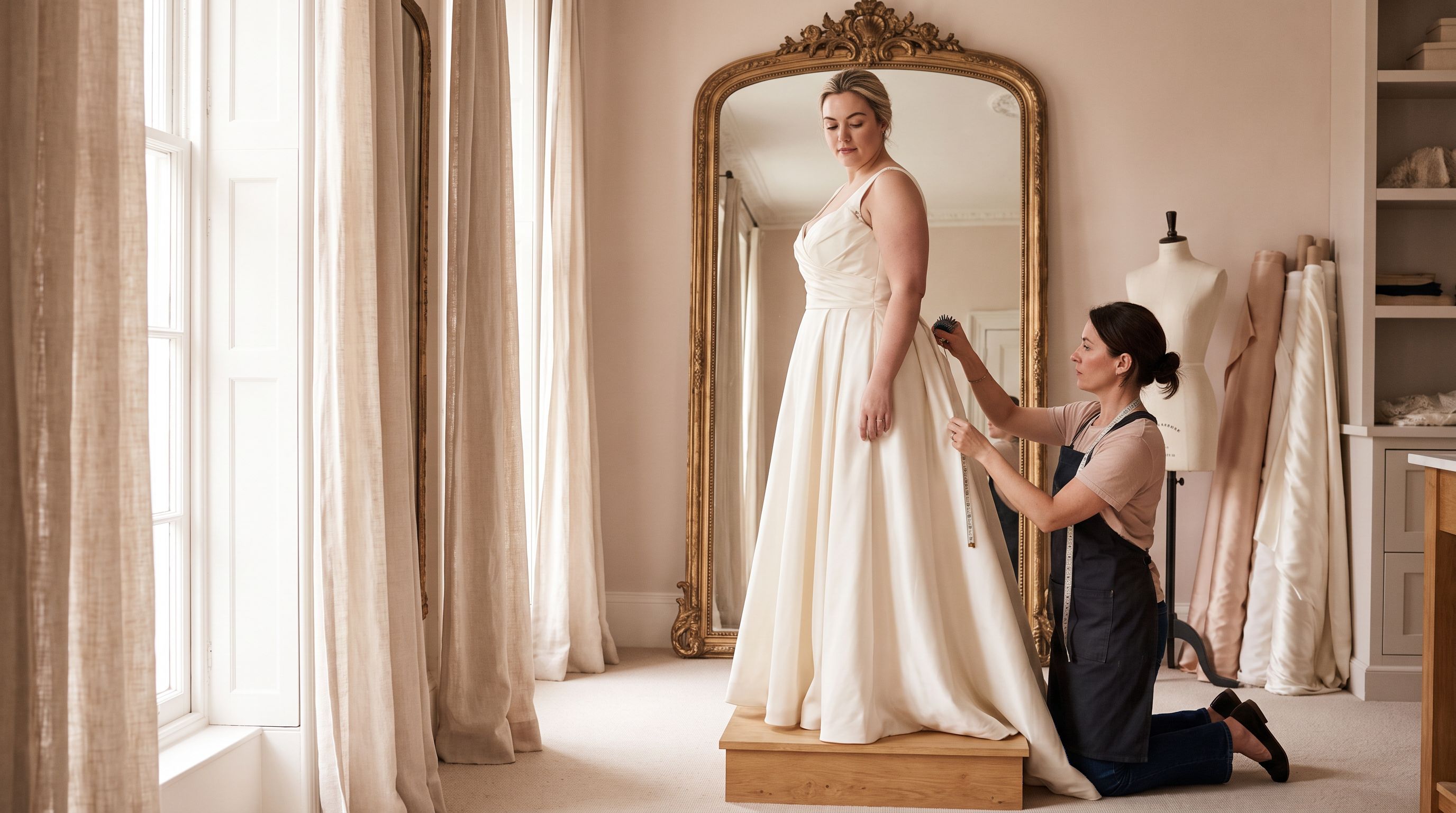
Why the fitting room felt like the problem was you
Here is the thing nobody says out loud in a bridal salon: most wedding dresses are graded from a block that assumes a B or C cup and a fairly standard bust-to-waist difference. As the sample sizes go up, the cup barely changes — the dress just gets bigger everywhere at once.
So if you have a full bust and a defined waist, you get pushed into whichever size accommodates your largest measurement. The bust finally closes, and now there are three inches of slack at your waist, the neckline stands away from your chest, and the straps have wandered toward your shoulder points. You try seven gowns and start to believe your body is the outlier. It isn’t. The pattern is.
This is exactly the gap a custom or made-to-measure gown closes — not by flattering tricks, but by drafting a bodice to your actual rib cage, cup depth, and shoulder slope. And none of it is gown-specific: the same drafting applies to a lehenga blouse, a cheongsam, a two-piece, or a suit, and it applies to whoever’s wearing it — brides, non-binary and masc-presenting wearers included.
The five fit failures a full bust runs into
If you can name the problem precisely, you can ask a maker precisely how they’ll solve it. The usual suspects:
- Neckline gaping. A sweetheart or V-neck stands away from the chest because the upper edge is too long for the space between your bust and collarbone.
- The band riding up. The dress climbs at the back because the bust is taking up the length the bodice needed.
- Waist and hip excess. The garment fits at the fullest point and hangs everywhere else, killing the shape you actually have.
- Strap and armhole strain. Straps slide off, cut in, or sit too wide to carry any weight.
- No real support. Cups sewn flat into a bodice do nothing for a D+ bust; the garment needs internal engineering, not decoration.
What a custom maker actually does differently
A well-built full-bust bodice is a small feat of engineering, and it happens mostly on the inside.
The pattern is drafted with a real cup — often through princess seams or a rotated bust dart that puts fullness where your body actually is, rather than a flat panel that has to be forced into shape. The upper neckline edge is shortened and shaped to hug the chest so it lies flat when you lean forward for a hug. Straps are moved closer to the neck, where they can bear weight without sliding.
Inside, most makers build a separate structural layer: a fitted corselette with boning at the side seams and princess lines, a firm elastic band at the underbust that anchors the whole thing to your rib cage, and cups or padding chosen to your shape. That band is what stops the gown from traveling upward all night. A strong back closure — hooks and bars behind a zip, or a properly bound lace-up — matters more at a full bust than at any other size.
Most of what makes a full-bust gown work is the structure you never see.
Alterations or custom: where the line really is
Off-the-rack absolutely can work — plenty of full-busted wearers find a gown they love and have it altered. The question is how much of the bodice has to be rebuilt.
Our guide to where alterations stop being worth it walks through the specific changes that quietly cross into rebuild territory. And if you’re weighing overall value, the custom vs off-the-rack decision guide lays out the trade-offs without the sales pitch.
What this realistically costs
Prices vary enormously by city, fabric, and how much handwork your design involves, so treat any number as a starting point for your own math, not a quote.
The drivers that move your number: fabric (a structured mikado or silk satin costs more per yard than a good crepe — see how they behave differently on the body), beading and lace appliqué, sleeves and linings, the complexity of the internal corselette, and your maker’s experience and location.
Custom doesn’t have to mean four figures. A skilled local seamstress or dressmaker who doesn’t run a bridal-branded atelier often charges considerably less for the same drafting skill. Choosing an unbeaded fabric — a good crepe, a matte satin, a simple lace only at the neckline — removes the single biggest handwork cost. Remaking a mother’s or grandmother’s gown around a newly drafted bodice can be more affordable than starting from scratch, and carries meaning ready-to-wear can’t. A custom bodice paired with a ready-made or simple gathered skirt is another route: you’re paying for engineering exactly where you need it.
So is $3,000 a lot? It depends entirely on your total budget and what else you want that money to do. Whatever figure you land on, set it as an all-in number that includes alterations, undergarments, and any veil or cover-up, so nothing ambushes you in month eight.
The fitting process, step by step
-
Consultation and measurements
You’ll talk silhouette, coverage, and comfort. Expect a full set of measurements including underbust, bust height, and shoulder-to-bust point — the ones standard sizing ignores. -
Toile or mock-up fitting
A calico version of the bodice, pinned and marked on you. This is where neckline gaping and strap placement get solved before a single yard of silk is cut. -
Structure fitting
The inner corselette and cups are tested. Run the real checks: can you sit for twenty minutes without the underbust band creeping upward? Does the neckline stay flat against your chest when you lean forward? Can you raise both arms overhead without the hem lifting or the back gaping? If it shifts now, it shifts at your reception. -
Fashion fabric fittings
Usually two: one to refine, one to confirm hem and finishings. Bring your shoes and the exact undergarments you’ll wear. -
Final fitting
Typically one to three weeks out. Bust measurements can shift with cycle, medication, or weight changes — a good maker plans for a little adjustability.
Necklines and silhouettes worth trying
Nothing is off-limits with a well-built bodice, but some shapes reward a full bust with less fuss: square and scoop necklines give the bust a defined frame; a modest V lengthens without gaping when the edge is properly shaped; portrait and off-shoulder necklines look extraordinary when the internal corselette does the holding, not the neckline itself. Fitted-through-the-waist silhouettes — A-line, fit-and-flare, soft mermaid — celebrate the waist-to-bust contrast that ready-to-wear keeps hiding.
If you’re also navigating sizing beyond the bust, our plus-size and curvy custom gown guide covers overlapping ground on structure and fabric weight.
How to find and vet a maker near you
Start with your local alterations shops — the people who fix bridal gowns all week know exactly who drafts well, and they refer generously. Sewing and tailoring guild directories, local costume shops, theatre wardrobe departments, and university fashion programs are all reliable sources of names. Instagram and word of mouth work too, as long as you verify what you see in person.
Then vet properly. Ask to see photos of garments they’ve made for full-busted clients — the inside, ideally. Ask how many fittings are included, what happens if your measurements change, and how far out they’re booking. Ask what the internal support looks like and whether it’s built to your cup. Ask for the price in writing, with fabric allowances specified. A good consultation should cover measurements, a frank read on your budget, a realistic timeline, and what is and isn’t achievable in your fabric — and you should leave it feeling informed rather than pressured.
Ready to bring your dream dress to life?
Tell us what you're picturing — style, timeline, and budget — and we'll connect you with custom dressmakers who can make it. Free, no obligation.
Get matched with a dressmakerRelated guides
Off the Rack Wedding Dresses: What It Means and Costs
What "off the rack" really means in bridal, how off-the-rack wedding dress costs compare to custom and made-to-measure, and how to set a realistic budget.
Read guide →
Chapel vs Cathedral Train: Length, Cost, and Bustles
Chapel vs cathedral train for a custom wedding dress: real length measurements, what extra train costs, bustle types and prices, and how to decide at your fitting.
Read guide →
Bridal Sizing vs Street Size: Why Gowns Run Small
Bridal sizing vs street size explained: why wedding dresses run 2–3 sizes small, what off-the-rack really means, alteration costs, and when made-to-measure wins.
Read guide →