 Custom
 Ivory vs Champagne vs Blush: Custom Gown Color Guide
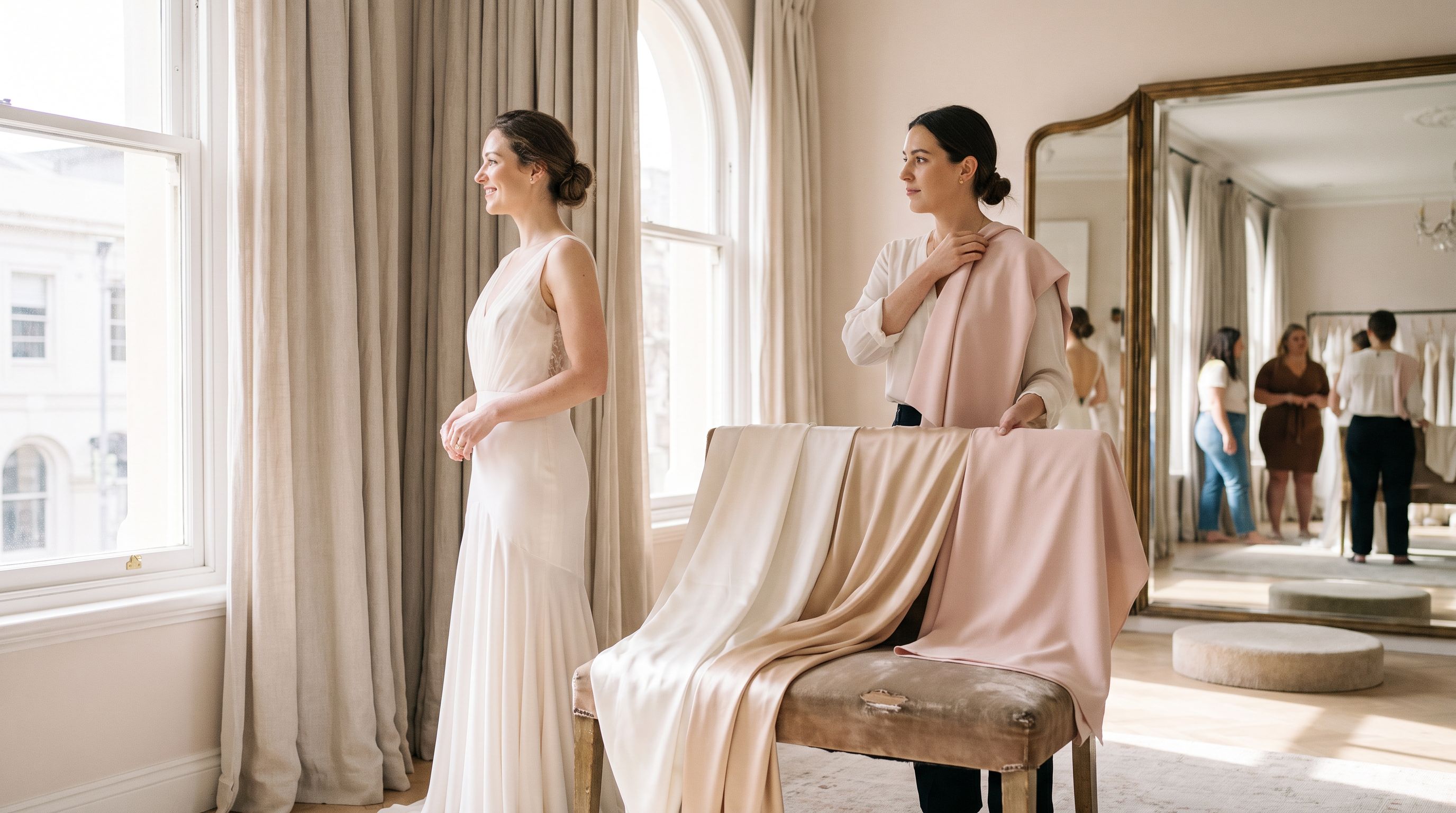
“White” Is Not One Color
Walk into any bridal fitting room and you’ll hear shades used loosely, but to a dressmaker they’re meaningfully different:
- Optic or stark white — a cool, bright, slightly blue-leaning white. Crisp and modern, most at home in structured fabrics like mikado. It can look startlingly bright next to natural skin and next to ivory tablecloths.
- Diamond white / natural white — a hair softer than optic white, still clearly white. The most common “safe” modern shade.
- Ivory — the bridal workhorse: white with a warm, creamy cast. Reads romantic and photographs beautifully in mixed lighting.
- Ecru, oyster, natural — deeper, slightly beige ivories. Gorgeous in raw silk and linen-blend gowns.
- Champagne — warm ivory with a distinct golden or honey undertone, sometimes used as a lining beneath ivory lace rather than as the outer shade.
- Blush, rose, petal — the palest pink, ranging from “is that pink?” to a clear soft rose.
- Beyond bridal neutrals — pale blue, sage, black, deep red, gold. Increasingly ordinary requests for second weddings, receptions, civil ceremonies, and cultural traditions where red or gold is the celebratory color.
None of these is more “bridal” than another. They just do different things in a photograph.
Undertone, Lighting, and Why Rules Fall Apart
You’ll read a lot of confident advice that certain skin tones “must” wear ivory and others “must” wear white. Treat that as a starting hypothesis, not a law. What actually matters is contrast and undertone.
Two concrete examples of how this plays out. Champagne against deep skin with golden undertones often glows — the shared warmth reads as luminous and rich rather than dulling, and it photographs beautifully beside gold jewelry and candlelight. That same champagne against very fair, cool, pink-toned skin can sink into beige and leave the wearer looking faintly sallow. Run it the other way: optic white on very fair cool-toned skin can read harsh and clinical, throwing a blue cast that emphasizes redness around the nose and eyes, while on deep or olive skin with warm undertones that same crisp white often looks striking and graphic because the contrast is doing the work.
These are tendencies, not verdicts. Some people love the soft, tonal, skin-adjacent look of a nude-blush gown; others want the gown to read unmistakably as a bright white statement. Both are correct — the swatch on your own face is the only real test.
Your venue is a lighting instrument too. Candlelit dinners and golden-hour outdoor ceremonies push everything warmer — a champagne gown can slide toward beige. Cool stone churches, winter afternoons, and blue-white uplighting push everything cooler, and true ivory can look almost white. Tell your dressmaker your venue and ceremony time; a good one will factor it in.
The Fabric Changes the Color More Than the Dye Does
This is the part most people don’t expect. The same dye lot reads as three different colors across three fabrics, because sheen controls how much light bounces back.
- High-shine satin and mikado amplify color. Ivory satin can look nearly white in bright sun and distinctly cream in candlelight.
- Matte crepe absorbs light and reads truer, slightly deeper, and more modern. Ivory crepe looks unmistakably ivory.
- Tulle and organza lighten in layers — five layers of ivory tulle reads paler and hazier than one.
- Lace rarely matches anything exactly. Cotton-blend laces take dye differently than silk grounds, and the lace’s own shade shifts once it’s laid over a lining.
If you’re weighing fabric and color at the same time, it’s worth understanding how crepe, satin, and mikado behave differently before you lock a shade. And because lace is the hardest element to color-match, knowing which lace style you’re drawn to early gives your maker time to source it in the right shade rather than dyeing around it.
Layering: The Trick Custom Gowns Do Best
Off-the-rack gowns come in whatever shades the designer produced. A custom gown lets you build color in layers, which is where the most beautiful results live.
Ivory lace over a blush lining gives a warm glow with no obvious pinkness. Champagne charmeuse under an ivory tulle overlay creates dimension that a single flat shade never achieves. A sheer illusion neckline or sleeve can be matched to your own skin rather than to a generic “nude” — a detail that matters enormously and that mass-produced gowns almost never get right across the full range of skin tones.
If you’re going saturated — a true red, deep black, emerald, or jewel-tone gown for a reception, civil ceremony, or cultural celebration — layering is a practical safeguard as much as an aesthetic one. Ask for a pre-washed, colorfast lining through the bodice and anywhere the gown sits against damp skin, and ask your maker to do a rub test on a swatch with a damp white cloth before cutting. Dye transfer onto skin, undergarments, or a partner’s pale jacket is entirely preventable with the right lining and a proper wash-off at the mill.
The most expensive-looking gowns usually aren’t one color at all — they’re two or three shades layered so the light has somewhere to travel.
What Color Choices Add to Your Budget and Timeline
Color is one of the more affordable ways to personalize a custom gown. It’s labor and materials, not structural complexity.
The cost drivers to understand:
- Silk vs. synthetic. Silk takes dye beautifully and predictably. Polyester often needs disperse dyes and heat, which fewer dyers offer, sometimes making a synthetic gown harder to dye than a silk one.
- Whether the fabric already exists in your shade. Sourcing mill-dyed champagne silk costs no more than ivory. Custom-dyeing an unusual color adds a dye run plus test strips.
- Color-matching multiple components. Lace, tulle, buttons, thread, boning covers, and the veil all have to agree. Each additional element is more sourcing time.
- Deep and saturated colors. Black, jewel tones, and true reds need more dye, more testing, and careful lining choices to avoid color transfer.
Color also costs time, and that surprises people more than the money does. A custom dye run plus test strips commonly adds a couple of weeks before the gown can even be cut, and lace sourced or dyed in an unusual shade can add several weeks more — longer if a sample has to cross borders or be re-dyed after a failed match. Settle your shade early in the process, ideally at or before the toile stage, rather than treating it as a finishing decision.
Getting the Color Right, Step by Step
-
Bring your inspiration, but name the shade
Photos lie about color. Screens, filters, and venue lighting all shift it. Say what you actually want — “warm, not pink” or “bright white, not creamy” — rather than relying on the image alone. This is the same discipline that makes working from an inspiration photo succeed.
-
Request swatches in your real fabric
A color card is not enough. Ask for the shade on the actual fabric you’re using — satin, crepe, tulle, and lace all behave differently. For deep or saturated shades, ask for the colorfastness rub test at this stage too.
-
Test in three lights
Indirect daylight, warm indoor light, and phone flash. Ideally at roughly the same time of day as your ceremony.
-
Check it against your skin and your wedding party
Hold it near your face and, if you can, near your wedding party’s fabrics and your attendants’ outfits. A gown that clashes with the palette is a preventable disappointment.
-
Confirm at the toile or first fitting
Good makers pin a real swatch into the muslin at the neckline so you can see the color in context on your body before the fashion fabric is cut.
-
Lock accessories to the same decision
Veil, shoes, jewelry metal, and undergarments all follow the gown — never the reverse.
What to Ask Before You Commit
- Can I see this shade on my exact fabric, in a swatch large enough to drape?
- Is the lace available in this shade, or will it need dyeing — and how many weeks does that add?
- Are all components coming from one dye lot, and are you ordering extra yardage?
- How will this read under flash photography and in candlelight?
- If I want a blush or champagne lining under an ivory outer layer, what does that add in time and cost?
- Can the illusion fabric be matched to my skin rather than a standard nude?
A maker who answers these easily, offers real swatches, and asks about your venue lighting before answering is showing you exactly the kind of care you want. If you’re still deciding what level of customization you need, it’s worth understanding the difference between semi-custom, made-to-measure, and true bespoke — color flexibility is one of the clearest places those tiers diverge.
If you have a color in your head that no salon rack seems to carry, that’s not a problem to solve alone. A dressmaker can pull swatches, show you dye options, and tell you honestly what will and won’t hold up in your venue’s light — usually in a single conversation, before you’ve committed to anything.
Ready to bring your dream dress to life?
Tell us what you're picturing — style, timeline, and budget — and we'll connect you with custom dressmakers who can make it. Free, no obligation.
Get matched with a dressmakerRelated guides
Custom Wedding Dress for Apple-Shaped Brides: Fit Guide
How a custom wedding dress solves fit for apple-shaped brides: the best silhouettes, internal support, fabrics, fittings, and realistic costs.
Read guide →
Custom Wedding Dress for a Small Bust: A Real Fit Guide
A custom wedding dress for a small bust: how bodices get cup-sized, strapless support without heavy padding, flattering necklines, and realistic cost ranges.
Read guide →
Custom Winter Wedding Dress: Fabric, Sleeves, Warmth
How to design a custom winter wedding dress that's genuinely warm: the best fabrics, sleeve and lining choices, capes, realistic costs, and timeline tips.
Read guide →