 Custom
 Semi-Custom vs Made-to-Measure vs Bespoke Gowns
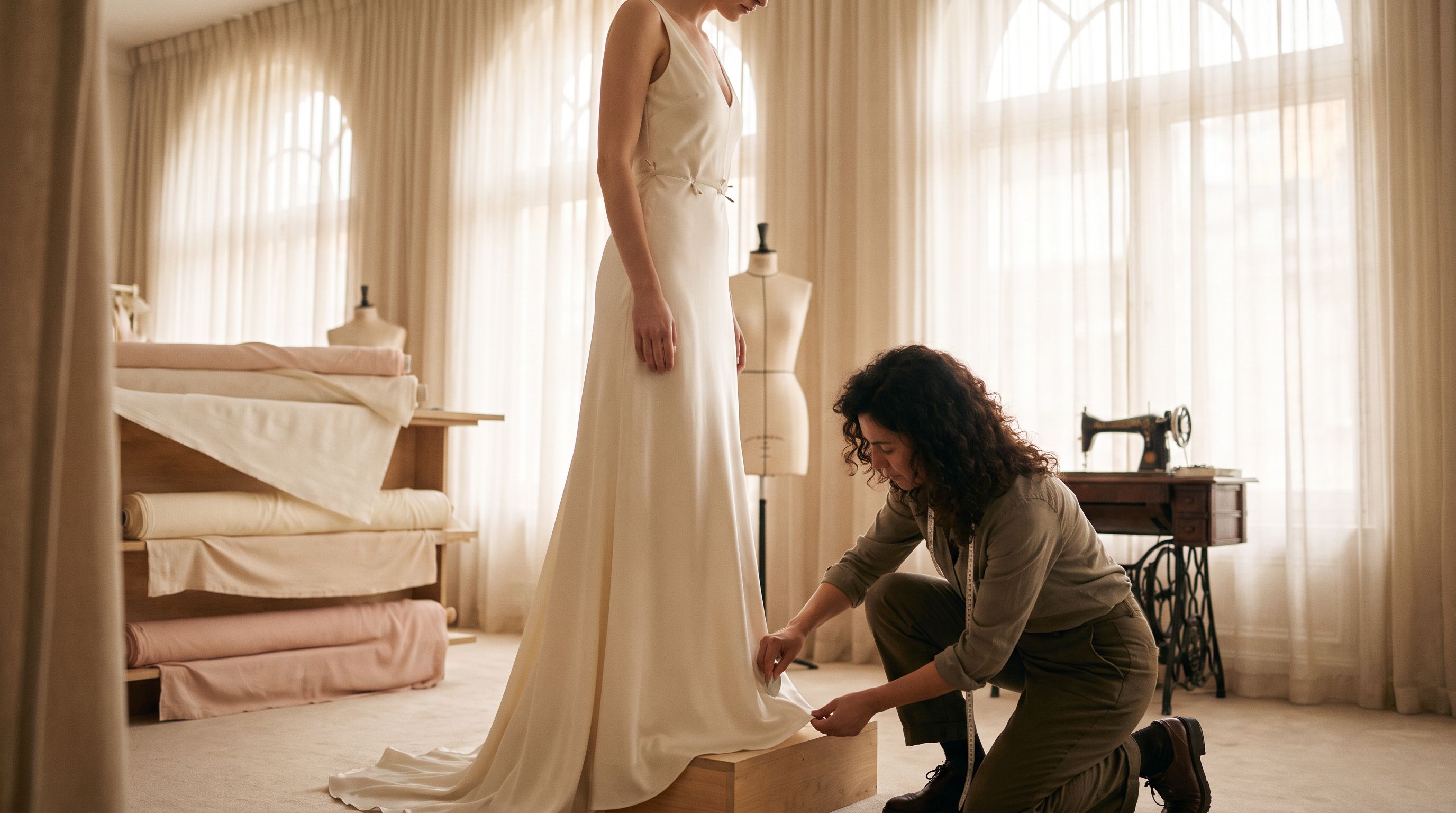
If you’ve spent an evening reading bridal forums, you’ve seen the same confusion over and over: one shop calls a gown “custom” because you picked the neckline from a menu; another calls it “custom” because they drafted a pattern from your measurements and built a test garment first. Those are very different products at very different prices, and nobody explains the difference until you’re standing in a fitting room trying to decide.
So let’s fix that. Here is what each tier actually means, what it typically costs, and how to tell which one your body, timeline, and budget really need.
The four tiers, in plain language
Off-the-rack means the gown exists right now, in a fixed size, and you take it home the day you buy it (or ship it). Sample sales, outlet racks, and “off the rack wedding dresses near me” searches all live here. You get speed and a discount; you get whatever size the sample happens to be.
Made-to-order (often marketed as semi-custom) is what most bridal salons sell. You try a sample, they order the same design in the closest standard size to your measurements, and you may be allowed a limited menu of changes: add sleeves, change the neckline, extend the train, line a sheer bodice, swap ivory for champagne. The pattern is not redrafted for you. Alterations are still expected.
Made-to-measure means an existing design (or one built from your inspiration images) is cut to your measurements — bust, waist, hip, plus the ones that actually determine fit: shoulder-to-bust, waist-to-hip, back width, arm circumference, hollow-to-hem in your wedding shoes. A good maker builds a muslin (toile) first, fits it on you, and adjusts the pattern before touching your real fabric.
Bespoke is made-to-measure plus original design. Sketches, fabric sourcing, sometimes custom-dyed lace or hand-beading, and a pattern that exists only for your gown. At the top of this tier sit small ateliers who build several looks around a single client over many months, with a team assigned to one commission. Beautiful, and a genuinely different budget conversation.
What each tier typically costs
The brackets below are in USD and reflect the US market, before tax, and they vary enormously by city, fabric, and the maker’s experience — treat them as starting points to adapt, not benchmarks. A silk mikado gown in New York and a crepe gown from an independent dressmaker in a smaller market can differ by thousands for the same silhouette. Outside the US, convert loosely and expect local labour costs to shift the picture.
The cost drivers are consistent across every tier: fabric (polyester crepe vs. silk charmeuse vs. imported beaded lace can triple a materials bill), hand-work (beading, appliqué placement, covered buttons, horsehair hems), structure (a boned, internally corseted bodice is many more hours than a soft-lined one), the maker’s experience and overhead, and how many fittings the process includes. Sleeves, linings for sheer panels, and long trains all add both fabric and labor — which is why modest gowns with real coverage sit a bit higher than their strapless equivalents.
Are off-the-rack gowns actually cheaper?
Often yes — but less often than the sticker suggests, and it depends almost entirely on how far your body sits from the sample’s proportions.
For standard alterations (hem, take in the side seams, bustle, cups), in most US markets expect roughly a few hundred dollars, though rates differ widely by city. Restructuring — moving a bust seam, rebuilding a bodice, shortening a lace bodice from the shoulder, resizing more than a couple of sizes — can, again in most US markets, reach four figures and still leave the proportions slightly off, because a pattern graded for someone else can only be pushed so far. Ask for a written alterations estimate before you assume the cheaper gown is cheaper.
We ran this arithmetic in detail in the real math on custom vs. off-the-rack cost — the short version is that the two paths converge more often than shops admit, especially once heavy alterations enter the picture.
Is $2,000 a lot to spend on a wedding dress?
Honestly: it’s a completely normal number, and it is neither extravagant nor a bargain. In many US markets $2,000 will buy a lovely made-to-order salon gown before alterations, a beautiful sample-sale designer piece, or a made-to-measure gown from an independent dressmaker in a clean fabric like crepe or silk-blend satin with modest embellishment.
A realistic budget is one you build from the whole picture, not the tag:
- The gown itself
- Alterations or fittings (ask whether they’re included — with made-to-measure they usually are; with salon purchases they usually aren’t)
- Foundation garments, cups, shapewear
- Veil, accessories, cover-up for a ceremony with coverage requirements
- Steaming, travel garment bag, preservation if you want it
Build that list before you fall in love with anything. A $1,500 gown with $900 of alterations and a $400 veil is a $2,800 decision.
The most expensive gown is the one that never quite fit — the one you spent the reception adjusting instead of forgetting about.
Which tier fits your situation
Choose semi-custom if: you loved a sample as it is, you need only one or two changes (sleeves, a neckline, a lining), your proportions sit near the designer’s block, and you have roughly six to nine months.
Choose made-to-measure if: you’re between sizes or your bust/waist/hip differences fall outside standard grading; you’re petite or tall and hemming alone won’t fix the proportions; you need real sleeves and coverage; you’re plus-size and tired of clipping samples closed at the back (more on that in our guide for plus-size and curvy bodies); or you’re combining elements from several inspiration photos.
Choose bespoke if: the design in your head doesn’t exist anywhere, you’re incorporating heirloom lace or a family veil, or fabric sourcing and original design matter more to you than budget efficiency. This is also the natural home for multi-outfit celebrations and reception changes, and for lehenga-inspired, hanbok, cheongsam, ao dai or other non-Western silhouettes — many dressmakers work in these traditions, so ask directly about their experience with the construction, drape, and fabrics involved rather than assuming.
What the made-to-measure process actually looks like
-
Consultation and design
You bring images, fabric preferences, venue and season details, and any coverage, cultural, or movement requirements. A good maker asks about your shoes, your undergarments, your ceremony, whether you’re changing outfits, and how you want to feel — then sketches and quotes in writing. -
Measurements and pattern
Twenty-plus measurements, taken over the foundation garments you’ll actually wear. The pattern is drafted or heavily adapted for you. -
Muslin / toile fitting
A test garment in cheap fabric. This is where necklines get raised, straps get moved, and the waist finds your natural waist. Changes here are free; changes in silk are not. -
Construction and 2–4 fittings
Bodice fit, skirt length in your shoes, sleeve mobility, bustle placement. Expect to be pinned into things repeatedly. That’s a good sign. -
Final fitting and handover
Ideally two to four weeks before the wedding, with a bustle lesson for whoever will be tying it.
Most made-to-measure gowns want six to nine months; simple designs can be done in less, heavily beaded ones want more. Our full timeline breakdown has the month-by-month version.
Questions that reveal which tier you’re actually being sold
Ask these before you put down a deposit, in any shop or studio:
- Is the pattern drafted for my measurements, or is this a standard size with changes?
- Do you make a muslin/toile, and is it included?
- How many fittings are included, and what happens if we need more?
- Are alterations included in this price, or billed separately?
- Which changes to this design are possible, and which aren’t?
- What’s the total, in writing, including fabric, labor, fittings, and tax?
A maker who answers those clearly and without pressure is telling you a lot about how the next six months will go. If you’d like more on separating the genuinely skilled from the merely well-photographed, our guide to vetting a dressmaker covers portfolios, contracts, and the red flags worth walking away from.
The most reliable way to decide is to gather comparable information. Book two or three consultations across different tiers — a salon selling made-to-order, an independent dressmaker offering made-to-measure, and, if it’s relevant to you, an atelier — and ask each for a written quote covering fabric, labor, fittings, alterations, and timeline. Lay them side by side. Once you can see what the same gown costs at each tier, and what’s actually included, the right choice for your body, your calendar, and your number usually becomes obvious.
Ready to bring your dream dress to life?
Tell us what you're picturing — style, timeline, and budget — and we'll connect you with custom dressmakers who can make it. Free, no obligation.
Get matched with a dressmakerRelated guides
Off the Rack Wedding Dresses: What It Means and Costs
What "off the rack" really means in bridal, how off-the-rack wedding dress costs compare to custom and made-to-measure, and how to set a realistic budget.
Read guide →
Chapel vs Cathedral Train: Length, Cost, and Bustles
Chapel vs cathedral train for a custom wedding dress: real length measurements, what extra train costs, bustle types and prices, and how to decide at your fitting.
Read guide →
Bridal Sizing vs Street Size: Why Gowns Run Small
Bridal sizing vs street size explained: why wedding dresses run 2–3 sizes small, what off-the-rack really means, alteration costs, and when made-to-measure wins.
Read guide →