 Custom
 Beaded Wedding Dress Cost: Hand-Beading vs Appliqué
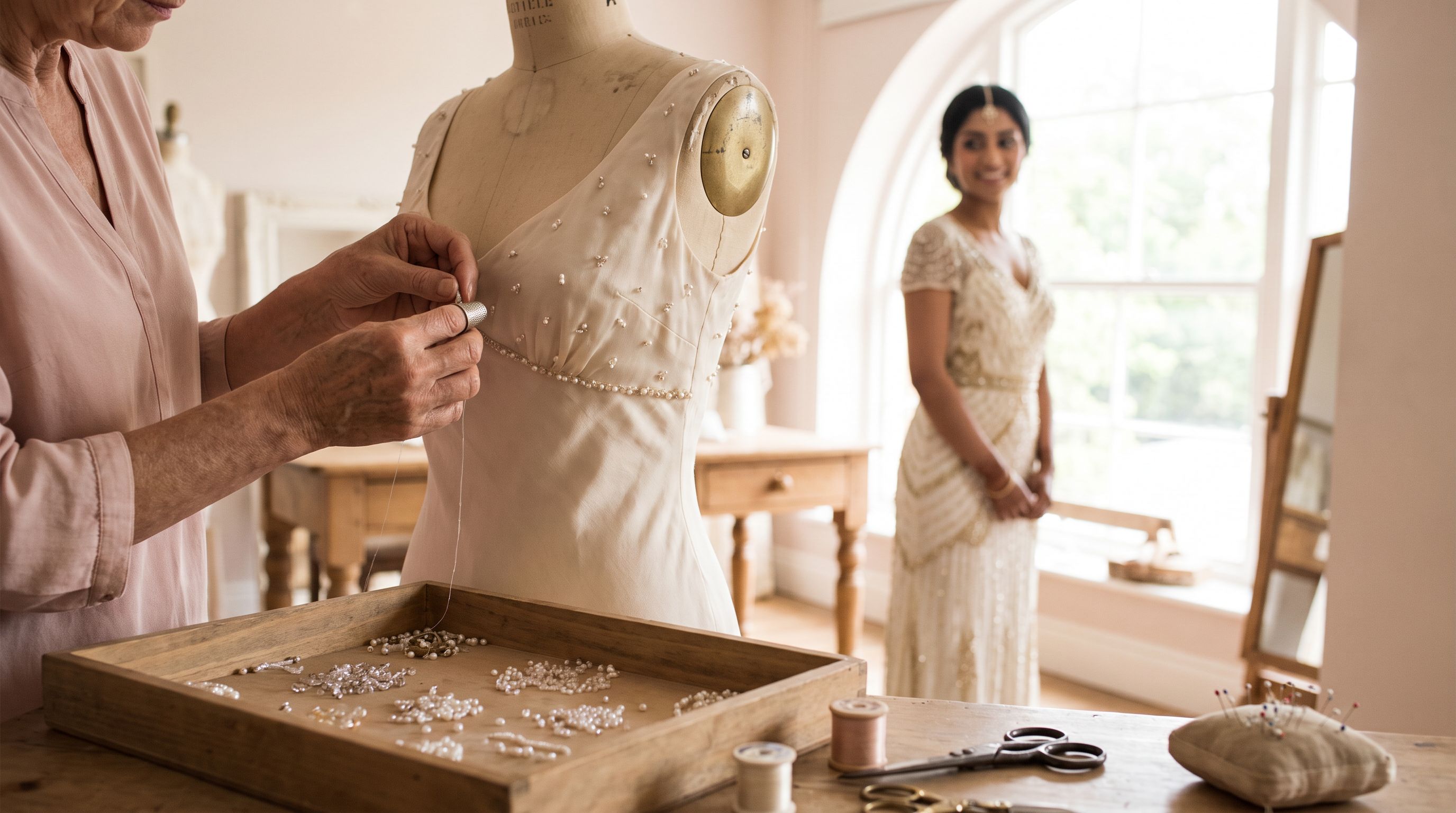
If you’ve been quoted wildly different prices for what looks like “a beaded gown,” you’re not imagining things. Two dresses can look similar in a photo and differ by several thousand dollars, because sparkle can be woven in, stitched on in pieces, or placed one bead at a time by a human hand. Those are three completely different cost structures.
Here’s how to tell them apart, what each typically costs, and how to get the look you want without paying for labor you didn’t need.
The three ways a gown gets its sparkle
Pre-beaded or embellished fabric. The beading, sequins, or glass is already applied to the yardage when it arrives — think sequin tulle, beaded net, or a fully embroidered French lace. The cost lives in the fabric price, not the labor, and it’s the most predictable of the three. The trade-off: the pattern is fixed. Your maker can place it thoughtfully, but can’t change its density or direction.
Beaded lace appliqués applied by hand. Motifs are cut apart from beaded lace yardage, then arranged and hand-stitched onto a base — often scattered thicker at the bodice and fading down the skirt. This is where most custom gowns land. It gives you placement control (a flattering shape at the waist, a graduated “ombré” of motifs down a train) at a fraction of full hand-beading labor.
Hand-beading from scratch. Beads, pearls, crystals, or bugle beads are stitched individually onto the gown — sometimes on a frame, sometimes with each bead knotted so a snag can’t unzip the whole row. This is couture-level work and it is priced by the hour.
What beading typically adds to the price
Treat these as illustrative ranges to adapt, not benchmarks. Beading cost swings enormously with your city, your maker’s experience, bead quality, and how densely you want coverage.
The math that matters: most makers price hand-beading either per hour or per panel. A studio rate somewhere in the $30–$80 per hour band is a reasonable starting assumption in many smaller markets — but treat the low end as a floor, not a target. Dedicated beading specialists, couture ateliers, and studios in major cities routinely sit well above that range, and a rate that looks surprisingly cheap is worth asking about. Either way, a lightly scattered bodice of 20 hours and a fully encrusted gown of 250 hours are not remotely the same purchase. Fully hand-beaded gowns commonly land in the four-to-five-figure range for labor alone — which is exactly why designer beaded gowns carry the price tags they do.
If you’re dressing for more than one event — a ceremony look plus a reception change, or a multi-day celebration with different cultural dress on different days — it’s common to concentrate the beading budget on whichever look will be photographed most and keep the other simpler. Gold, colored, or metallic zari-style beadwork is priced the same way: by hours and materials, not by tradition, so the same questions apply.
Hand-beading vs beaded lace appliqué: an honest comparison
Best for: wearers who want a romantic, textured look with placement control and a manageable budget. Motifs can be cut, flipped, and scattered to draw the eye where you want it, cover a bra seam, or fade out toward the hem.
Watch for: motif repeats that read “busy” up close, and the fact that appliqués can limit later alterations — you can’t cut through a motif without re-beading the edge.
Cost behavior: driven by lace yardage plus a countable number of hours. Easier to quote accurately up front.
Best for: a truly one-of-a-kind surface — a gradient of pearls down a column gown, a constellation motif, beadwork that follows your seam lines and body exactly.
Watch for: lead time. Beading happens after fit is locked, and hundreds of hours can’t be rushed without adding beaders (and cost).
Cost behavior: hourly and open-ended unless you agree on a coverage level and a cap in writing.
Scaling beadwork to your body
Placement is where a good maker earns their fee. On a petite frame, oversized motifs eat the bodice and shorten the torso — smaller-scale motifs repeated more often read as detail rather than as a single big shape. On a tall or long-torsoed frame, the reverse is true: tiny seed-bead scatter can disappear, and larger motifs or a vertical gradient keep the surface from looking empty. On a fuller bust, density is usually redistributed away from the apex and toward the neckline, shoulders, or waist, so the eye travels rather than lands. Weight matters here too: the same beadwork that sits happily on a supported, boned bodice can drag visibly on a strapless or unstructured style, so heavier coverage often needs internal support built in from the start.
Sparkle is the easiest thing to add and the hardest thing to undo. Decide the coverage level before the first bead goes on, not at the second fitting.
How to get an accurate beading quote
-
Bring photos that show the beading up close
Full-length inspiration shots hide everything. A detail shot of the bodice tells a maker whether they’re looking at sequin fabric, appliqué, or individual beadwork — and that’s the whole price difference. Our guide to working from an inspiration photo covers what to send. -
Name your coverage level in plain words
”Scattered at the bodice, fading by the hip” costs a fraction of “solid from shoulder to hem.” Makers can quote precisely once you commit to a density. -
Ask to see finished beaded work in person
Photos flatter everything. Ask to handle a completed beaded piece and turn it inside out: you want secured, knotted threads and tidy backing, not one long continuous thread that unzips a whole row when a bead catches on a chair. That inspection is the clearest way to separate durable beadwork from work that won’t survive a reception. -
Ask for a beaded sample swatch
Many makers will bead a small test square — on your actual base fabric — so you can see the density, bead finish, and how it catches light in your venue’s lighting. Expect a modest fee; it’s worth it. -
Confirm when beading happens in the timeline
Beading typically comes after the muslin/toile and after your fit is approved, so it isn’t disturbed by later adjustments. Ask how many weeks it adds — this is often the difference between a six-month and a nine-month build. -
Get the beading priced as a separate line
A quote that breaks out fabric, construction, and embellishment lets you dial the sparkle up or down without renegotiating the whole gown.
Where to spend, and where to quietly save
Beading reads most where people look most: the neckline, the bodice, the back (especially if you’re being photographed from behind during the ceremony), and the edge of a train. A gown with a richly worked bodice and a clean, fluid skirt often photographs more expensively than an evenly sprinkled gown — and costs far less.
Other honest savers: choose a beaded lace for the bodice only and a plain matching net for the skirt; ask for larger pearls or bugle beads, which cover ground faster than tiny seed beads; keep beading off areas that will be re-fitted later. If your budget is fixed, consider putting it into cut and fabric instead — a beautifully cut silk or mikado gown can carry a room with zero sparkle.
Is a beaded custom gown worth it?
If what you love about a designer gown is its surface, custom is often the better value — you’re paying a maker directly for hours rather than paying a brand markup on the same hours. If what you love is the silhouette, you may be better served by a clean custom cut and a modest appliqué accent. Lace choice matters here too; the base you bead onto changes the whole effect, which we break down in our Chantilly, Alençon and guipure comparison. And if you’re still mapping out the overall number, what $2k, $5k and $10k actually buys will show you where embellishment fits.
A maker who’s comfortable talking about beading hours, showing you finished work you can inspect, and writing the embellishment as its own line item is showing you exactly the transparency you want. To make a first conversation productive, arrive with four things: one close-up detail photo of the beading you’re drawn to, your coverage level described in plain words, the maximum you’re willing to spend on embellishment specifically, and your wedding date — so hours, materials, and timeline can all be priced against something real.
Ready to bring your dream dress to life?
Tell us what you're picturing — style, timeline, and budget — and we'll connect you with custom dressmakers who can make it. Free, no obligation.
Get matched with a dressmakerRelated guides
Wedding Dress Budget: The Hidden Costs Beyond the Gown
A realistic wedding dress budget includes more than the gown. Here's what alterations, undergarments, veils, rush fees and cleaning really cost — custom or off-the-rack.
Read guide →
Silk vs Polyester Wedding Dress: Is Silk Worth the Cost?
Silk vs polyester wedding dress fabric, honestly compared: real price ranges per yard, how much fabric a gown needs, drape, sweat marks, and when to splurge.
Read guide →
Custom Wedding Dress Deposits and Payment Plans, Explained
How much deposit a custom wedding dress maker should ask for, what a fair payment plan looks like, what your contract must say, and the red flags to avoid.
Read guide →