 Custom
 Restyling Your Mom's Wedding Dress: Cost, Limits, Steps
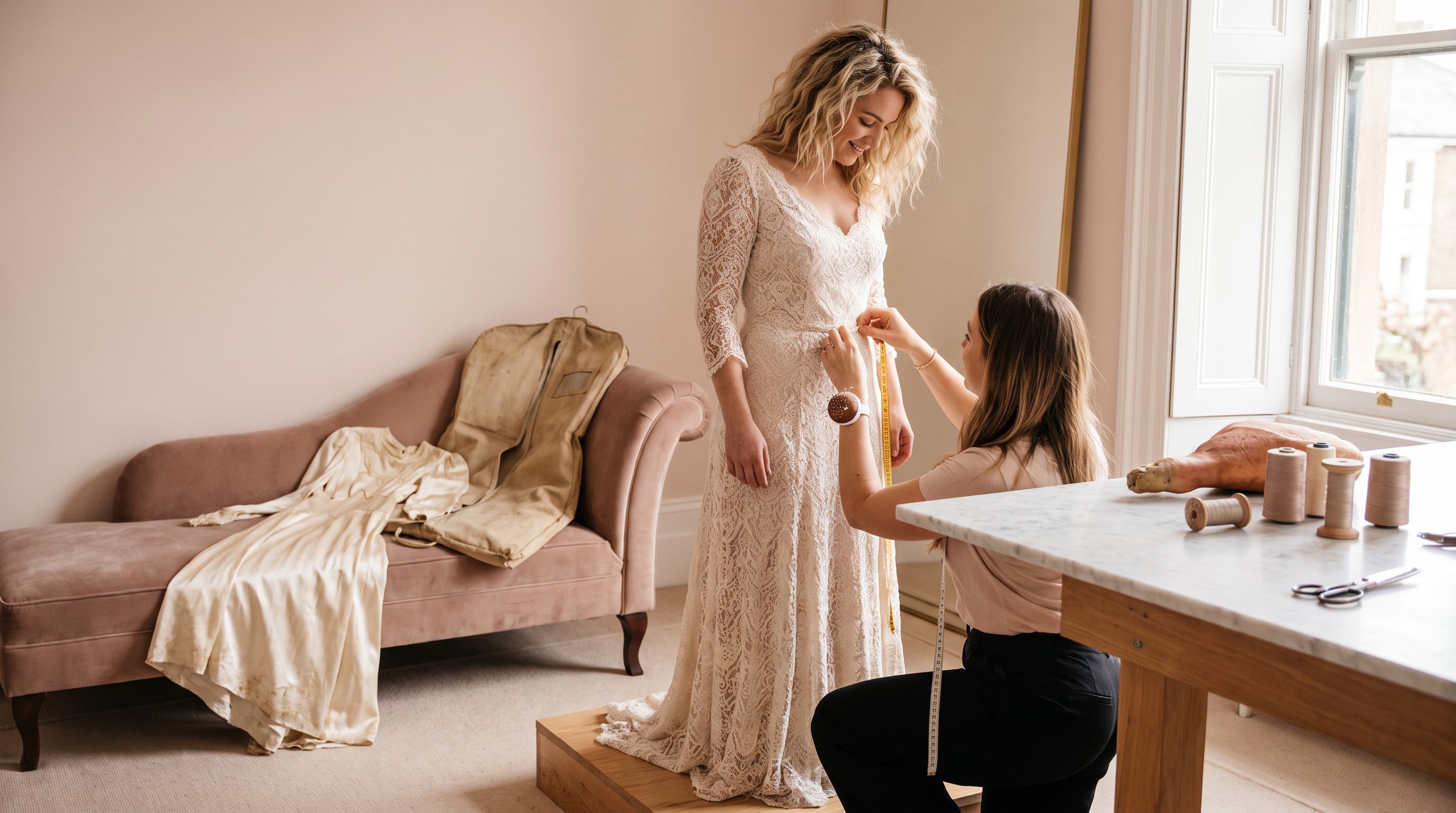
Why so many brides are opening the garment bag first
There is a particular moment that happens in a lot of engagements: someone drags a box down from a closet shelf, unzips a yellowed garment bag, and a dress from 1988 or 1974 or 1996 comes out into the light. Sometimes it fits like it was waiting for you. More often it doesn’t — and that’s where the real question starts.
The heirloom isn’t always a mother’s gown, either. It might belong to a grandmother, an aunt, a mother-in-law offering something with real tenderness, or a chosen-family figure who has been more of a parent than anyone. And it isn’t always a white Western dress. A silk sari, a lehenga, a hanbok, a cheongsam, or an embroidered family shawl goes through exactly the same assessment: what condition are the fibres in, how much seam allowance is hidden inside, how much yardage is genuinely salvageable, and can the metallic zari, hand embroidery, or beadwork be lifted and reclaimed even if the base cloth can’t be saved.
And if there’s no heirloom in your family at all — because things were lost, or left behind in a move, or simply never kept — you haven’t missed anything. Plenty of brides are commissioning the first gown their family will ever pass down, and a maker can build that intention in from the start.
Whatever you’re holding, you don’t have to choose between honoring it and loving what you wear. But you do need an honest technical assessment before you fall in love with a plan.
What actually makes a vintage gown reworkable
A good heirloom maker looks at four things before they’ll quote you anything.
Fibre and condition. Silk from the mid-century and earlier was often weighted with metallic salts, which causes shattering — the fabric splits along fold lines like old paper and cannot be repaired. Hold the skirt up to a window: if you see fine cracks, pinholes at the creases, or the fabric tears with almost no pressure, the base fabric is finished. Polyester and nylon from the 70s through the 90s, ironically, tend to survive far better — less luxurious, but usually structurally sound.
Yellowing and staining. Overall ivory-ing is often even and can look intentional. Localized amber stains (underarms, hem, champagne spills) sometimes lift with professional wet cleaning and sometimes don’t. Ask a bridal restoration specialist — not a standard dry cleaner — for an honest read.
Yardage. This is the one people forget. A dress can only become something else if there’s enough fabric. A full 1980s ballgown skirt is a gift: yards and yards of usable material. A slim 1990s column with a 1cm seam allowance gives a maker almost nothing to work with.
Lace, embroidery and trim. Often the surface work is the true heirloom. Lace can be removed, cleaned, and re-appliquéd onto brand-new fabric; hand embroidery and metallic thread panels can be cut out and re-set. This is where the most gorgeous results tend to come from.
What can change, and what can’t
As a rough rule: a maker can nearly always remove (sleeves, a train, shoulder pads, a high neckline, lace overlays), can often restructure (rebuild the internal corsetry, re-cut a bodice, change a neckline, convert a ballgown skirt to an A-line), and can add with more effort and ingenuity than people expect.
If you’re larger than the original wearer, this is not a dead end — it’s a design problem with well-worn solutions. Converting the back to a corset or lace-up closure with a modesty panel behind it typically buys a couple of inches and reads as intentional, not improvised. Side panels or godets can be inserted at the seams, either tone-matched as closely as possible or made deliberately contrasting so the addition looks like a design choice. And when the bodice simply won’t stretch far enough, a maker can build a new bodice to your measurements and use the original purely as lace, overlay, or sleeves — you keep the part everyone actually recognises in photographs.
What genuinely can’t be solved: fabric that has already shattered, and length added to a hem that’s already at the right drop with no facing to let down. If you’re weighing what alterations can and can’t achieve on any gown, our guide to where alterations stop and custom work begins walks through those limits in detail.
What restyling actually costs — and why the number surprises people
Here is the part that catches most brides off guard: restyling an heirloom is often not the budget option. You are paying for reverse-engineering. A maker has to unpick a finished garment, work around wear and seam lines that are already set, and solve problems that only reveal themselves halfway through.
The drivers are the same ones that move any custom quote: hours of hand-work, whether beading has to be removed and reapplied one motif at a time, whether new fabric must be sourced and dyed to match, how many fittings the fit will realistically need, and the experience level of the maker and their local market — heirloom specialists in a city like New York or London price differently from those in smaller towns. For context on how those drivers stack up on a fresh commission, see what different budget tiers actually buy in custom bridal work.
An heirloom isn’t raw fabric — it’s a finished garment with a history, and every seam you open is a decision you can’t take back.
The process, step by step
-
Assess before you dream
Bring the dress — unaltered, uncleaned — to a maker who does heirloom work, or a bridal restoration specialist. Ask them to check for shattering, seam allowance, and yardage before you discuss design at all. -
Clean it
Restoration usually comes first, because cleaning can change the color, reveal hidden damage, and occasionally weaken fragile areas. You want to know that before design decisions are locked. -
Design within the constraints
Bring inspiration images, but hold them loosely. A good maker will tell you which elements the fabric can support. The same principles apply as when you work from an inspiration photo — the goal is the feeling, not a literal copy. -
Toile it
A muslin mock-up of the new design, made in cheap fabric to your measurements, is non-negotiable on heirloom projects. It’s how you test a neckline or a new bodice shape without risking a single stitch of the original. -
Deconstruct and rebuild
The dress is unpicked, pieces are pressed and mapped, and the new gown is cut from what exists. Expect surprises here — many makers suggest holding back a contingency of roughly 15–20% of the quote for exactly this stage. -
Fittings
Plan on somewhere around three to five, spaced a few weeks apart, with the final one close enough to the wedding to reflect your actual body but far enough out for a fix. Wear your real undergarments and shoes every time.
When you should only use part of it
If the assessment comes back rough, this is the route most heirloom specialists will steer you toward — and not as a consolation prize. Heirloom fabric used selectively often reads as more elegant than a whole reworked dress. Real possibilities:
- Lace, embroidery, or a zari border appliquéd onto a new gown or a cathedral veil
- Original sleeves rebuilt onto a modern base — lovely if you’re after more coverage or modest styling
- A cropped jacket or capelet for the ceremony, removed for the reception
- A hidden lining panel, a covered button, or fabric stitched inside the hem
- A rehearsal-dinner dress or a bridal jumpsuit made from the skirt yardage
This also frees the original garment to stay intact for the next person in the family who wants it.
What to ask before you hand over the dress
Ask to see photos of previous heirloom reconstructions, specifically before-and-afters. Ask directly: what could go wrong once you open this, and what happens to my cost and timeline if it does? Ask how they price — flat quote after assessment, or hourly with an estimate. Ask what happens to the leftover fabric (you should get it back). And ask for the plan in writing, including the toile stage.
A maker who says I’d rather not cut this — here’s what I’d do instead is showing you good judgment, not turning down work. That instinct is one of the strongest signals of a trustworthy dressmaker, and it’s worth reading more on how to vet a maker properly before you commit.
You can do three useful things this week, before you speak to anyone. Lay the garment flat near a window and photograph it in daylight — front, back, inside the bodice, and any damage, close up. Hold the skirt up against the light and look for fine cracks or pinholes along the fold lines; that tells you whether shattering is in play. Then turn the dress inside out, find the side seam, and measure how much fabric sits beyond the stitching — a centimetre means very little room, three or more means real options. Bring those photos, that observation, and that measurement to your first assessment, and the conversation starts several steps ahead.
Ready to bring your dream dress to life?
Tell us what you're picturing — style, timeline, and budget — and we'll connect you with custom dressmakers who can make it. Free, no obligation.
Get matched with a dressmakerRelated guides
Off the Rack Wedding Dresses: What It Means and Costs
What "off the rack" really means in bridal, how off-the-rack wedding dress costs compare to custom and made-to-measure, and how to set a realistic budget.
Read guide →
Chapel vs Cathedral Train: Length, Cost, and Bustles
Chapel vs cathedral train for a custom wedding dress: real length measurements, what extra train costs, bustle types and prices, and how to decide at your fitting.
Read guide →
Bridal Sizing vs Street Size: Why Gowns Run Small
Bridal sizing vs street size explained: why wedding dresses run 2–3 sizes small, what off-the-rack really means, alteration costs, and when made-to-measure wins.
Read guide →