 Custom
 Tulle vs Organza vs Chiffon: Custom Skirt Fabric Guide
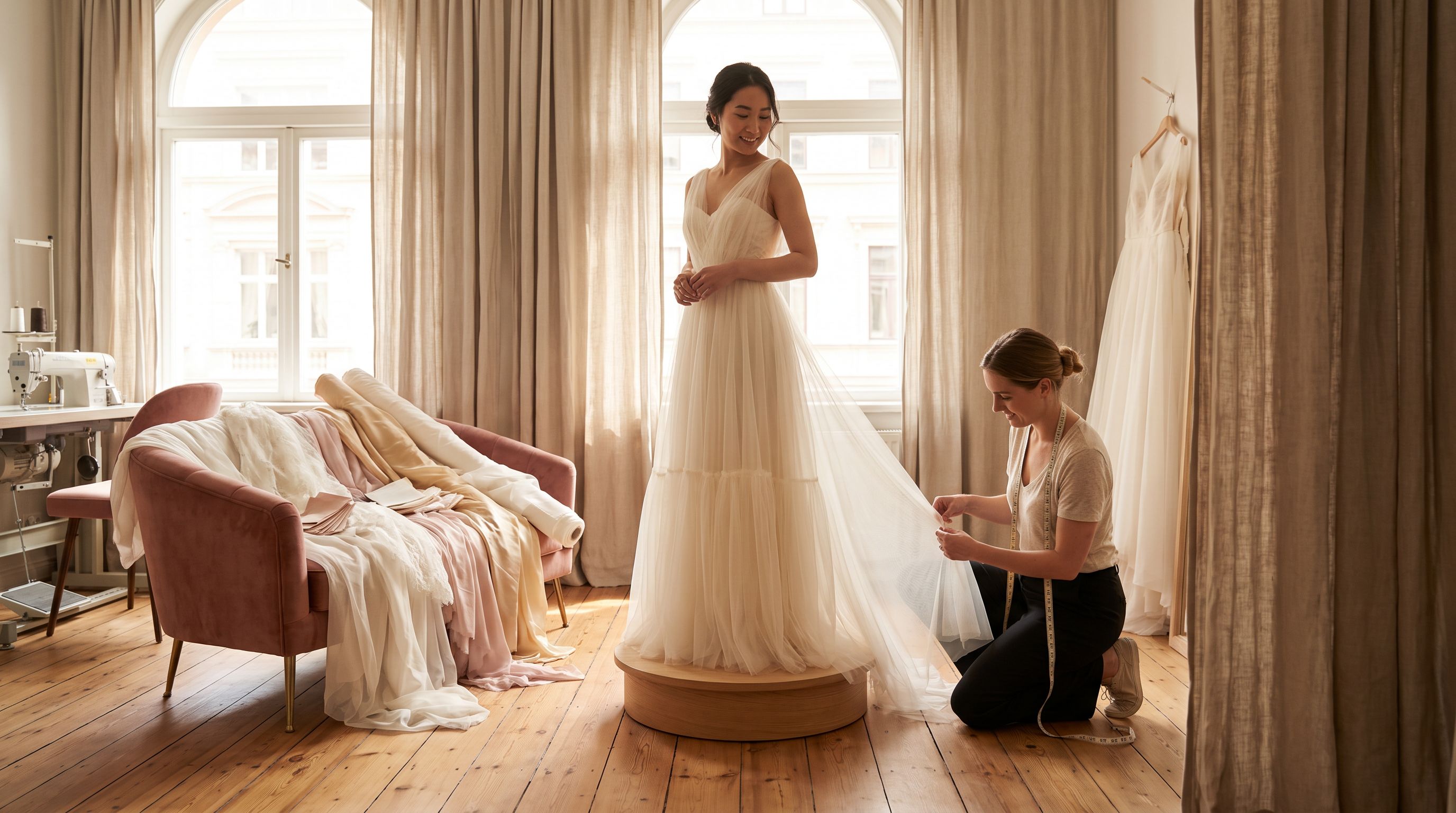
Three fabrics that all read “floaty” — and behave nothing alike
If you’ve saved twenty inspiration photos of soft, drifting skirts, they’re probably not all the same cloth. Knowing which one you’re actually looking at is one of the most useful things you can bring to a first consultation, because it changes the silhouette, the price, the number of fittings, and how the gown will feel after eight hours of wearing it.
Tulle is a net — an open mesh, not a woven cloth. It has almost no weight on its own, so it creates volume by layering. Bridal illusion tulle (usually nylon or polyester) is stiff and airy and gives you the classic cloud. Silk tulle is dramatically softer, drapes closer to the body, and photographs with a smoky haze rather than a puff.
Organza is a plain-woven sheer with a crisp hand. It stands away from the body, holds a pleat or a gather with architecture, and catches light at the edges. Silk organza has a papery, luminous quality; polyester organza tends to be shinier and a little stiffer.
Chiffon is also sheer, but it’s woven with a high-twist yarn that makes it soft, slightly textured, and fluid. It doesn’t build volume — it pours. Chiffon is what you want when you picture fabric moving in a breeze rather than standing out from your hips.
Organza vs chiffon: the two sheers
These two are confused most often, so it’s worth putting them side by side. Tulle sits outside this comparison on purpose — it isn’t a woven cloth at all, and it earns its own paragraph below.
Tulle is really a volume tool. Three layers of soft tulle over a lining gives a whisper of fullness; twelve layers of stiff tulle over a structured underskirt gives the ballgown you’re picturing. Layered tulle over a properly built underskirt is also one of the most reliable ways to create balance and deliberate fullness at the hip — the structure does the work, so the volume sits where you and your maker decide it should, rather than collapsing onto the body. How many layers there are, and whether they’re gathered by hand, is a real cost and fitting consideration, not a detail.
All three need thoughtful lining, and lining changes colour: white tulle over an ivory lining reads differently from white over white. Saturated colours behave differently too — organza intensifies and shines a colour, while layered tulle mutes and hazes it. That matters well beyond a Western white gown: chiffon and organza do enormous work in dupattas and lehenga layers, and tulle is a frequent choice for tea-ceremony and reception changes. If you’re still deciding on shade, our guide to ivory, champagne and blush for custom gowns is worth reading alongside this one.
What a skirt in each fabric typically costs
Fabric price is only half the story. The other half is yardage and hand-finishing. A tiered chiffon skirt with hand-rolled hems can cost more in labour than the cloth itself; a simple two-layer organza A-line is often the opposite.
Use those to estimate your own situation, not as a benchmark. The real cost drivers in a custom skirt are:
- Fibre. Silk versions of all three cost multiples of their synthetic equivalents, and they behave better — softer drape, less shine, more breathability. Whether that difference is visible in photos depends on the silhouette.
- Yardage and fullness. A circle skirt or a heavily gathered ballgown can triple your fabric bill before anyone picks up a needle.
- Hem finishing. Horsehair braid, hand-rolled hems, bound hems and deep faced hems all take time. A tiered chiffon skirt can easily contain many yards of rolled hem.
- Layers and linings. Every layer needs cutting, seaming and levelling at a fitting.
- The maker’s experience and your local market. Two skilled dressmakers in different cities can quote very differently for the same design.
For how these choices roll into a total, see our breakdown of what drives the cost of a custom wedding dress. If you’re weighing these against heavier cloths, the crepe, satin and mikado comparison covers the structured end.
A skirt’s personality comes from how it moves when you walk away, not how it looks standing still. Ask to see the fabric in motion before you fall in love with a swatch.
Choosing for your season, venue and how much you plan to dance
Outdoor summer, garden, beach. Chiffon and soft silk tulle are your friends — light, breathable, forgiving in humidity. Crisp organza behaves beautifully in still air but acts like a sail in a coastal breeze. If you’re travelling to your wedding, packing and creasing matter too; our destination and elopement gown guide goes deeper on travel-friendly construction.
Winter, ballroom, cathedral. Layered tulle and organza give the volume and presence a large room asks for. Organza holds structure without adding much weight, which is a gift if you’re worried about carrying a heavy gown all evening.
Dancing. Fewer, better layers beat many cheap ones. Ask about the weight of the finished skirt and how the layers are attached at the waist — a well-engineered waistband distributes weight so you’re not hauling fabric with your hips all night.
Lace lovers. All three work as a base for appliqué, though the ground changes how lace reads. Scattered motifs on tulle float; the same motifs on organza sit flat and graphic. If lace is central, read our Chantilly, Alençon and guipure comparison before choosing a ground fabric.
What to do at your consultation
-
Bring your photos and say the word
Show your inspiration images and name what you want: volume, shape or movement. A good maker will immediately reach for the right bolts. -
Ask to see the fabric draped on you, not held up
Gather a length at your waist and walk. Swatches lie; a yard (about a metre) of fabric in motion tells the truth. -
Ask about layers, lining and weight
”How many layers, how are they finished, and roughly how heavy will the finished skirt be?” are three questions that separate experienced makers from optimistic ones. -
Ask what happens at the toile stage
Sheer skirts are usually mocked up in a cheaper stand-in fabric first so hem length, fullness and train shape can be judged before the real cloth is cut. -
Get the fabric allowance in writing
Your quote should state which fabric, which fibre, and roughly how much of it in yards or metres. If you later upgrade from polyester to silk organza, you’ll know exactly what changes.
The short answer, if you want one
If you want volume you can feel from across the room, start with tulle. If you want clean modern architecture with a luminous edge, start with organza. If you want something that moves with you and reads soft and easy, start with chiffon. Then let a maker show you how to combine them — that conversation, with fabric in hand and a mirror in front of you, is where most wearers finally understand what they actually want. Consultation policies vary: some makers offer a free first meeting, others charge a design fee that’s credited toward the gown. Ask when you book.
Ready to bring your dream dress to life?
Tell us what you're picturing — style, timeline, and budget — and we'll connect you with custom dressmakers who can make it. Free, no obligation.
Get matched with a dressmakerRelated guides
Custom Wedding Dress for Apple-Shaped Brides: Fit Guide
How a custom wedding dress solves fit for apple-shaped brides: the best silhouettes, internal support, fabrics, fittings, and realistic costs.
Read guide →
Custom Wedding Dress for a Small Bust: A Real Fit Guide
A custom wedding dress for a small bust: how bodices get cup-sized, strapless support without heavy padding, flattering necklines, and realistic cost ranges.
Read guide →
Custom Winter Wedding Dress: Fabric, Sleeves, Warmth
How to design a custom winter wedding dress that's genuinely warm: the best fabrics, sleeve and lining choices, capes, realistic costs, and timeline tips.
Read guide →