 Custom
 Custom Destination Wedding Dress: Fabric, Cost, Travel
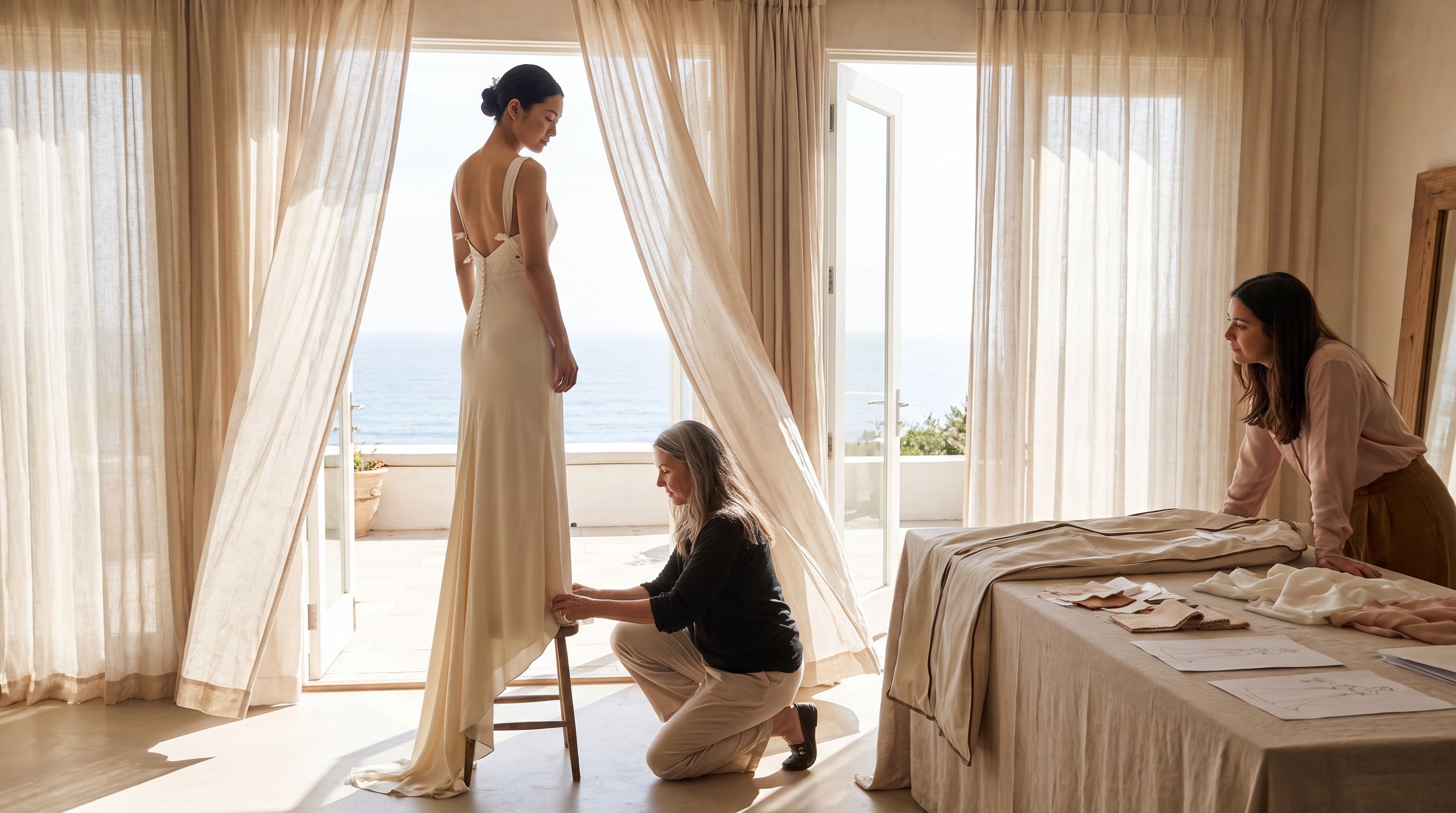
Why destination weddings so often end up custom
Walk into most bridal shops and you’ll find gowns built for a climate-controlled ballroom: heavy tulle, layered linings, boned bodices, cathedral trains. Gorgeous — and genuinely difficult in real conditions. A July afternoon in coastal Mexico can sit near 88°F with high humidity; an exposed clifftop ceremony can meet wind strong enough to wrap a chiffon skirt around your legs; a 14th-century church may have stone floors, deep shade, and no air conditioning at all.
A made-to-measure gown lets you start from your actual conditions instead of a sample size hanging in a showroom. Your maker can under-line a bodice in breathable silk instead of polyester, cut the skirt so it moves in the wind rather than fighting it, and finish the hem so it doesn’t drag a pound of sand behind you. On a hot day, that’s the difference between enjoying your ceremony and counting the minutes until you can change.
It’s also the route that handles anything a rack doesn’t stock. Plenty of the people we hear from aren’t brides at all — non-binary clients wanting a gown without bridal-shop assumptions, grooms and partners commissioning something to wear alongside a spouse — and plenty want a red or gold gown, a lehenga-influenced two-piece, a modest high neckline with long sleeves, or a silhouette their family will recognize. Custom is simply the path that starts with what you are wearing rather than what a showroom happens to carry.
What a custom destination gown typically costs
Destination and elopement gowns often sit at the friendlier end of custom pricing, simply because the designs that work best in heat — a bias-cut slip, a soft crepe column, an unlined georgette gown with a light overlay — use less structure and fewer labor hours than a corseted ballgown with hand-beading.
The drivers are the same ones that move any custom quote: fabric quality and yardage, how much internal construction the design needs, hand-finishing versus machine, the maker’s experience and location, and whether you’re asking for rush work.
If that lower figure is above where you can comfortably go, you still have real options. Many makers offer made-to-order rather than made-to-measure: one of their existing designs, cut in your nearest size and adjusted at a fitting or two, which removes a large chunk of drafting labor. A maker earlier in their career — recently graduated from a tailoring or couture program, building a portfolio — will often quote considerably less for the same care. Choosing linen, cotton voile, or a good viscose crepe over silk can move a quote significantly on fabric alone. And there’s no shame in the fourth route: buying an existing dress you love and paying a skilled alterations specialist to make it travel-ready — removing heavy lining, replacing a stiff underskirt, shortening the hem, adding a breathable underlayer.
One budget note specific to destination weddings: factor in the travel of the dress itself. A hard garment case, a hotel steaming service, and possibly an extra bag fee are small costs that surprise people at the end.
Fabrics that survive heat, humidity, and a suitcase
Fabrics that tend to travel and breathe well: silk crepe and crepe-back satin (fluid, matte, forgiving of wrinkles), silk georgette and chiffon (airy, moves beautifully in wind), lightweight linen blends for coastal and garden settings, and fine Chantilly lace over a soft lining.
Fabrics to think twice about: heavy mikado and duchesse satin hold structure gloriously but retain heat and hold creases; multiple layers of stiff tulle turn into an oven; and pure silk satin can water-spot if it meets rain, sea spray, or perspiration. None of these are forbidden — structured gowns are worn in warm climates all the time — but they should be a deliberate choice, not an accident.
Building in flexibility for a body that travels
Heat, salt air, long flights, and a week of celebrating all affect how a fitted gown feels. Experienced makers plan for it — and they plan around your body specifically, not a fit model’s.
A laced or partially laced back is one of the quietest luxuries in destination gown design. It gives you range without a last-minute alteration you can’t get in a foreign city.
The timeline, with a travel buffer built in
-
6–9 months out: consultation and design
Bring your venue conditions, inspiration images, and a realistic budget. Discuss fabric, lining, closure, and hem length for your ground surface. -
4–6 months out: toile (muslin) fitting
You’ll try on a plain calico version to test proportion, neckline height, and how the shape sits when you sit, hug, and raise your arms. Say everything you’re unsure about now — this is the cheapest stage to change your mind. -
2–4 months out: first and second fabric fittings
The real gown, pinned and adjusted. Wear or bring the exact undergarments and shoe height you’ll use. Ask to walk on a hard floor and, if possible, test the hem over a rug to approximate grass or sand. -
4–6 weeks out: final fitting
Aim to be finished here, not the week you travel. Build in one contingency slot in case something needs a small correction. -
2–3 weeks out: collection and packing rehearsal
The gown should be in your hands by now. Practice folding it into the case you’ll actually fly with, ask your maker to show you the fold lines that won’t crease permanently, and get steaming instructions in writing for hotel staff.
If your timeline is tighter than this, don’t panic — but be honest about the date in your first email. Our guide to how long a custom wedding dress really takes explains which stages can compress and which genuinely can’t.
Getting the dress there in one piece
Carry it on if you possibly can. Fold it into a soft garment bag inside a carry-on case, or bring it aboard in a garment bag and ask at the gate about the crew closet — some airlines and crews will hang it, but policies vary and space is never guaranteed, so ask early rather than at the aircraft door. Never check the only wedding dress you own.
A few things worth doing:
- Photograph the gown before packing, so you have a reference if you need a local repair.
- Pack a tiny emergency kit: needle, matching thread, safety pins, and a stain pen suitable for your fabric.
- Confirm whether your hotel or villa can steam it, or bring a compact travel steamer with the right voltage.
- If you’re ordering internationally rather than travelling with it, understand duties and delivery risk first — our overseas custom gown guide covers what to check before you pay a deposit.
A destination gown isn’t a lighter version of a ballroom dress. It’s a dress designed backwards from the weather, the ground, and the flight.
Should you plan a second look?
Many people want a ceremony gown and something shorter or looser for dinner and dancing — especially in heat. That can be two garments, or one cleverly built gown with a detachable overskirt, removable sleeves, or a train that unclips. A convertible design is usually cheaper than two dresses and easier to travel with; we compare the real numbers in our convertible gown vs second reception dress guide.
What to ask before you commit
Bring these to any maker you’re considering — the answers tell you a great deal:
- Have you made gowns for hot or humid climates? What fabric would you steer me toward, and why?
- How will this be lined, and can the bodice be made cooler without losing support?
- What support will I have through the bust and back, and can it work with (or without) a bra?
- Can you build in a closure that allows for a little change on the day?
- Will the hem length work on sand or grass, and can the train detach or bustle?
- Can my final fitting land 4–6 weeks before I travel, with the gown in my hands 2–3 weeks out?
- How should I pack, steam, and store it once it leaves your studio?
A maker who answers these fluently — with specific fabric names and construction reasoning, not just reassurance — is someone you can trust with a dress that has to cross an ocean. Consult two or three makers before committing; comparing how they answer these questions is far more useful than any single quote.
Ready to bring your dream dress to life?
Tell us what you're picturing — style, timeline, and budget — and we'll connect you with custom dressmakers who can make it. Free, no obligation.
Get matched with a dressmakerRelated guides
How to Measure Yourself for a Custom Wedding Dress
A step-by-step guide to taking wedding dress measurements at home: the exact list, tools, common mistakes, and how makers use them for a custom gown.
Read guide →
Adaptive Custom Wedding Dresses: Seated Fit and Access
How an adaptive custom wedding dress is drafted for a seated fit, easy closures, and real mobility needs — plus realistic cost ranges, fittings, and what to ask a dressmaker.
Read guide →
Corset vs Built-In Bra: Wedding Dress Support Explained
Corset, boning, or built-in bra cups? A clear guide to wedding dress support: what each does, what it costs in a custom gown, and how to choose for your bust.
Read guide →