 Custom
 Ordering a Custom Wedding Dress Overseas: What to Know
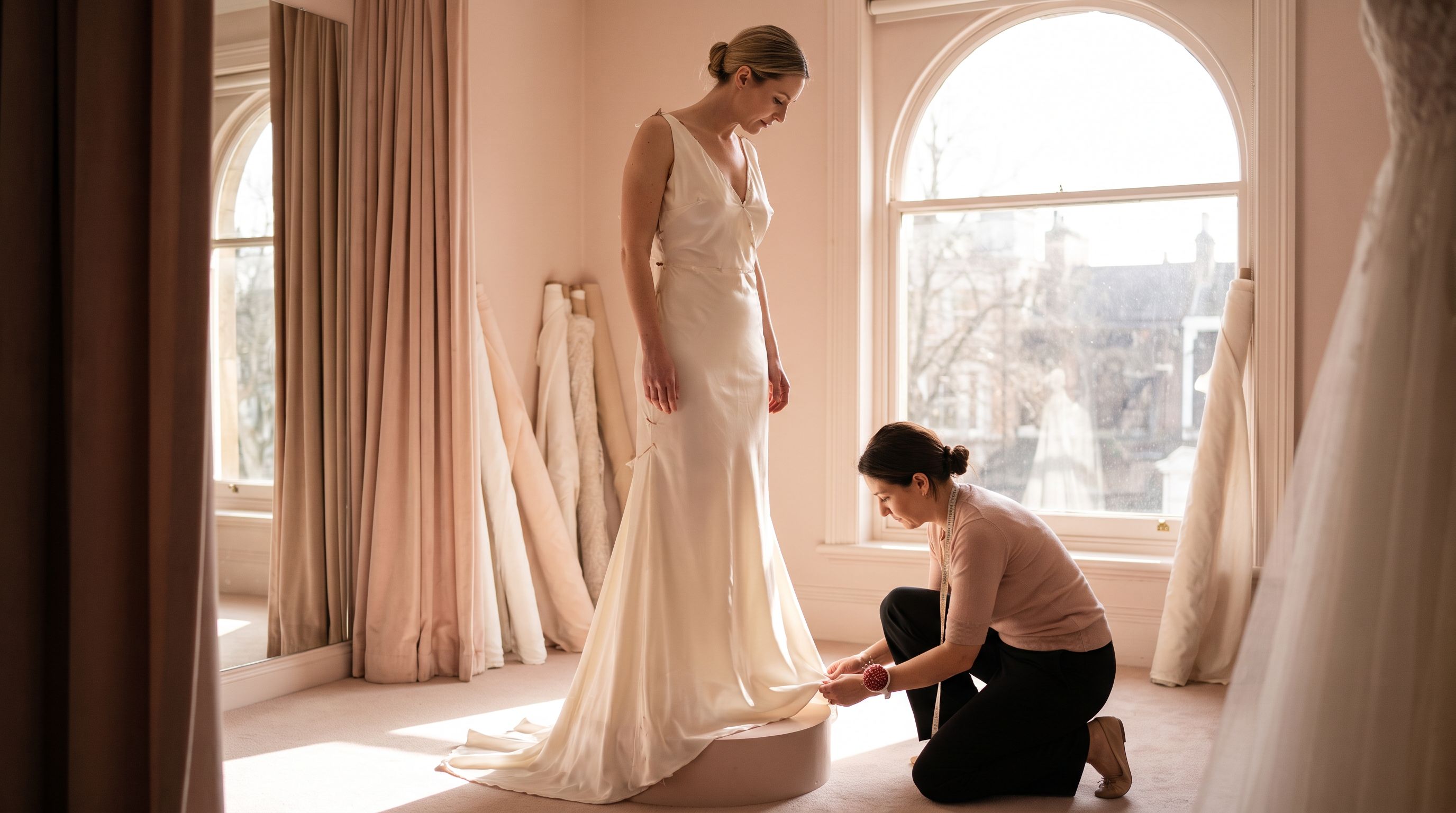
Search “custom wedding dress online” or “custom wedding dress Vietnam” and you’ll fall into a rabbit hole fast: marketplace listings promising a gown made to your measurements for less than the alterations bill on a boutique dress, plus long Reddit threads where the results range from genuinely lovely to genuinely heartbreaking.
Both outcomes are real. The difference usually isn’t luck — it’s what was ordered, how it was specified, and how much fitting budget you keep in reserve. Here’s how to tell which side of that line you’re likely to land on.
What “custom” actually means on an overseas listing
This is the single biggest source of disappointment, and it’s a vocabulary problem more than a dishonesty problem.
When a local dressmaker says custom, they usually mean: a pattern drafted or heavily adapted for your measurements, a muslin or toile (a cheap test version) fitted on your body, then two to four fittings as the real gown is built. Your posture, your shoulder slope, one hip sitting higher than the other — all of it gets corrected on you.
When most online and overseas sellers say custom, they mean made-to-measure: an existing factory pattern graded to the numbers you submit. That’s a real service and it can fit beautifully. But nobody sees your body, nobody corrects a swayback or a full bust, and any error in your measurements gets sewn permanently into the gown.
The price you see versus the price you pay
Overseas made-to-measure gowns are genuinely inexpensive, and that’s not a trick — labor costs, fabric sourcing, and overhead are simply different. But the listing price is rarely the landed cost.
Add international shipping, possible import duties or handling fees, and a rush surcharge if you’re inside three months. Thresholds change and vary a lot by country — US shoppers can check the current rules on CBP’s guide to internet purchases, and readers elsewhere should look up their own national customs authority’s de minimis page before ordering. Then add the line most people forget: pressing and steaming a gown that has been folded into a box for two weeks.
The cost drivers are the same everywhere — fabric quality, amount of hand beading, boning and internal structure, lining, train length, and how many hours of skilled labor the design demands. A silk crepe slip with clean seams is cheap to make anywhere. A boned corset bodice with hand-sewn lace appliqué is expensive to make well anywhere. If a heavily beaded gown is quoted at $250, something in that equation is being substituted — usually the fabric. Our full breakdown of what drives custom wedding dress pricing is worth reading alongside any quote you’re comparing.
Cheap gowns aren’t a scam. They’re a trade — you’re paying less because you’re absorbing the fitting risk yourself.
Where overseas orders most often go wrong
- Fabric substitution. “Satin” and “lace” describe a look, not a fiber. Polyester satin photographs beautifully and behaves very differently on a warm day than silk. Always ask for fiber content in writing.
- Measurement error. Self-measuring, or measuring in the wrong undergarments, is the most common cause of a gown that “doesn’t fit” — and it’s not the maker’s fault.
- Structure that can’t be fixed locally. A bodice built on the wrong pattern block can’t always be rescued by an alterations specialist. Some will decline the job entirely.
- Timeline compression. Production plus shipping plus customs plus alterations is a long chain, and any delay stacks. Our realistic timeline for a custom gown applies here too — with extra weeks added for transit.
- Returns. Practically speaking, a return means paying to ship a heavy garment internationally, and duty refunds on re-export are slow and paperwork-heavy where they’re available at all.
How to lower the risk if you order abroad
-
Get measured by a professional
Pay a local tailor or alterations shop for 20 minutes of measuring, in the bra and shapewear you’ll actually wear. Ask for height, torso length, and hollow-to-hem — that last one is measured from the dip at the base of your throat to the floor, in the exact shoe height you’ll wear on the day — not just bust, waist, hip. -
Order a sample or a swatch set first
A swatch pack — often a small flat fee, sometimes credited back against an order — tells you the true weight, sheen, and color of the “ivory” you’re buying. If you have time, order an inexpensive dress from the same seller to judge their construction. -
Put the spec in writing
Fiber content, lining, boning, closure type (zipper vs. corset back), train length, and exact hem length with your shoes on. Vague briefs produce vague gowns. -
Ask for in-progress photos
A seller willing to send a photo of the bodice on a form before it’s finished is a seller with something to lose. Silence at this stage is a warning. -
Pay with protection and keep receipts
Use a payment method with buyer protection and a clear dispute window. Screenshot every message and listing detail. -
Ring-fence an alterations budget and 8+ spare weeks
Assume the gown will need work. Book a local alterations appointment before it even ships.
Who overseas ordering genuinely suits
It’s a strong option for a second or reception dress, a simple slip or A-line in a stable fabric, an elopement or beach gown where structure matters less, and for anyone whose measurements sit close to standard sizing and who is comfortable managing the process. Shopping in person while traveling — the tailoring districts of Hoi An, Bangkok, Delhi, Istanbul — is a different and often better proposition, because you can be measured and have at least one fitting before you fly home. Even then: leave days, not hours, in the trip for corrections.
Think harder if your gown involves a boned or corseted bodice, dense beading, a fitted mermaid shape, added sleeves or modest coverage that must sit precisely, or if the person wearing it has a bust-to-waist difference, height, or posture that off-the-rack sizing never handles well. Those are exactly the cases where fittings do the heavy lifting — and where the local price premium buys real value. If you’re still weighing the broader options, our honest comparison of custom versus off-the-rack lays out the trade-offs.
The questions that separate good makers from risky ones
Ask these of anyone — an Etsy seller, an overseas atelier, or the dressmaker two towns over:
- What exactly is included: how many fittings, and is a toile made?
- What is the fiber content of every fabric, and can I see a swatch?
- What’s the payment schedule, and what happens if the fit is wrong?
- Who handles alterations after delivery, and at whose cost?
- Can I see photos of a finished gown on a real client with a body like mine?
A maker who answers all five clearly and without irritation is showing you their process, and that’s the best predictor of a good outcome. Our checklist for vetting a custom wedding dress maker near you goes deeper on red flags and contract language.
There’s no wrong answer here, only informed and uninformed ones. Plenty of people have worn gorgeous, inexpensive gowns from across the world and never looked back. The ones who did it happily almost always chose a forgiving design, measured carefully, and kept money and calendar space in reserve for the fitting that always, eventually, has to happen somewhere.
Ready to bring your dream dress to life?
Tell us what you're picturing — style, timeline, and budget — and we'll connect you with custom dressmakers who can make it. Free, no obligation.
Get matched with a dressmakerRelated guides
Off the Rack Wedding Dresses: What It Means and Costs
What "off the rack" really means in bridal, how off-the-rack wedding dress costs compare to custom and made-to-measure, and how to set a realistic budget.
Read guide →
Chapel vs Cathedral Train: Length, Cost, and Bustles
Chapel vs cathedral train for a custom wedding dress: real length measurements, what extra train costs, bustle types and prices, and how to decide at your fitting.
Read guide →
Bridal Sizing vs Street Size: Why Gowns Run Small
Bridal sizing vs street size explained: why wedding dresses run 2–3 sizes small, what off-the-rack really means, alteration costs, and when made-to-measure wins.
Read guide →