 Custom
 Convertible Gown vs Second Reception Dress: Cost Guide
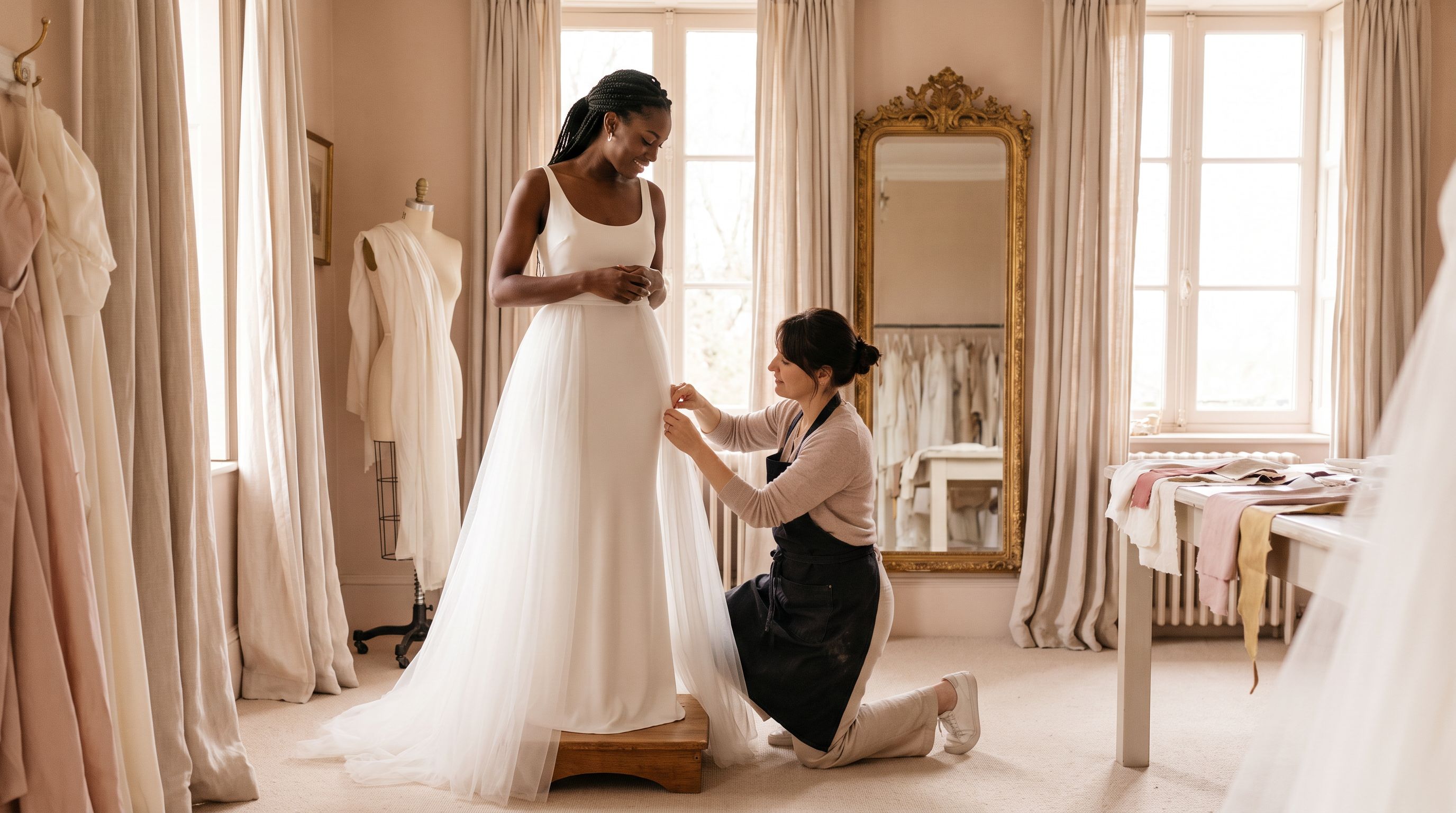
The “second look” has quietly become one of the most common requests in custom bridal. Every wedding season brings another round of celebrity fitting recaps featuring two or three custom looks in a single day, and each one sends a wave of people to their dressmakers asking the same question: can I have two looks without doubling my budget?
Usually, yes. But which route you take changes the price, the timeline, and how your day actually runs.
The three ways to get two looks (and what they really are)
One convertible gown. A single dress built with removable parts: a detachable overskirt or train, sleeves that unbutton at the shoulder, a beaded topper or capelet that lifts off, a bow or sash that snaps away. You wear one base garment all night.
Separates. A skirt and a bodice made as two pieces, so you can swap the skirt (full tulle for the ceremony, slim crepe for dinner) or wear the bodice with tailored trousers later. This sits between the other two options in both cost and drama.
A second garment. A genuinely different piece — often shorter, lighter, or in a completely different fabric — that you change into for the reception. Maximum transformation, maximum cost.
And two looks aren’t always a white gown plus a shorter white gown. One of the most common versions we see is a ceremony in a red lehenga, a hand-woven aso-oke ensemble, or a hanbok, followed by a Western-cut reception gown — or exactly the reverse. The engineering questions below apply either way.
What each route typically costs — and what drives the number
Every figure below is illustrative. What you’ll actually pay depends on your fabric, the amount of hand-beading, your dressmaker’s experience level, and your local market — a maker in a major city with a couture background will quote very differently from a skilled independent in a smaller town.
The cost drivers are the same ones that shape any custom gown: fabric yardage (a floor-length overskirt in silk organza can eat 7–11 yards / 6–10 m), hand-finishing (a detachable piece still needs a clean, self-faced waistband and hidden hardware), beading, and fittings labour — every removable element has to be fitted twice, once alone and once layered over the base dress.
One thing people consistently underestimate: matching. If you commission the overskirt later, from a different bolt or dye lot, the whites may not agree under photography lights. Designing both pieces at once, from the same cut of fabric, is genuinely cheaper and better. If you’re still weighing fabrics for the base gown, our guide to crepe, satin and mikado is a good place to start, because the base fabric determines what can sit over it without bulk.
How a good convertible gown is actually built
This is where craftsmanship shows. A well-engineered convertible gown almost always includes:
- A waist stay — a grosgrain ribbon anchored inside the bodice that carries the weight of the overskirt so it doesn’t drag the dress down. Its placement is personal: a short torso usually needs a narrower stay sitting slightly higher, while a long torso can carry a wider one lower without looking compressed.
- Support built for your actual body. For a fuller bust, that means internal cups or light underwiring, straps and sleeve heads anchored into a reinforced seam rather than a single line of stitching, and removable sleeves that attach at the armhole seam so they can’t slide. On plus-size builds — or anyone with a softer midsection — a heavy overskirt should attach at a structural seam such as a hip yoke or dropped waist, which spreads the weight across the garment instead of digging into the natural waist.
- Hidden hardware: hook-and-bar closures, covered snaps, or a discreet button placket rather than visible ties (unless a bow is the design).
- A finished base garment. The dress underneath must look complete and intentional on its own — not like a slip that lost its skirt.
- A hem tested at both stages. Your dressmaker should hem you in your reception shoes and check that the base dress still clears the floor once the overskirt is gone.
- A change you can genuinely manage. For many people that’s under two minutes with one helper. If reaching behind your back is difficult, or fine motor control is limited — arthritis, tremor, limited shoulder range, dressing one-handed — ask for magnetic closures, oversized hook-and-bar sets, wide grosgrain pull loops, or a front-opening placket. Say it at the consultation; a good maker designs around it rather than patching it on at the last fitting.
What a realistic budget looks like when you want two looks
A useful approach is to set a total wardrobe figure rather than a dress figure — then allocate. If your ceiling is around $5,000 (a lot of money in absolute terms, and squarely mid-range for custom in many North American and Western European markets), that might be a $3,600 gown, a $700 detachable overskirt, $300 for a veil or headpiece, and a genuine buffer for shoes, undergarments and final press. Trying to fit two standalone gowns into that number usually means both are compromised.
If your total is closer to $1,200–$2,000, two looks are still very much on the table — you just choose one change instead of three. That typically looks like a clean, unbeaded base gown in a well-behaved fabric such as crepe or a good polyester satin, plus one removable element: a capelet, a tulle overskirt, or a second simple skirt to swap in. Skip the hand-beading, keep the train modest, and put the money into fit. A simple gown that fits beautifully and transforms once reads far more expensive than an ambitious one that doesn’t.
Our breakdown of what $2k, $5k and $10k actually buys in custom is worth reading alongside this, and how much a custom wedding dress costs explains the cost drivers line by line.
A second look should feel like a gift to yourself at 9pm, not a line item you resent at 3am when the invoices land.
The timeline: two looks need more runway, not double
-
Raise it at the consultation (9–12 months out is comfortable)
Bring inspiration for both moments and be honest about which one matters more. A good maker will tell you which transformation is achievable within your budget. -
Confirm fabric quantities early
Both pieces should be cut from the same purchase. Silk especially varies between dye lots, and specialty laces sell out. -
Toile the base gown first
The removable pieces are drafted over the finished base shape, so the bodice fit gets locked in before the overskirt is cut. -
Add one fitting to the schedule
Expect roughly 3–5 fittings rather than 2–4. Budget a little extra lead time; see our notes on how long a custom gown takes. -
Rehearse the change at the final fitting
Time it. Photograph the closures. Send that photo to whoever is helping you dress.
How to decide
Choose the convertible gown if your venue is one location, you want the same fabric and mood all night, your priority is dancing comfortably, or your budget is fixed. For most budgets it delivers the biggest visual change per dollar spent.
Choose a second garment if you’re changing venues, want a short reception look, want a different colour entirely, are honouring two cultural traditions in one day, or want something you’ll genuinely wear again.
Choose separates if you’re between the two — or if you love the idea of keeping a beautifully made bodice or skirt in your wardrobe afterwards.
If a maker answers those clearly, shows you real construction photos, and gives you a written quote that itemises the second look separately, you’re in good hands. Even from a first conversation, you should come away with three things you didn’t have before: a realistic price range for your fabric and market, an honest read on whether your timeline works, and a clear sense of whether the transformation you’re picturing needs one clever gown or two.
Ready to bring your dream dress to life?
Tell us what you're picturing — style, timeline, and budget — and we'll connect you with custom dressmakers who can make it. Free, no obligation.
Get matched with a dressmakerRelated guides
Wedding Dress Budget: The Hidden Costs Beyond the Gown
A realistic wedding dress budget includes more than the gown. Here's what alterations, undergarments, veils, rush fees and cleaning really cost — custom or off-the-rack.
Read guide →
Beaded Wedding Dress Cost: Hand-Beading vs Appliqué
What beading really adds to a custom wedding dress cost — hand-beading vs beaded lace appliqué vs pre-beaded fabric, with realistic price ranges and cost drivers.
Read guide →
Silk vs Polyester Wedding Dress: Is Silk Worth the Cost?
Silk vs polyester wedding dress fabric, honestly compared: real price ranges per yard, how much fabric a gown needs, drape, sweat marks, and when to splurge.
Read guide →