 Custom
 Custom Wedding Dresses for Petite and Short Brides
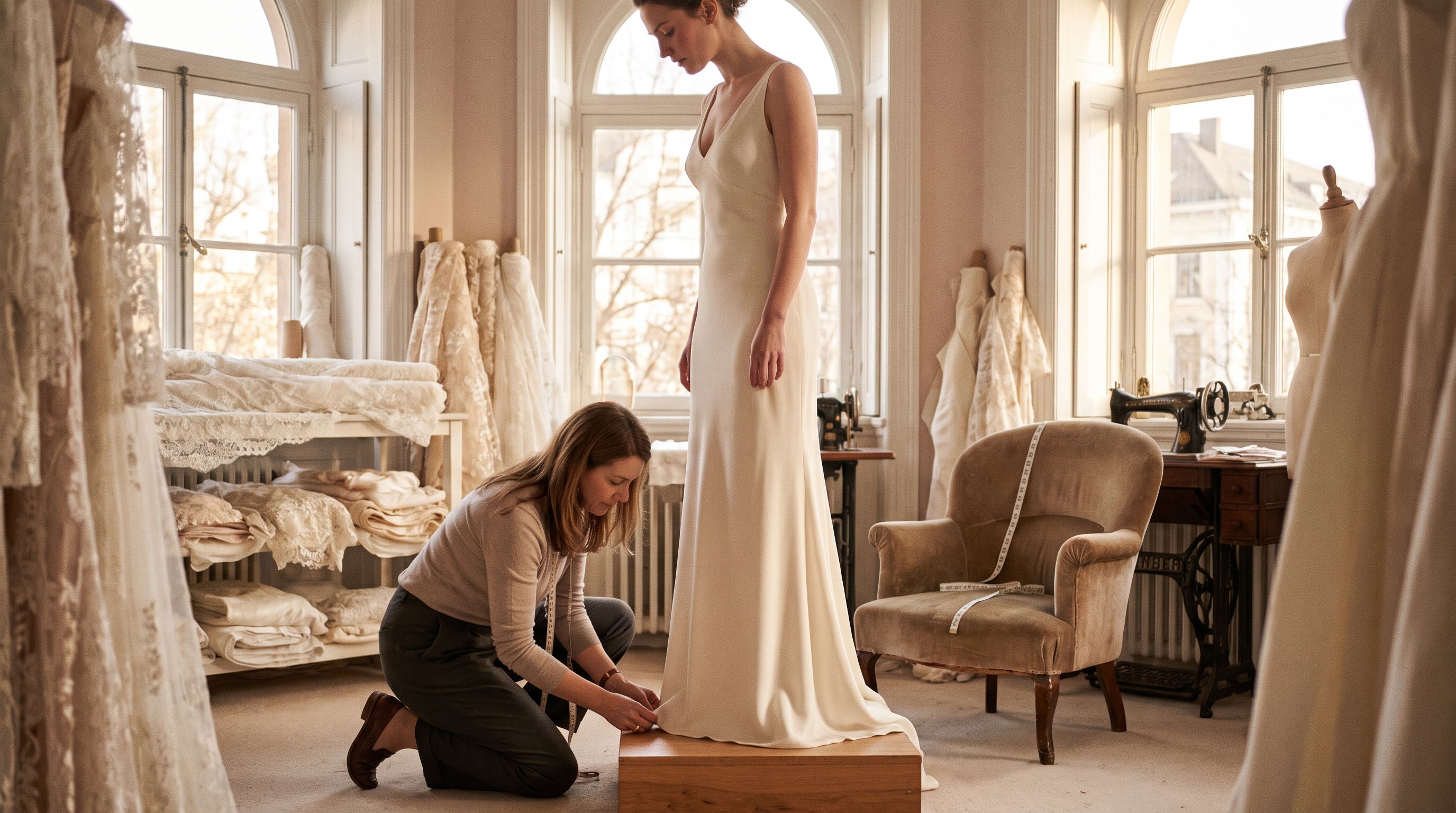
Why “we’ll just hem it” is only half the fix
Bridal samples are typically cut on a fit model somewhere around 5’8” to 5’10”, often in a single sample size, and then graded up and down. Grading changes width far more than it changes vertical proportion. So when a bride at 5’1” steps into a gown, the length is the obvious problem — but it’s rarely the only one.
What’s actually happening underneath the extra fabric pooling on the floor:
- The waist seam sits below your natural waist, which visually shortens your legs and lengthens your middle.
- The bust darts or cups land low, so the fullest part of the gown doesn’t line up with the fullest part of you.
- The armholes are cut deep and wide, gaping under the arm no matter how tight the back is laced.
- The neckline drops lower than intended, because the shoulder-to-bust distance is longer than yours.
- The lace motifs are large relative to your frame — a scalloped border designed to sit at mid-thigh on a taller bride may hit your knee and cut you in half.
- The train is proportionally enormous, and the horsehair or crinoline in the hem is engineered for a longer skirt.
None of this is specific to a white gown with a chapel train. The same torso-versus-height drafting logic governs a lehenga blouse, a qipao, a two-piece with a separate skirt, a colored gown, or a modest design with sleeves and a higher neckline — the questions are still where the waist lands, where the bust point sits, and how deep the armhole is cut. If anything, petite proportion problems are worse on heavily embellished garments: dense zardozi, hand-beaded borders and structured mandarin collars are placed to a fixed layout, so shortening the body of the garment means the embellishment no longer sits where the design intended.
Altering off-the-rack versus starting from scratch
With under three months, custom isn’t automatically off the table — but the shape of it changes. Many makers will take a simplified design (clean crepe or mikado, minimal beading, fewer fittings, in-stock fabric rather than ordered lace) on a compressed timeline, sometimes with a rush fee. What they generally can’t compress is hand-beading and imported fabric lead times. Ask directly: “What could you build for me in ten weeks, and what would you have to leave out?” If you’re weighing the two paths on money rather than time, the real cost math of custom versus off-the-rack breaks the line items down side by side.
Budget planning ranges — not survey data
Cost drivers matter more than any headline number. A clean silk crepe column with a lined bodice and no beading sits at the bottom of a maker’s range. A hand-beaded lace overlay with a cathedral train, boned corselette and covered buttons down the back can multiply the labor hours several times over. Fabric alone can swing the total significantly — silk duchesse or French chantilly costs meaningfully more per yard than a good polyester crepe or a domestic mikado. Ask your maker to quote fabric and labor separately so you can see which lever to pull.
If your budget is under about $1,500
Plenty of petite brides land here, and there are honest routes:
- Sample sales, filtered for petite-friendly sizes. Smaller samples have less vertical excess to remove, so the alteration bill starts lower.
- Buy simple, then spend only on the bodice. An unbeaded crepe, satin or mikado gown lets a seamstress raise the waist and reshape the armhole without unpicking and re-beading — the single biggest cost multiplier in bridal alterations.
- Commission in accessible fabric. Some independent makers will draft to your measurements in polyester crepe, domestic mikado or a simple lined lace for well under typical custom pricing. You’re paying for the pattern, not the mill.
- Alter an inherited or vintage gown. Older gowns were often built with generous seam allowances, which gives a skilled seamstress room to work.
The honest caveat: these routes reliably fix hem length, waist height, strap length and side seams, and they can shorten a plain bodice above the waist. They generally cannot rescale a printed or beaded lace motif so it stops cutting across your knee, re-cut a deep armhole in a fully boned corselette, or re-engineer a train built for a taller frame. If those are your three problems, cheap fabric plus good drafting beats an expensive gown plus heavy surgery.
Design choices that work with a shorter frame
There’s no rule you have to follow, and “elongating” is a preference, not an obligation. But if you want a longer visual line, these are the levers that do the work:
- Raise the waist seam to your true natural waist, or slightly above it — the single biggest change.
- Keep the vertical seaming continuous. Princess seams running unbroken from shoulder to hem read longer than a heavily horizontal bodice.
- Scale the lace down. Ask about a smaller-motif lace, or have appliqués cut and re-placed so a border doesn’t slice across your knee.
- Watch the hem finish. A slight break at the front with a longer back, and a lighter horsehair, keeps the skirt from stacking on the floor.
- Right-size the train and veil. A chapel train and a fingertip or waltz veil often read more elegant on a petite frame — though a long veil can be gorgeous if the width is reduced so it doesn’t overwhelm your shoulders.
- Shrink the details, not the drama. Narrower straps, smaller covered buttons, a thinner belt: same design language, proportioned to you.
If you’re petite and curvy, or petite with a fuller bust, the fit problems compound: standard grading assumes the bust and hip grow with height. A made-to-measure bodice with a properly placed internal corselette can carry the weight so straps aren’t doing the work — the same drafting-to-measurement principle explored in our guide to why grading fails curvy and plus-size frames.
What the process actually looks like
-
Consultation and inspiration
Bring 3–6 photos and be ready to say what you like about each — neckline, fabric, movement. Expect an honest conversation about which elements translate to your frame and which need re-scaling. Good makers tell you when a design element will fight you rather than just saying yes. -
Full measurements and a design sketch
Expect 15–25 measurements, including nape-to-waist, waist-to-floor front and back, bust point placement, and armhole depth. You should leave with a sketch, a fabric plan, a written price and a payment schedule. -
The muslin (toile)
A test garment in cheap fabric, fitted on your body. This is where a petite fit is won: waist height, bust point, armhole and neckline depth all get adjusted before a yard of silk is cut. If a maker skips this entirely for a from-scratch gown, ask why. -
Two to four fittings
First in the real fabric with raw edges, then refinements, then the hem set in your actual shoes and undergarments. Small changes are normal — that’s what you’re paying for. -
Final pickup and steaming
Usually 2–4 weeks before the wedding, with a demonstration of any bustle or fastening. Bring whoever will be helping you dress on the day.
A hem tells you how tall you are. A well-drafted bodice tells you nothing at all — it just looks like the dress was always yours.
How to tell a good maker for your frame
When you’re shortlisting makers, look past the pretty gallery and ask targeted questions:
- “Have you drafted for brides under 5’3”? Can I see photos where the full length is visible?”
- “Where will you place my waist seam, and why?”
- “Will we do a muslin, and is it included in the quoted price?”
- “How do you handle seated drafting and seated fittings? Can we break a long fitting into shorter sessions?” — essential if you use a wheelchair (front hem shorter than back, no pooling at the footplates, waistline checked while seated) or have limited standing tolerance.
- “What happens if my measurements change before the date — pregnancy, planned change, medication, or postpartum?” Ask what adjustment allowances they build in and when the final measurement deadline falls.
- “If we use a border lace, how will you scale or re-cut it for my proportions?”
Vague answers on fittings and revisions are the reddest flag. A written contract listing the number of fittings, the deadline for design changes, and what triggers an extra charge is what separates a professional from a hobbyist — there’s a fuller checklist in our guide to vetting a custom dressmaker.
Here’s a decision rule you can apply on your own, no appointment required: look back at your notes from every gown you’ve tried. If the only recurring complaint was length, alterations will serve you well. If the same three fit problems appeared at every single appointment — waist sitting low, armhole gaping, motif cutting across your knee — price a made-to-measure quote before you commit to an alterations contract, because you’d be paying to fight a pattern that was never drafted for your torso.
Related reading: when custom genuinely wins over off-the-rack — and when it doesn’t.
Ready to bring your dream dress to life?
Tell us what you're picturing — style, timeline, and budget — and we'll connect you with custom dressmakers who can make it. Free, no obligation.
Get matched with a dressmakerRelated guides
Off the Rack Wedding Dresses: What It Means and Costs
What "off the rack" really means in bridal, how off-the-rack wedding dress costs compare to custom and made-to-measure, and how to set a realistic budget.
Read guide →
Chapel vs Cathedral Train: Length, Cost, and Bustles
Chapel vs cathedral train for a custom wedding dress: real length measurements, what extra train costs, bustle types and prices, and how to decide at your fitting.
Read guide →
Bridal Sizing vs Street Size: Why Gowns Run Small
Bridal sizing vs street size explained: why wedding dresses run 2–3 sizes small, what off-the-rack really means, alteration costs, and when made-to-measure wins.
Read guide →