 Custom
Final Wedding Dress Fitting: Your Complete Checklist
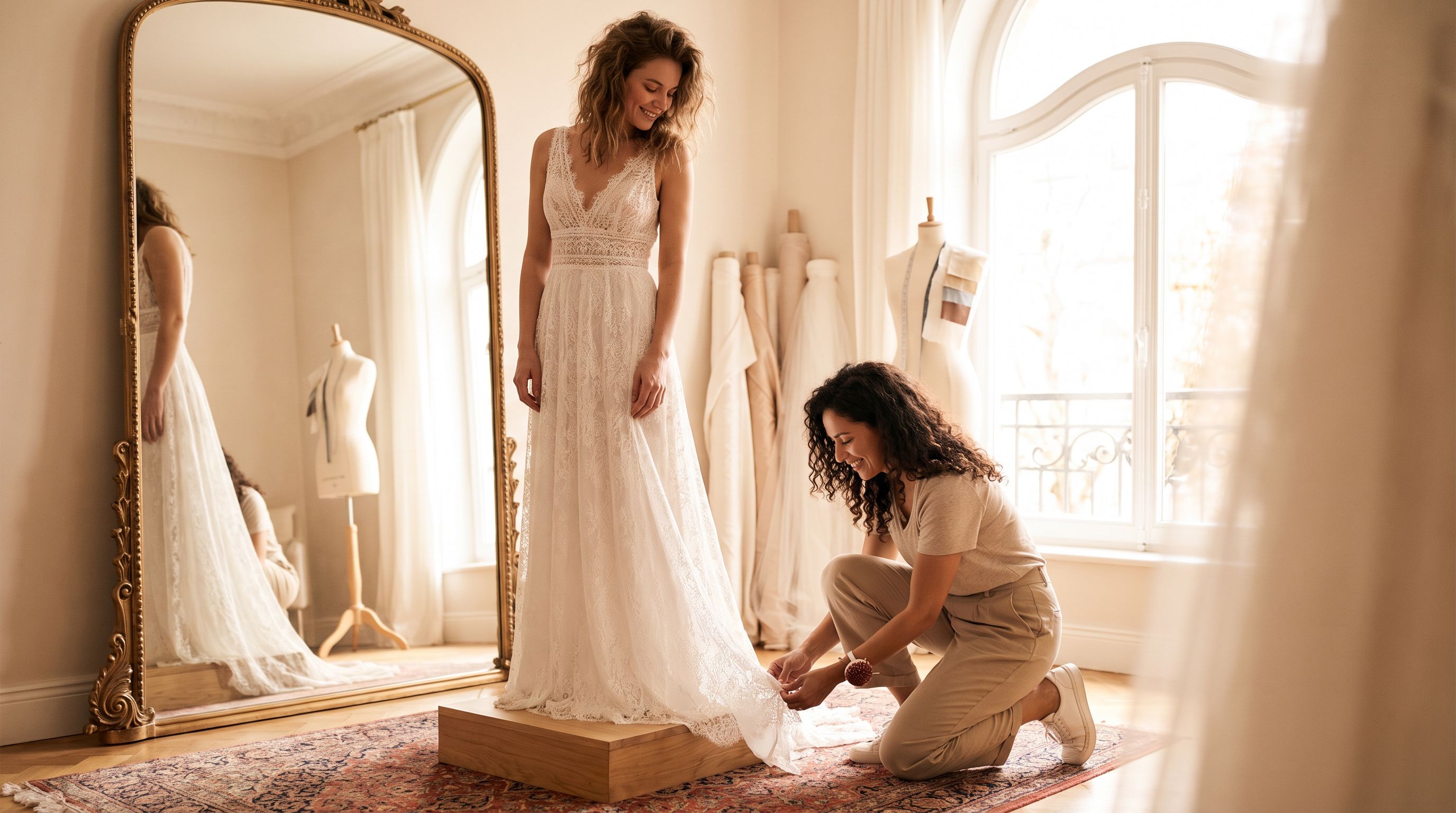
What the final fitting actually is — and when it should happen
By the time you reach your final fitting, the hard work is done. The toile has been corrected, the gown has been cut in your real fabric, the structure has been built, and one or two fittings have already dialed in the bodice. The final fitting isn’t for big changes. It’s for confirmation: that everything closes cleanly, hangs level, moves with you, and that the people who will handle the dress on the day know how it works.
A note before we go further: not everyone wearing a custom gown is a bride, and not every wedding is one outfit on one day. If you’re wearing a gown as a mother, a guest of honour, or a non-bridal celebrant — or if your celebration spans a mehndi, a ceremony, and a reception with a change between them — run this checklist for each look. The same goes for modest or culturally specific gowns with sleeves, high necklines, layered overskirts, or a separate covering piece: each layer needs its own movement test, and the pieces need testing together.
Most makers schedule the final fitting close enough to the wedding that your body is unlikely to change, but far enough out that there’s room to fix a surprise.
These are working norms from general atelier practice, not survey data — every maker runs differently.
If you’re traveling with the gown, ask for the final fitting a little earlier so there’s a buffer week. If you want a refresher on how the whole sequence works, our guide to how many fittings a custom gown needs walks through each stage.
What to bring (the non-negotiable list)
The final fitting is only as accurate as what you bring to it. Showing up in borrowed shoes or a different bra undoes weeks of precision work.
-
Your actual wedding shoes
Not a similar heel height — the ones you’ll wear. Break them in a little first. If you’re changing into flats for the reception, bring those too so the hem can be checked against both, or discuss a bustle that handles the difference. -
The exact undergarments
Whatever you’ll wear underneath, including shapewear, pasties, or a strapless bra if your gown isn’t internally supported. If your dress has built-in support or a corset structure, wear nothing that fights it. -
The person who will dress and bustle you
Your partner, a friend, a sibling, a parent, or a paid dresser — whoever it will actually be on the day. They need hands-on practice, not a video. -
Veil, headpiece, jewelry, and any cover-up
Proportion only reads correctly with the full picture. A cathedral veil changes how a train looks; a jacket or modesty layer changes how a neckline sits. -
Your phone, fully charged
Film the bustle, the closure, and the steaming instructions. You will not remember them in six weeks.
Move the way you’ll actually move
Standing still in front of a mirror tells you almost nothing. A gown that looks flawless at a standstill can bind at the ribs the moment you hug someone. Ask for a few minutes to genuinely test it — experienced makers expect this and build time for it.
Sit down in a low chair and a dining chair. Walk across the room, then up and down stairs if there are any. Raise both arms overhead. Hug someone tightly. Take a deep belly breath and hold it. Lean forward as if greeting a guest in a receiving line. Dance a little, even if you feel silly. Then look in the mirror again and see where the fabric has settled.
If you use a wheelchair, walker, or cane, do your testing seated and in motion — check where the skirt pools at the footplates, whether the hem can catch in wheels, and that the back of the bodice doesn’t ride up against a seat back.
Things to flag: a bodice that rides up when you raise your arms, a neckline that gapes when you lean, boning that digs when you sit, a hem that catches the toe of your shoe at the front, straps that slip, or a skirt that twists so the side seams no longer sit at your sides.
The most common complaint we hear after a wedding isn’t about the photos — it’s the ribs. A bodice fitted to a still, upright body can bind across the lower ribs the first time someone hugs you hard. Fit it for the hug, the chair, and the dance floor, not just the mirror.
The bustle lesson is the most important ten minutes
In most ateliers, the bustle is the single most common source of wedding-day gown trouble — it’s the one step a helper has to perform unsupervised, under pressure, often in a dim room. Whoever will do it needs to practice in the atelier, twice, while the maker watches.
Ask your dressmaker to mark the bustle points with matching ribbon or numbered thread tags so the pairs are obvious under low reception lighting. Film it from behind. Count the points out loud. If you have a long train, the bustle may have six, eight, or more connections — our guide to chapel versus cathedral trains explains how length drives bustle complexity and cost.
Same goes for the closure. A long row of covered buttons, a lace-up corset back, or a concealed zipper with hooks all have their own technique. Practice getting in and out at least once with your helper doing the work.
How to tell whether it’s truly finished
Saying something’s wrong without feeling rude
Many people find this the hardest part of the appointment, and it’s almost always easier than expected. You don’t need to diagnose the problem or propose the fix — that’s your dressmaker’s job. Describe what you feel and what you see, in plain language.
Try: “When I sit, this seam presses right here.” Or: “I love the front, but in the mirror the back feels higher on this side — can you look?” Or: “I keep wanting to pull this up. Is that normal?” Those sentences give a skilled maker everything they need. If you’re ever met with defensiveness rather than curiosity, that’s useful information too — and one of the markers we cover in how to vet a custom dressmaker.
Should the final fitting cost extra?
With a from-scratch custom or made-to-measure gown, fittings are normally built into the quoted price — that’s a large part of what you’re paying for. Confirm this in writing at the start so there’s no ambiguity at the end.
Where extra charges legitimately appear: design changes you request late (adding sleeves, changing a neckline, lengthening a train), rush work if you’ve moved the date, or a significant refit because your measurements changed substantially. Those are typically quoted per job and vary widely with fabric, beading, and your local market. By contrast, altering a gown you bought off the rack is usually billed separately from the dress price and often lands in the low hundreds (USD or GBP, depending on your market) for simple work, climbing steeply for restructuring heavily beaded or boned gowns. Major-city ateliers run materially higher than smaller markets, so treat any figure as a starting point for your own quotes. Our breakdown of the hidden costs beyond the gown itself covers how to budget for pressing, veils, and travel.
Before you walk out the door
Ask these, and write the answers down:
- How should this be transported — hung, or folded into a box? Can I lay it flat in a car?
- Can it be steamed at the venue, and at what distance? Any fabric that must never be touched with a hot head?
- How should it hang in the days before — by the straps, or by the interior ribbon loops?
- Who do I call if something happens in the final week?
- Is there a small kit you’d recommend — matching thread, spare buttons, double-sided tape?
Most makers will send you home with spare fabric, extra buttons, and matching thread. If they don’t offer, ask.
You should leave your final fitting feeling the way the dress is supposed to make you feel: steady, comfortable, and a little bit stunned. If you don’t, say so while you’re still standing there. That’s exactly what the appointment is for.
Ready to bring your dream dress to life?
Tell us what you're picturing — style, timeline, and budget — and we'll connect you with custom dressmakers who can make it. Free, no obligation.
Get matched with a dressmakerRelated guides
Bridal Seamstress vs Regular Tailor: Who to Trust
Can a regular tailor alter a wedding dress? Here's how a bridal seamstress differs, what each job costs, and when to hire a custom dressmaker instead.
Read guide →
Church Wedding Dress Code: Shoulders, Sleeves, Coverage
Does your church require covered shoulders? Here's how to confirm the dress code and design a custom wedding dress with sleeves, a cape, or removable coverage.
Read guide →
Custom Wedding Dress After a Mastectomy: Fit & Support
A practical guide to a custom wedding dress after mastectomy or breast surgery: prosthesis pockets, support without underwire, scar coverage, timing, and real costs.
Read guide →