 Custom
How Many Fittings Does a Custom Wedding Dress Need?
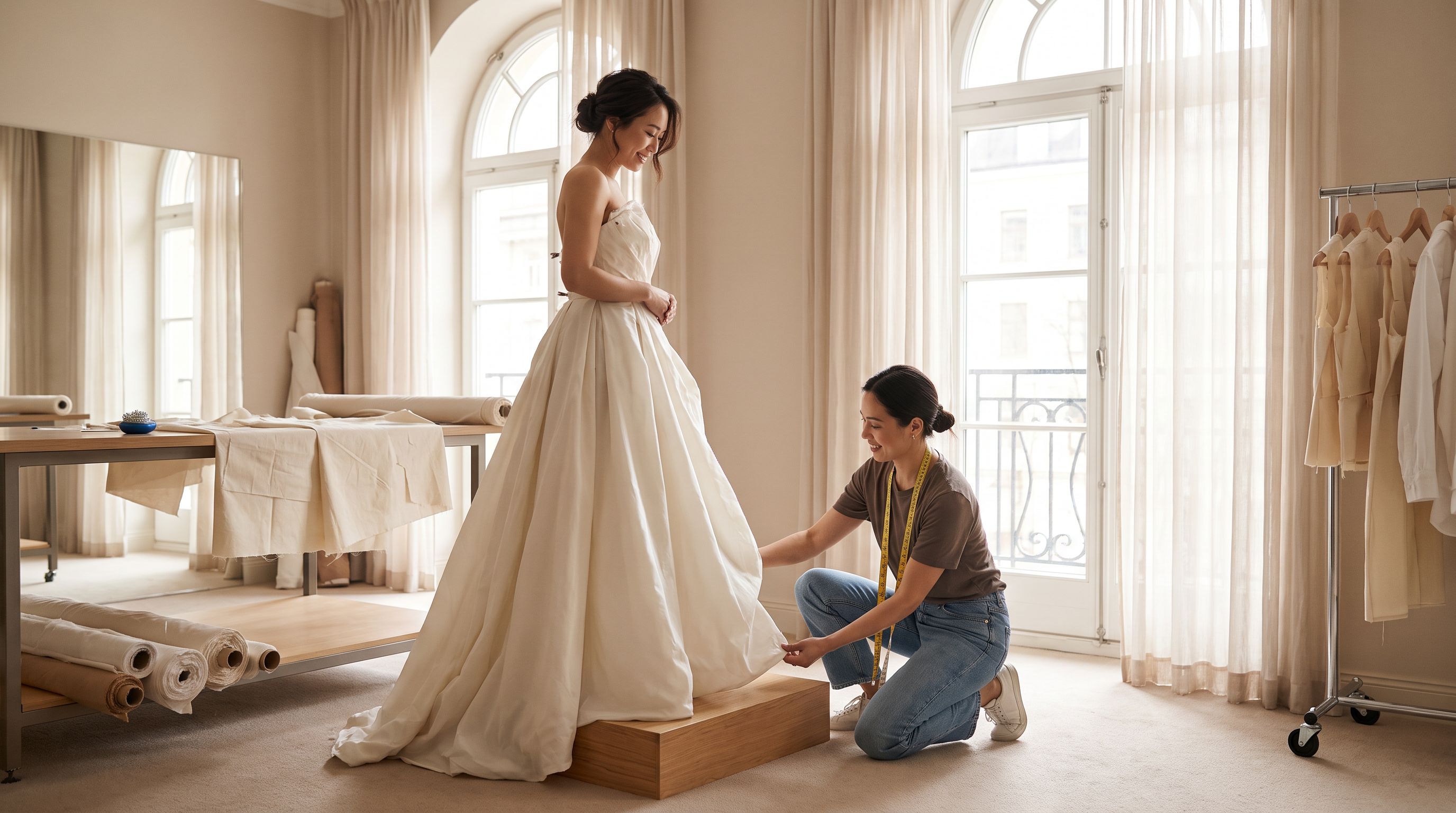
If you’ve only ever bought clothes off a rack, the fitting process is the part of going custom that feels most mysterious. How many times will you have to go in? What actually happens? Will you see the real dress, or something that looks like a hospital gown made of bedsheets?
Here’s the honest, unglamorous, genuinely reassuring answer.
The short answer: plan for three to five
For a made-to-measure or bespoke gown, three to five fittings is the standard range. Simple silhouettes in forgiving fabrics — a soft crepe slip, an unstructured A-line — can sometimes be done in two or three. A structured gown with internal corsetry, a full skirt, sleeves, or hand-applied lace will often want four or five, because every layer has to be balanced against the ones underneath it.
Those fittings don’t start the week you sign. They cluster in the back half of the process, after patterning and construction. If you want the full month-by-month picture of what happens before the first pin goes in, our guide to how long a custom wedding dress takes walks through the whole runway.
If travelling for four or five appointments isn’t realistic — because of cost, distance, or time off work — say so at the consultation rather than quietly hoping. Ask whether the maker can combine the toile and the first fashion-fabric fitting into one longer session, or work remotely with a toile posted to you and reviewed over video. Both are legitimate approaches, and both trade a little precision in the areas hardest to judge on yourself (back balance, strap pitch, hem level) for fewer trips. Ask what that trade-off costs in practice, and whether extra sessions are charged if something needs a second pass.
What actually happens at each appointment
-
Consultation and measurements
Not technically a fitting, but it’s where fit begins. Your maker takes 15–30 measurements, looks at how you stand, notes a higher hip or a longer torso, and discusses design. Wear or bring the undergarments you’re considering. If you’re preparing remotely first, our guide on how to measure yourself accurately covers the points that matter most. -
The toile (muslin) fitting
A plain cotton or calico mock-up of your gown, sometimes marked up in pen. It exists to test the pattern: neckline height, bust apex, waist placement, how the skirt falls when you sit and walk. Expect it to look like nothing. Expect your maker to slash, pin and redraw it on your body. Most costly late-stage fixes trace back to a pattern issue that a toile would have caught. -
First fitting in the real fabric
Now you see your dress — usually basted together, zip not set, hem raw, lace not yet applied. This is where the maker checks that the fashion fabric behaves the way the cotton did (it often doesn’t, which is exactly why the toile came first) and refines the fit through the ribcage, bust and back. -
Second fitting: refinement and detail
Support structure is in, seams are closer to final. You’ll discuss lace placement, beading density, strap position, sleeve pitch. Hem is marked in your actual shoes. If there’s a train, the bustle is planned here. -
Final fitting
Ideally two to four weeks out. The dress should be finished. You do the full rehearsal: shoes, undergarments, veil, jewellery, hair roughly as planned. You sit, raise your arms, walk, hug someone. Whoever will bustle you on the day should come and be taught how.
Are fittings included in the price, or charged separately?
With a true custom maker, fittings are usually built into the quoted price — they’re part of making the dress, not an add-on. That’s one of the quiet advantages of going custom, and it’s why comparing a custom quote to an off-the-rack price tag isn’t apples to apples until you add the salon’s alteration bill.
Charges tend to appear after completion. If you approve the dress, take delivery, and then want the neckline lowered or the waist taken in after a body change, most makers bill that as alterations. Post-delivery alterations are usually charged hourly, and rates vary widely — by city, by the seamstress’s experience, and above all by whether beading, boning or a lining has to be unpicked and rebuilt to reach the seam. A simple hem or side-seam nip sits at the low end; reopening a beaded, corseted bodice can run to several hours of skilled labour. Ask two questions up front: how many fittings are included? and what’s your hourly rate, and will you give me a written estimate before starting any post-delivery work?
How the fitting experience differs from off-the-rack alterations
If you’re weighing a beautiful sample against a made-from-scratch gown, our honest look at what alterations can and can’t fix is the piece to read before you commit.
When you’ll need more fittings — and why that’s fine
A few situations reliably add an appointment:
- Heavily structured or boned bodices. Internal corsetry has to be fitted before the outer layer is finished, which is effectively a fitting of its own.
- Hand-beading or lace appliqué. Placement is decided on your body, then applied, then checked again.
- A full bust, a long torso, a significant hip-to-waist difference, or any proportion that standard patterns handle badly. More refinement is the point of going custom, not a sign something’s wrong.
- A body that’s changing — pregnancy, medication, training, a health journey. A good maker builds in adjustability and schedules the last fitting closer to the date.
- More than one outfit. Custom gowns are made for people of any gender, and many weddings involve two or more looks — a ceremony gown plus a reception dress, or a cultural outfit such as a lehenga, hanbok or cheongsam. Each garment carries its own fitting schedule, so list every piece at the consultation rather than halfway through.
- Long-distance or online makers, where a toile may be posted to you and reviewed by video. Build in extra shipping time and expect more photo-and-measurement exchanges.
How to give feedback that actually helps
This is the skill nobody teaches clients, and it changes everything.
Describe the sensation, not the solution. “It digs in when I sit” tells your maker more than “can you let out the waist.”
Useful things to say: it slides forward when I walk; I can’t take a full breath; the strap falls off this shoulder; I feel exposed when I lift my arms; the hem catches on my left toe. Unhelpful: silence, politeness, or waiting until you get home to text a list.
Take photos at every fitting — front, side, back, seated. Your eye in a mirror under atelier lighting is not the same as your eye at home the next morning.
What to ask before you book a maker
Fit is where a custom gown is won or lost, so ask about the process, not just the price:
- How many fittings do you include, and roughly when do they fall?
- Do you make a toile, or fit directly in the fashion fabric? (Neither is automatically wrong — but a maker who skips the toile on a complex design should explain why.)
- Who does the fittings — you, or an assistant?
- What happens if my measurements change between now and the wedding?
- Can I see a gown mid-process, or photos of client fittings?
Our guide to vetting a custom dressmaker goes deeper on these questions — and the answers that should give you pause.
Before you book anyone, put that list to two or three makers and compare how specifically they answer. The one who gives you concrete numbers, dates and contingencies — rather than warm generalities — is usually the one who will run your fittings the same way.
Ready to bring your dream dress to life?
Tell us what you're picturing — style, timeline, and budget — and we'll connect you with custom dressmakers who can make it. Free, no obligation.
Get matched with a dressmakerRelated guides
Bridal Seamstress vs Regular Tailor: Who to Trust
Can a regular tailor alter a wedding dress? Here's how a bridal seamstress differs, what each job costs, and when to hire a custom dressmaker instead.
Read guide →
Church Wedding Dress Code: Shoulders, Sleeves, Coverage
Does your church require covered shoulders? Here's how to confirm the dress code and design a custom wedding dress with sleeves, a cape, or removable coverage.
Read guide →
Custom Wedding Dress After a Mastectomy: Fit & Support
A practical guide to a custom wedding dress after mastectomy or breast surgery: prosthesis pockets, support without underwire, scar coverage, timing, and real costs.
Read guide →