 Custom
 Wedding Dress Budget: The Hidden Costs Beyond the Gown
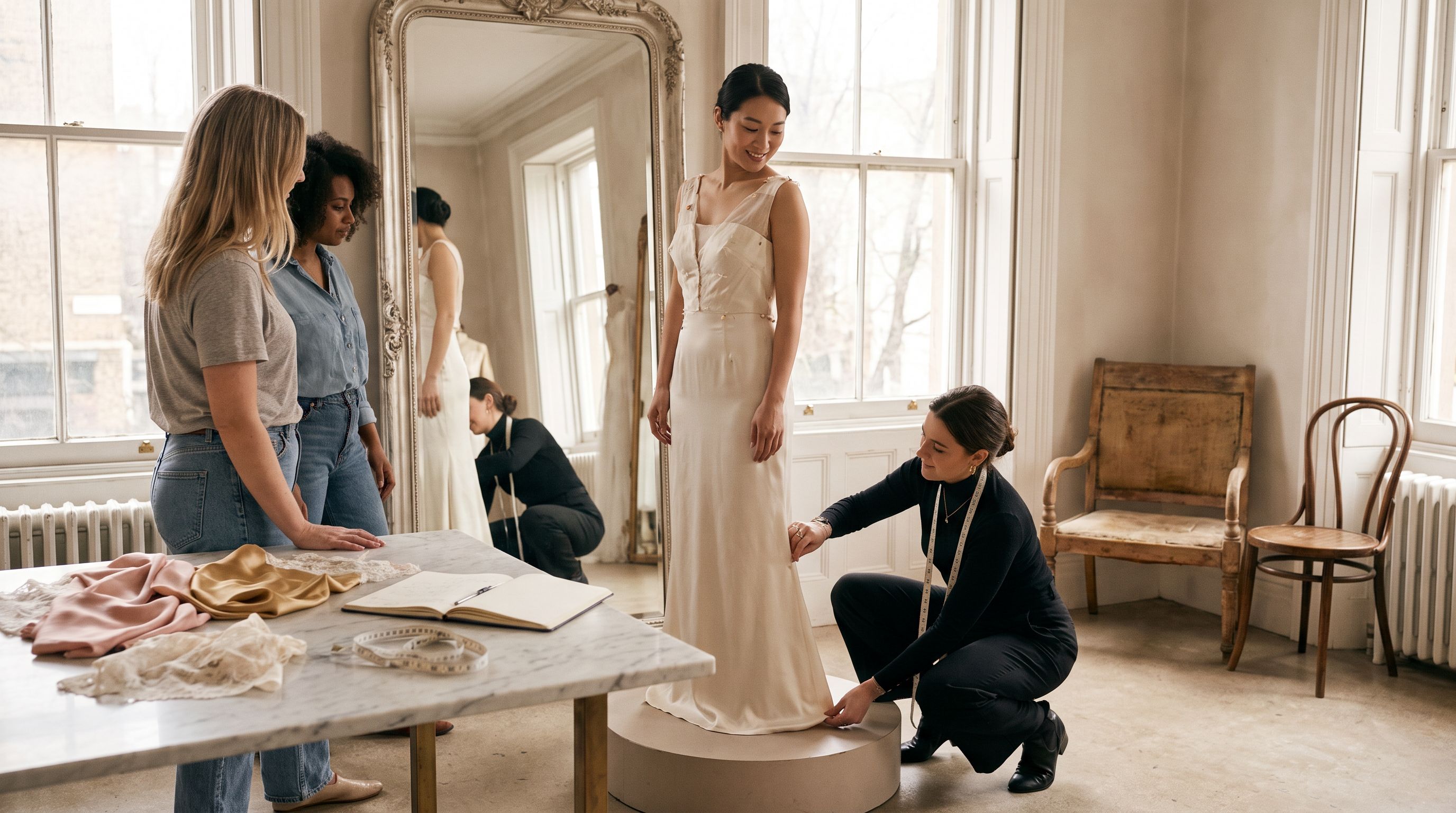
The most common budget surprise we hear about is this one: you find the dress, love the price, say yes — and then discover the price was the beginning of a conversation, not the end of one. It isn’t anyone being dishonest. It’s that bridal pricing is quoted for a garment, while what you’re actually buying is a garment that fits you, on a specific day, with everything it needs to work.
Whether you’re wearing a gown, a suit-and-skirt combination, a sari or lehenga alongside a Western look, or something in between, the arithmetic works the same way. So let’s put the whole thing on the table — not to scare you, but to make your number real so you can stop guessing.
What people mean when they say “my dress budget”
When couples divide up a wedding budget, “the dress” usually gets one line. In practice that line has to stretch across six or seven purchases:
- The garment itself (custom, made-to-measure, off-the-rack, sample, rented — or an heirloom restyled)
- Fit work: alterations, or the fittings built into a custom process
- Undergarments and support: cups, bra, shapewear, sometimes a slip
- The bustle, if you have a train
- Veil, overskirt, sleeves, jewelry, shoes (shoes matter — they set your hem length)
- Pressing or steaming right before the wedding
- Cleaning and preservation after
Rental and heirloom restyling are legitimate paths, not consolation prizes. Renting can put a gown well outside your purchase budget on your body for a day, and remaking a parent’s or grandparent’s dress — new lining, reshaped bodice, shortened train — is often a fraction of new-build cost while carrying far more meaning.
It’s also worth naming this plainly: most salons carry samples in a narrow band of sizes, and above roughly a US 16 the rack thins out fast. Plenty of people end up in made-to-measure by default rather than by preference, simply because there was nothing to try on. If that’s you, the good news is that the made-to-measure route removes the alterations guesswork entirely.
Some of those line items are small. Together they aren’t. Here’s the arithmetic on a gown people would describe as “$1,800”: $1,800 gown + $600 alterations + $120 undergarments + $80 pre-wedding steam ≈ $2,600 by the time it walks down the aisle. None of those numbers are unusual. They’re just rarely added up in one place.
Those are starting points to adapt, not benchmarks. A silk gown in a major city with a beaded bodice sits at a different place on every one of those ranges than a crepe sheath made in a smaller market.
Why the cheaper gown isn’t always the cheaper dress
The question clients actually ask sounds like this: if the rack gown is $1,200 and custom is $2,400, isn’t the rack gown obviously cheaper? The straight answer is: yes, off-the-rack usually has a lower sticker price — and no, that doesn’t automatically make it cheaper.
Off-the-rack means you buy the physical garment in the shop, in the size it exists in, and take it home that day. (Sample sales work similarly, with the gown having been tried on by others.) Bridal sizing runs small and is cut for a standard set of proportions, so most people need real work done. If you’re within a size and have a fairly standard vertical fit, alterations may be modest. If you’re being taken in two sizes, if your torso is long or short, if the bust cups sit in the wrong place, or if the lace has to be cut and re-laid so the pattern still matches at the seams — the labor climbs quickly. There’s a reason so many alterations quotes land at $700, $900, sometimes more than the garment itself. We go deeper on where alterations stop being worth it in alterations vs. custom: know the limits.
Timing drives that cost as much as the work does. Plan to book alterations for roughly 8–12 weeks before the wedding, and expect two to three appointments: a fit-and-pin, a check, and a final hem-and-press. Anything you change inside the last month — a new neckline, a sudden size shift, added sleeves — is where rush pricing bites hardest, because the fitter is reshuffling other clients to make room.
Run both numbers all-in before you decide. Our real math on custom vs. off-the-rack cost walks through side-by-side scenarios, and if bridal sizing is the reason you’re even asking, why gowns run small will explain a lot.
Compare total cost to total cost. A garment that fits badly is never a bargain, no matter what the tag said.
The line items nobody warns you about
Undergarments. Cups sewn into the bodice, a longline bra, shapewear, a slip for a sheer skirt. Often $50–$300, and it affects fit, so buy them before your first fitting and bring them every time.
The bustle. If you have a train, it has to come up for the reception. Many alterations quotes include a simple one; a multi-point French bustle on a full skirt can be priced separately, often in the $50–$200 range. Worth asking about specifically.
Extra fittings. Most custom processes include a set number — commonly two to four after the muslin/toile. Additional ones (because your body changed, because you added sleeves, because you decided on a different neckline) may be billable.
Rush fees. A surcharge for a compressed timeline is normal and fair — it’s overtime and reshuffled production. Expect it if you’re inside roughly four months.
Shipping, duties, travel. If your maker is not local, factor in courier costs both ways and, for overseas orders, possible customs charges.
Pressing and cleaning. A professional steam before the wedding often runs $50–$150. Cleaning and preservation afterward is commonly $200–$500 depending on fabric and any staining.
Building your number backwards
-
Decide the all-in ceiling first
Pick the total you’re comfortable spending on everything you’ll wear. Not the gown — everything. This is the only number that protects you. -
Reserve 20–30% for everything that isn't the garment
Alterations or fittings, undergarments, veil, pressing, cleaning. If your ceiling is $3,000, you’re shopping in the $2,100–$2,400 range. -
Price your non-negotiables early
Sleeves, full coverage, pockets, a specific lace, a cathedral train — all cost drivers. So are the ones people forget to budget for: a second or third outfit change, a ceremony gown plus a separate reception or cultural look, sleeve and neckline coverage required by your faith or community, or a dress code that rules out sheer panels and open backs. Name these at the start; they tell you fast whether off-the-rack can realistically get you there. -
Get one custom quote for comparison
Ask one custom maker to quote your design; it costs nothing and gives you a real ceiling to measure the rack against — especially versus an off-the-rack gown needing heavy reconstruction. -
Leave a small cushion
Bodies change, minds change, shoes change. A few hundred dollars of margin turns a crisis into a phone call.
What “realistic” looks like at different levels
There’s no true national average — prices swing enormously by city, fabric and how much of the work is done by hand, and anyone quoting one precise figure is generalizing. But as rough planning shapes:
- Modest budget: a simple crepe or clean satin silhouette, minimal beading, an off-the-rack or sample garment with light alterations — or a straightforward made-to-measure design from an independent maker. All-in often lands in the low four figures.
- Mid budget: made-to-measure in a nicer fabric, some lace or detail, a proper fitting sequence, a veil, cleaning. Comfortably in the mid four figures all-in.
- Higher budget: silk, hand-beading, structured corsetry, a long train, multiple fittings, possibly a second look. Into five figures — and every one of those choices is a lever you can adjust. What $2k, $5k and $10k actually buys breaks it down in detail.
How to tell you’re in good hands
A dressmaker or salon worth your deposit will: quote alterations or fittings clearly and in writing, explain what happens if your measurements change, show you actual finished work (not just mood boards), give you a realistic delivery date rather than the one you want to hear, and tell you honestly when custom isn’t the right call for your budget. That last one is the strongest signal of all.
When you’re ready to replace a guess with a number you can plan around, a conversation with a custom maker — fabric, fittings and timeline priced honestly — is the fastest way to get there.
Ready to bring your dream dress to life?
Tell us what you're picturing — style, timeline, and budget — and we'll connect you with custom dressmakers who can make it. Free, no obligation.
Get matched with a dressmakerRelated guides
Beaded Wedding Dress Cost: Hand-Beading vs Appliqué
What beading really adds to a custom wedding dress cost — hand-beading vs beaded lace appliqué vs pre-beaded fabric, with realistic price ranges and cost drivers.
Read guide →
Silk vs Polyester Wedding Dress: Is Silk Worth the Cost?
Silk vs polyester wedding dress fabric, honestly compared: real price ranges per yard, how much fabric a gown needs, drape, sweat marks, and when to splurge.
Read guide →
Custom Wedding Dress Deposits and Payment Plans, Explained
How much deposit a custom wedding dress maker should ask for, what a fair payment plan looks like, what your contract must say, and the red flags to avoid.
Read guide →