 Custom
 Wedding Dress for Scoliosis or Uneven Shoulders
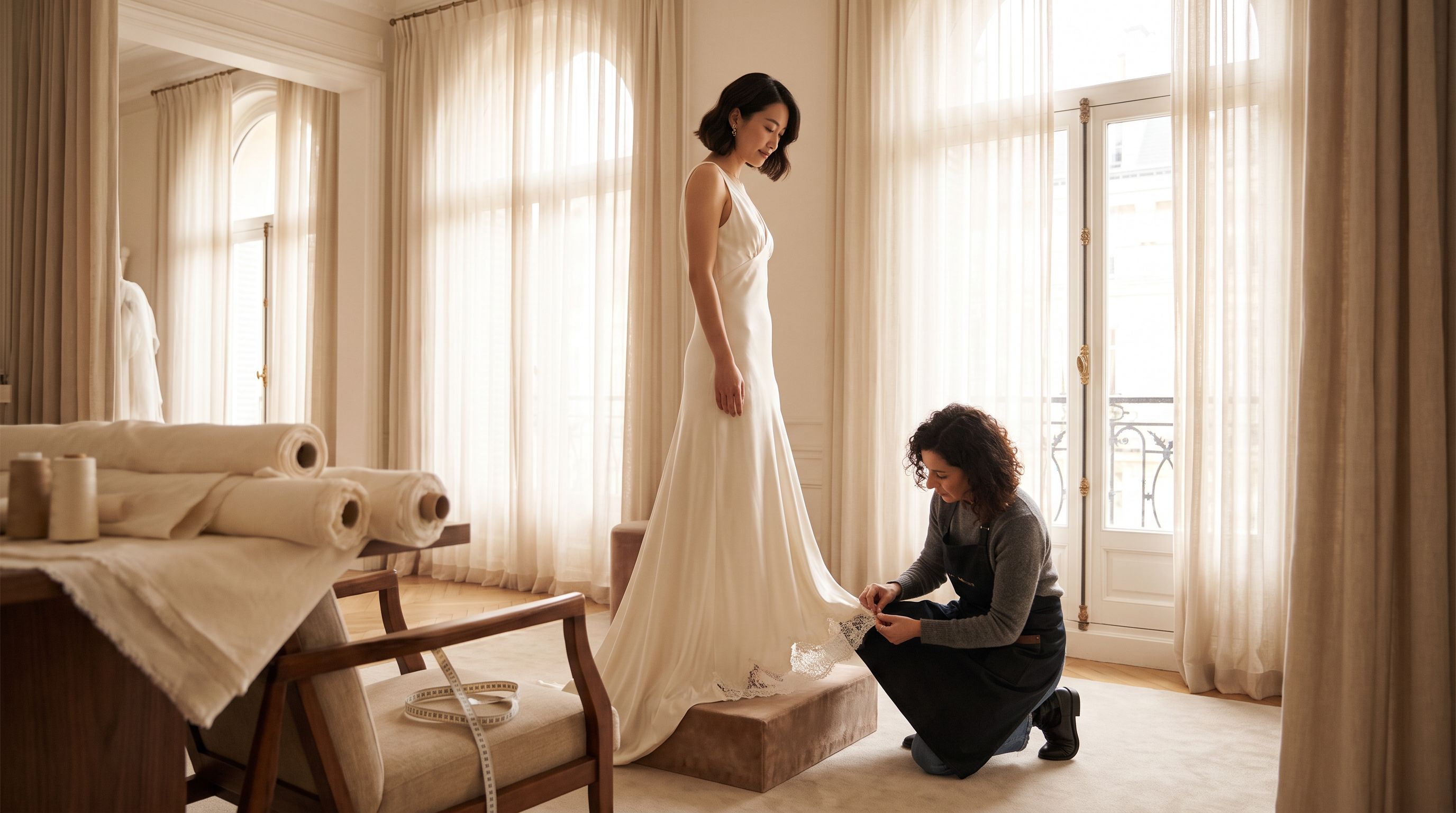
Almost nobody is symmetrical — bridal patterns just pretend otherwise
Here is something dressmakers know and sizing charts don’t: a standard dress pattern is drafted on half a body and mirrored. One side, flipped. Real bodies rarely work that way. Most people have one shoulder slightly lower (often the dominant side), one hip a touch higher, one breast larger than the other, a rib cage that rotates a few degrees. For many people the difference is small enough to ignore. With scoliosis, a leg-length difference, an old injury, or a surgery that changed how you stand, it isn’t ignorable — it’s the whole reason the dress in the mirror looks “off” and nobody can tell you why.
You are not fitting wrong. The garment is drafted wrong for you. That distinction matters, because it changes what you should be shopping for.
What asymmetry actually does to a gown
Knowing the mechanics helps you describe the problem to a maker — and spot whether they understand it.
- The hem rises on the higher side. If one hip or shoulder sits higher, the fabric is lifted there, so a floor-length hem cut level reads visibly short on that side — especially in satin or mikado, where the hemline is a hard horizontal line.
- Straps and sleeves slip. A sloped shoulder lets a strap travel outward all night. Identical strap lengths on unequal shoulders guarantee one of them misbehaves.
- Seams twist toward the shorter side. Side seams and princess seams drift off the vertical, which the eye reads as “the dress is crooked” even if it fits beautifully everywhere else.
- Boning digs in on one side. A corset or structured bodice drafted symmetrically presses into a rotated rib cage or a rib hump in exactly one spot. That’s a comfort issue, not a cosmetic one.
- A back zipper pulls to one side. Center back isn’t always the center of your back when there’s a curve through the spine.
How a dressmaker measures an asymmetrical body
This is where custom genuinely differs from a salon gown ordered off a size chart. A good fitter stops taking single numbers and starts taking paired ones — left and right, recorded separately.
Expect split measurements for: shoulder point to bust point; shoulder to natural waist, front and back; nape to waist; armhole depth; waist to high hip; and waist to floor, taken at several points around the body rather than just center front. They should also note shoulder slope, any rib rotation, and how your posture settles after you’ve been standing a few minutes — not the “best” posture you hold for a measuring tape.
If you’re preparing at home before a consultation, our guide to measuring yourself for a custom gown walks through technique. Just take every vertical measurement twice, once per side, and write both down. Bringing that list to a first appointment tells a maker immediately what kind of fit you need.
-
Consultation and honest disclosure
Say it plainly: scoliosis, fusion, a brace, a leg-length difference, uneven bust. A maker who responds with specific questions (Which direction does the curve run? Do you wear the brace all day or only sometimes?) is the one you want. -
Full paired measurements and photos
Many makers photograph front, back and both sides in fitted clothing for reference while drafting. It’s normal, and it’s useful. -
The muslin fitting
A cotton mock-up is where asymmetry is solved. The fitter slashes, re-pins and re-draws seam lines on each side independently. This fitting usually runs longer than average — a good sign, not a bad one. -
Second muslin or first fabric fitting
For significant asymmetry, many makers want to see the corrected pattern again before cutting silk. Expect one extra fitting compared with a straightforward build. -
Hem and finishing in your real shoes
The hem is leveled by eye on your body, walked in, and checked from all sides — never measured down evenly from the waist seam.
For the general rhythm of appointments, how many fittings a custom gown needs covers the standard sequence; asymmetry typically adds one appointment, not three.
Design choices that quietly do the heavy lifting
Some gowns forgive asymmetry; some advertise it. Worth raising at your consultation:
- Softer, drapey fabrics — crepe, silk georgette, chiffon overlays — blur an uneven hemline far better than crisp mikado or heavy duchesse satin.
- Asymmetric design lines by choice. A one-shoulder neckline, a diagonal drape, a gathered side seam or a cowl gives the eye an intentional diagonal, so a natural one reads as design.
- Ruching or a soft gather on the shorter side. An old couture trick: take up the excess length as deliberate texture.
- Wider straps, or sleeves. More surface area means less slipping.
- Concealed internal shaping. A thin shoulder shim or shaped pad on the lower side, hidden in the lining, levels a neckline invisibly.
- Independent cups and asymmetric boning. Different cup volumes left and right, and boning channels placed around a rib prominence rather than across it.
A dress that hangs level on an asymmetrical body is not a compromise — it’s simply a dress drafted from a real person instead of a mirrored half.
If you wear a brace, or you’ve had spinal surgery
Tell your maker early, and bring the brace to every fitting. A brace changes your circumference, your waist position and sometimes your torso length, and a gown fitted without it will not close over it. If you’ll wear it for only part of the day, you may need built-in ease and an adjustable closure — a corset-laced back or a hidden lacing panel handles both states far better than a fixed zipper.
After a fusion, limited bending matters for practical things: getting into the gown (step-in rather than overhead), reaching a back fastening, managing a bustle, and sitting comfortably through a long dinner. Ask for a bustle you don’t have to twist to reach, and consider a lighter train. Pressure points are worth raising too — if boning or a heavy beaded bodice sits on hardware or a sensitive area, a maker can pad it, reroute it, or leave it out.
What it costs, including the lower-budget routes
Off-the-rack gowns usually have a lower sticker price, but for an asymmetrical body the gap narrows fast, because the alterations aren’t simple ones. Taking a gown in at the waist is routine. Re-cutting one armhole, rebalancing a bodice, re-leveling a beaded hem and shortening one strap is skilled remedial work — and on a heavily beaded or lace-edged gown, some of it can’t be done without visible damage.
Treat those as starting points to adapt, not benchmarks, and adjust for your currency and city. If your total budget is closer to $800 than $3,000, you have real options: buy a secondhand or sample gown in a plain, unbeaded fabric and spend the rest on an alterations tailor who is genuinely willing to split the pattern and rebalance each side; choose crepe, matte satin or georgette, which re-level cheaply because there’s no beading to lift and reapply; or ask an independent maker to quote a pared-back custom build — polyester crepe instead of silk, a clean bodice with no appliqué, a shorter train. A simple gown drafted to your actual two sides will almost always beat an elaborate one that fights you.
Asymmetry itself adds pattern-drafting time and usually one extra fitting. Some makers itemize that, some fold it into the overall quote — ask yours directly how they price it, rather than assuming either way. Our guide to where alterations stop and custom begins lays out which fit problems a tailor can genuinely solve.
How to tell you’ve found the right maker
Ask directly: Have you fitted a client with scoliosis or significant asymmetry before? How do you handle a hem that isn’t level? Do you draft the left and right sides separately, or adjust at fitting? How do you price the extra drafting time? You want someone who answers in technique, not reassurance. Phrases like “we’ll split the pattern,” “I’ll balance the hem on you, not by measurement,” and “let’s do a second muslin before we cut” are the green flags.
Notice how they talk about your body, too. The right maker is matter-of-fact and curious, discussing a shoulder slope the same way they’d discuss a fabric weight. Anyone who treats your asymmetry as something to apologize for isn’t the right fit, however lovely their portfolio.
Start about nine to twelve months out if you can — it leaves room for the extra muslin without rush fees, and space to pause if your body or your comfort changes along the way. From there, the practical next step is simple: book two or three consultations rather than one, bring your paired measurements written down, and ask those four questions before you commit to anyone. If you’d like help finding makers with this kind of fitting experience near you, you can get matched with a custom dressmaker and compare their answers side by side.
Ready to bring your dream dress to life?
Tell us what you're picturing — style, timeline, and budget — and we'll connect you with custom dressmakers who can make it. Free, no obligation.
Get matched with a dressmakerRelated guides
Bridal Seamstress vs Regular Tailor: Who to Trust
Can a regular tailor alter a wedding dress? Here's how a bridal seamstress differs, what each job costs, and when to hire a custom dressmaker instead.
Read guide →
Church Wedding Dress Code: Shoulders, Sleeves, Coverage
Does your church require covered shoulders? Here's how to confirm the dress code and design a custom wedding dress with sleeves, a cape, or removable coverage.
Read guide →
Custom Wedding Dress After a Mastectomy: Fit & Support
A practical guide to a custom wedding dress after mastectomy or breast surgery: prosthesis pockets, support without underwire, scar coverage, timing, and real costs.
Read guide →