 Custom
Bridal Cape vs Detachable Sleeves vs Bolero: Cost & Fit
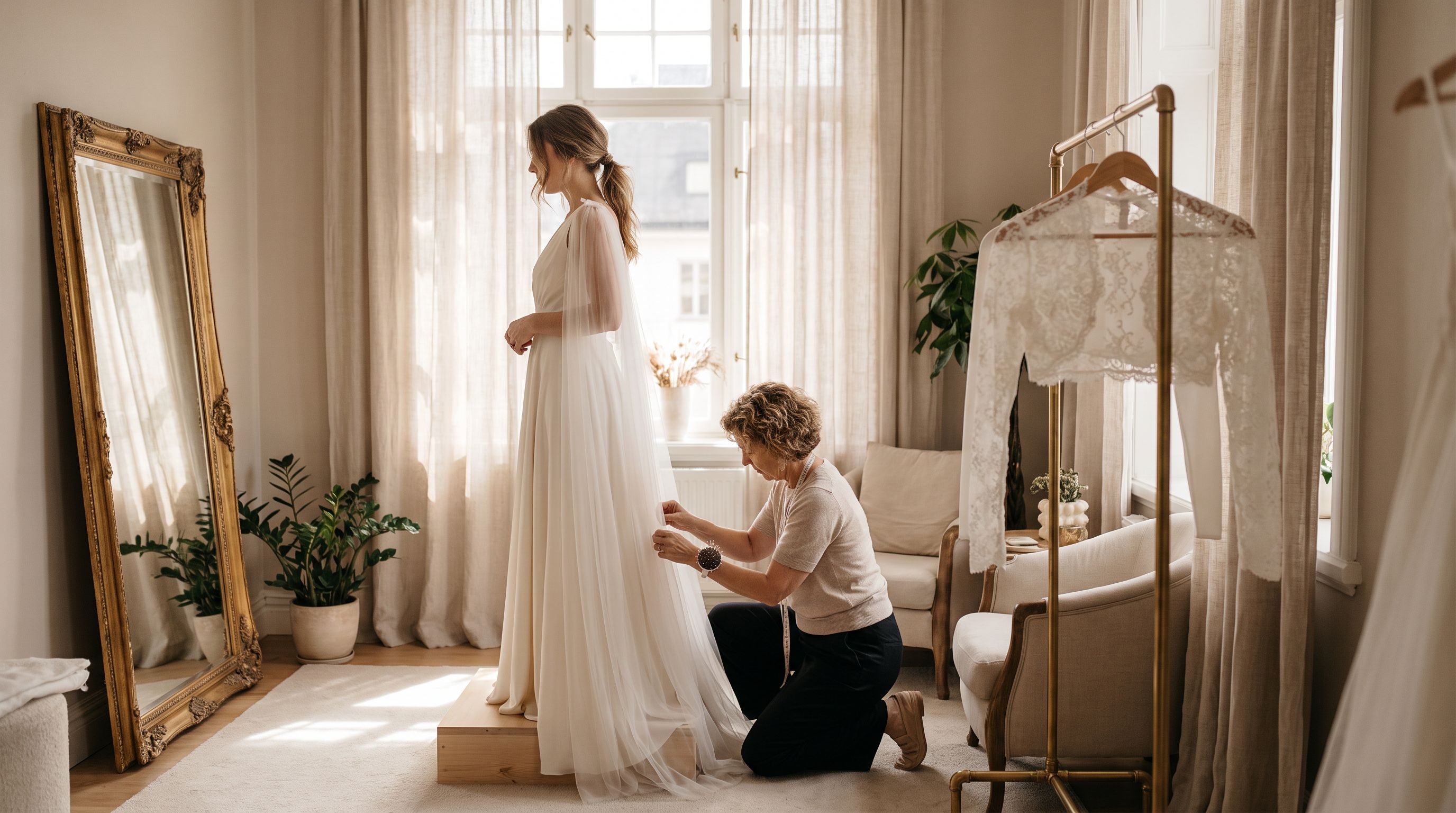
Why so many people add a cover-up
This comes up constantly in consultations. You love a strapless or thin-strapped silhouette, but the ceremony is in a space with shoulder-coverage guidelines, or your grandmother will be in the front row, or it’s October in a stone chapel, or you simply want one more moment of drama walking down the aisle than a bare neckline gives you.
A cover-up solves that without compromising the dress you actually want to dance in. It’s also the most budget-friendly way to get two looks from one gown — a cousin of the approach we cover in convertible gowns versus a second reception dress. The catch: these three pieces are not interchangeable. They hang differently, cost differently, and ask different things of your gown’s construction.
What each piece actually is
A cape attaches at the shoulders or neckline and falls free down the back — anywhere from a shoulder-skimming capelet to a cathedral sweep of tulle. It doesn’t pass through the armholes, so it never fights your bodice, but it won’t cover your arms in any structured way. Think about where it goes afterward: a cathedral cape is a wide, slippery thing that creases if it’s bundled onto a chair, so arrange a padded hanger at the venue and brief one person to carry it off.
Detachable sleeves come in two families: sleeves that clip or button onto the gown’s straps or armhole seams, and “floating” off-shoulder sleeves held by elastic or a hidden back strap. These are the closest thing to a real sleeve — and the most demanding, because the armhole is where fit lives or dies. Removed, they’re small enough to tuck into a clutch, though elastic-backed ones crease, so hand them to someone rather than leaving them on a bathroom hook. For more, see our breakdown of sleeve types, fit, and cost.
A bolero or jacket is a separate constructed garment: shoulder seams, set-in sleeves, usually lined. It’s genuinely tailored, so it needs its own pattern and fittings — essentially a small second garment. It also holds its shape and needs a hanger for the rest of the night, so decide in advance who takes it and where it hangs.
What a custom cover-up typically costs
Prices vary enormously with fabric, handwork, your maker’s experience, and your city. Use these as starting points for your own estimate, not as quotes.
If those numbers aren’t realistic for you, there are honest cheaper routes. Ask whether a local seamstress can make a simple capelet or straight sleeves from your gown’s leftover fabric — the yardage is already paid for, so you’re buying labor only. An heirloom piece — a parent’s or grandparent’s lace jacket, a relative’s shawl — can often be taken in, shortened, or relined for a modest alteration fee, and carries meaning a new piece can’t. And ask your maker whether your veil can double as shoulder coverage: a wide, soft tulle veil draped forward over the shoulders satisfies some coverage expectations at no extra cost.
The cost drivers are simple once you see them:
- Fabric yardage and quality. A cathedral cape can eat four to six yards; in silk tulle that’s the whole budget.
- Lace matching. Carrying your bodice motif onto sleeves means cutting around the pattern and hand-appliquéing edges — hours, not minutes.
- Edge finishing. A raw tulle edge is free. Horsehair hems, hand-rolled silk, and scalloped lace borders are where time stacks up.
- Lining, structure, and attachment. Boleros need lining and closures; hidden snap tape or thread loops that vanish under a bare neckline take real skill.
Fit details that separate a good cover-up from a sad one
Weight versus support. A long cape in heavy fabric pulls backward and down on whatever it’s attached to. Anchored to a strapless neckline, that neckline will migrate — and the fuller your bust, the harder it pulls, because there’s more weight already asking that edge to stay put. Good makers anchor the cape into the gown’s internal structure rather than the surface fabric, or spec a lighter fabric. If your bodice relies on a corselette, discuss it early — see corset versus built-in bra support.
Bodies aren’t standard, and sleeves are where that shows. If you have fuller upper arms, ask for one to two extra inches of bicep ease and a slightly lower armhole so you can raise your arms overhead, and ask for a taller sleeve cap so the sleeve sits smoothly rather than straining. Broad shoulders need the shoulder seam and cape anchor points moved outward so nothing cuts in; narrow or sloping shoulders need the opposite, plus a hidden back strap, because floating off-shoulder sleeves slide straight down otherwise. None of this is a special request — it’s ordinary drafting, and any maker worth booking will already be measuring for it.
Armhole mobility. Always move in a sleeve at the fitting: arms forward, arms overhead, a mimed hug. A tight bicep feels fine standing still and awful by the first dance.
Clean removal. The wearer should be able to shed the piece alone, in a bathroom, in under a minute. Ask directly: how do I take this off by myself? Thread loops over covered buttons are discreet; an unpicked seam is not.
Color. Ivory is not one color. Tulle against satin can read a half-shade cooler under daylight. See the pieces together outdoors and under warm light before anything is finished — our ivory, champagne, and blush guide explains why. Ultimately, a cover-up should feel like part of the gown’s design, not something borrowed from it.
Choosing by ceremony, venue, and weather
If your ceremony has coverage requirements, sleeves or a bolero are the honest answer — a sheer cape falling behind the shoulders rarely satisfies a shoulders-and-upper-arms guideline. Confirm the expectation in plain terms, and if modesty is a core value rather than a one-hour accommodation, consider building coverage into the gown itself; see modest custom gowns. Outdoors, capes photograph gloriously but wind is real — two anchor points behind the shoulder behave far better than a single neckline tie. In cold stone buildings, a lined bolero in crepe or mikado actually warms you; tulle does not. In heat, one layer of silk chiffon, unlined, is the only comfortable option.
How it fits into your timeline
-
Raise it at the consultation
Bring inspiration photos for the cover-up as well as the gown, and ask for extra fabric from the same bolt at the outset. -
Decide attachment at the toile stage
Once the bodice is locked in the muslin, armholes and anchor points can be drafted rather than retrofitted. -
Fit the cover-up after the bodice fits
A sleeve can only be fitted to a finished armhole — expect pinning at the second or third fitting. -
Rehearse the quick change
At the final fitting, remove it alone, with hair and veil in place. Then put it back on. Twice.
What to ask before you commit
- How will this attach, and can I take it off by myself in a minute?
- Will the attachment points be visible once it’s removed?
- Are you ordering extra fabric or lace now so it matches later?
- How will the weight affect my neckline staying put?
- Can I move my arms fully — may I try a toile version?
- Is the cover-up priced in the gown quote or billed separately?
Here’s a concrete next step: email two makers the same three questions — how it attaches, whether they’ll order matching fabric now, and how the weight will affect your neckline — and compare how specifically they answer. One will send construction detail, fabric names, and a fitting sequence; the other will send reassurance. That difference tells you more than any portfolio.
Ready to bring your dream dress to life?
Tell us what you're picturing — style, timeline, and budget — and we'll connect you with custom dressmakers who can make it. Free, no obligation.
Get matched with a dressmakerRelated guides
Outdoor Wedding Dress: Rain, Grass, and Humidity Guide
How to choose a custom outdoor wedding dress that survives rain, grass, wind, and humidity — fabric picks, hem strategy, and what weatherproofing costs.
Read guide →
Halter vs One-Shoulder vs Asymmetric Gown: Fit & Cost
Halter vs one-shoulder wedding dress: how each neckline carries weight, flatters different shoulders and busts, what it costs custom, and what to ask your maker.
Read guide →
Butter Yellow Wedding Dress: Custom Color, Fit, Cost
Butter yellow is bridal's softest new neutral. Here's how custom dyeing works, which fabrics hold the shade, what it costs, and how to pick your tone.
Read guide →