 Custom
 Summer Wedding Dress: Hot-Weather Fabric Guide
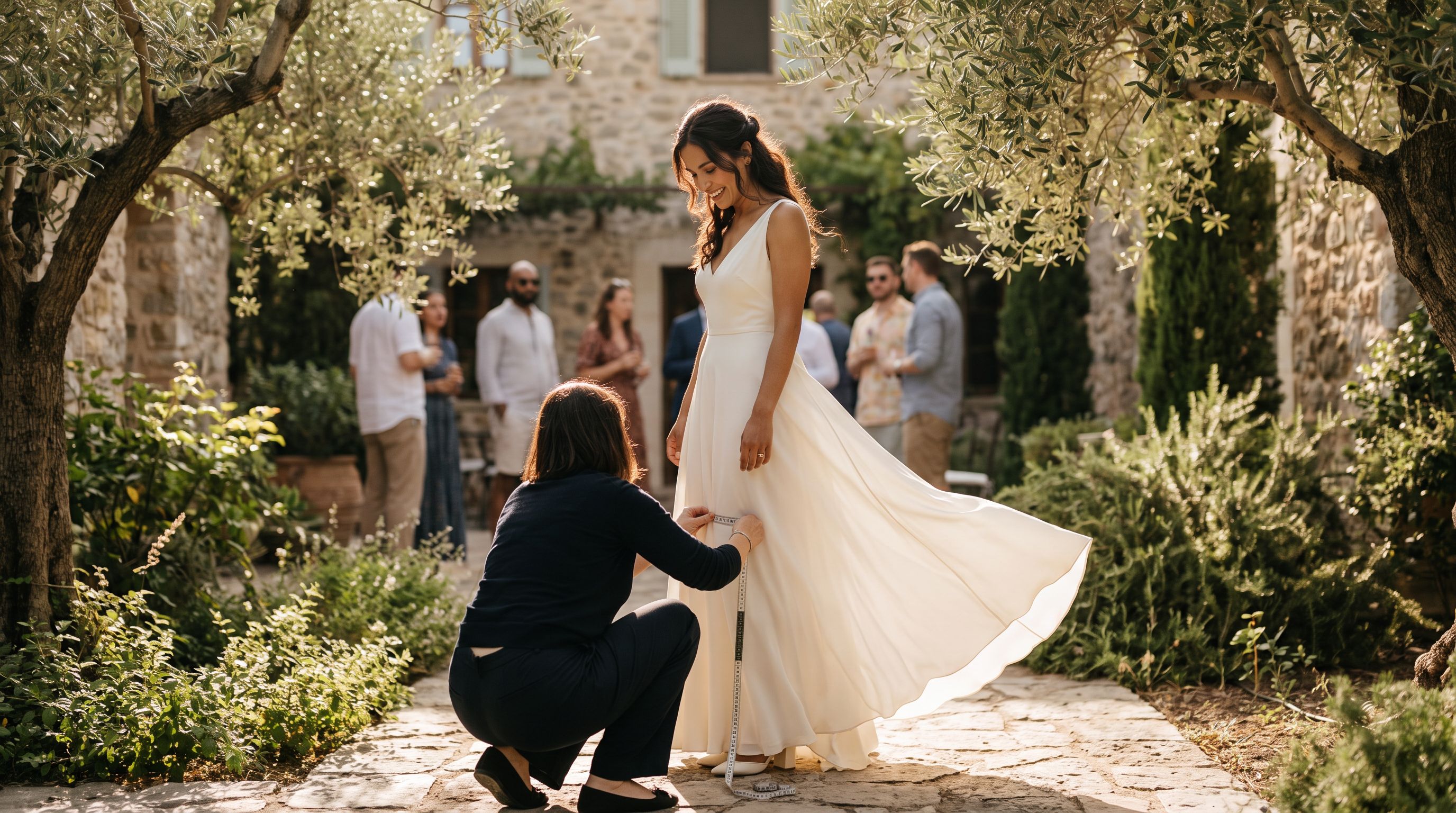
Why heat changes the brief, not just the fabric
A summer gown has a longer list of jobs than a winter one. It has to stay comfortable through a ceremony in full sun at 85–95°F (29–35°C), survive a cocktail hour where you’re hugging two hundred people, photograph beautifully in harsh midday light, and not go translucent when the sun hits it from behind.
Most people start and stop at “something light.” But a garment’s weight is only part of the equation. Breathability — whether air and moisture can actually pass through the cloth — is a property of the fiber, not the weight. A feather-light polyester chiffon and a feather-light silk chiffon look nearly identical on a hanger and behave completely differently against skin at 90°F (32°C). Polyester is a plastic filament; it doesn’t absorb moisture, so perspiration sits on your skin instead of wicking away. Silk, cotton, and linen absorb and release moisture, which is why they feel cool.
None of this is specific to a white dress. If you’re wearing a lehenga, an áo dài, a two-piece, a jumpsuit, or a suit, the same fiber-and-lining logic applies: a silk-blend lehenga with a cotton-lawn-lined blouse wears very differently from the same shape in polyester with stiff fused interlining, and a linen or tropical-wool suit breathes where a bonded synthetic one won’t.
This is the whole argument for going made-to-measure for a hot-weather wedding: in a shop, you get the fabric the manufacturer chose at the price point they were building to. With a dressmaker, you choose the fiber, the lining, and the support structure for your actual venue and your actual body.
The fabrics that genuinely breathe — and the ones that only look light
Silk georgette and silk crepe de chine are the workhorses of hot-weather bridal. Georgette has a faint grain and a dry, floaty hand that moves constantly in a breeze; crepe de chine is smoother and more fluid. Both drape close without clinging and photograph softly in bright sun.
Silk chiffon is the lightest of the group, nearly weightless, and usually used in multiples — two or three layers over a lining for opacity. More layers means more air trapped, so it’s cooler than satin but not as cool as a single-layer georgette.
Cotton voile, organdy, and Swiss dot are underrated: crisp, matte, and cool, and lovely for garden and backyard weddings. They wrinkle — that’s the trade — but on a relaxed outdoor day, a soft crease reads as charming, not sloppy.
Linen and linen-silk blends are having a genuine moment for coastal and vineyard weddings. Expect texture and wrinkles; embrace them or don’t choose it.
Silk tulle is dramatically softer and lighter than the nylon tulle used in most mass-market gowns, and it costs considerably more. If you want volume in the heat, this is where to spend.
What to be careful with: polyester satin, mikado, and duchesse are structured, gorgeous, and warm. They’re not wrong for summer — a mikado column in an air-conditioned ballroom is stunning — but they’re wrong for a ceremony on a lawn at 4pm. If you’re weighing structure against drape, our breakdown of crepe, satin, and mikado goes deeper.
The layers nobody sees — lining, boning, and support
Here’s where a good dressmaker earns their fee.
Lining. Ask specifically. The cool choices are cotton batiste, silk habotai (china silk), or a fine cotton lawn. The common default in budget construction is polyester bridal lining, which is cheap, opaque, and hot. A skilled maker can also line only where opacity is needed — through the bodice and to mid-thigh — and leave the lower skirt unlined so air moves.
Support. A fully boned corselette is secure but adds a compression layer across your torso. For summer, many makers use a lighter internal structure: a few strategic bones, a cup-and-band built-in bra, or power mesh instead of a full foundation. Lightweight construction adapts to any body — a larger bust or larger frame is often better served by wider straps and a longer, firmer underbust band that carries weight across more surface area rather than by more boning; a petite frame usually needs the band and cups scaled down rather than a shorter bodice chopped from a standard pattern; and if you want no bust support at all, a smooth, well-cut slip with no boning and a soft inner stay is a completely legitimate choice. Our guide to corset versus built-in bra support walks through the trade-offs honestly.
Water-spotting. This is the warning nobody gives you. Silk dupioni, taffeta, and some crepes can mark where they get wet — including from perspiration — and those marks can be very difficult or impossible to remove at home. A specialist dry cleaner can often reduce or remove water spots on silk, but it isn’t guaranteed, so test the method on a spare swatch first. If you run warm or you’re marrying somewhere humid, say so out loud. Remedies include sewn-in dress shields under the arms, choosing a fiber and weave less prone to spotting, and testing a swatch with water before you commit.
Sun transparency. Thin fabric backlit by low sun can become see-through in photographs even when it looks opaque indoors. A good maker will hold your fabric and lining combination up to a window and show you.
Coverage and sleeves without overheating
If you want or need sleeves — for modesty, for sun protection, for how you feel most yourself — summer doesn’t take that away from you. The move is the lightest, most open structure possible: silk chiffon bishop sleeves that balloon away from the arm, unlined georgette flutter sleeves, fine cotton net, or an open-weave lace rather than a dense one. A sleeve that stands slightly off the skin is cooler than a close fitted one, and an unlined sleeve is dramatically cooler than a lined one.
Detachable sleeves and overlayers are genuinely practical here: full coverage for the ceremony, lighter for the dancing. If coverage is a priority, our modest custom gown guide covers sleeve shapes, linings, and the cost of added yardage in more detail.
What a hot-weather custom gown typically costs
Prices vary enormously by region, by the maker’s experience, and by how much hand-work your design involves — treat these as starting frames to adapt, not benchmarks.
The drivers to understand: fiber (silk costs several times what polyester does per yard, and lightweight silks demand more skill and time to cut and sew cleanly), yardage (a full chiffon skirt can eat twenty-plus yards; a bias slip might use six), hand-work (beading, hand-rolled hems, French seams — all common in sheer summer fabrics and all time-intensive), and your maker’s overhead and market. Two more that blindside people: ask how many fittings are included in the quoted price versus billed hourly, and whether any alterations after the final fitting — weight changes, a last-minute hem for different shoes — are extra. Get both answers in writing before you sign.
One honest note: lightweight silk is not the budget option. If your budget is tight, a beautifully cut cotton voile or a silk-blend crepe will serve you better than a cheap polyester chiffon dressed up as luxury.
Timing and fittings for a summer date
-
Start 8–12 months out
Lightweight silks are often ordered in, not stocked. Build in time for swatches, sampling, and a sun test. -
Do a water and light test at the swatch stage
Dab the swatch with water, let it dry, and hold it up to strong daylight with the lining behind it. Five minutes now prevents a real problem later. -
Fit the toile in realistic conditions
A muslin that fits beautifully in a cool studio may feel different on a humid day. Mention how you’ll be moving — sitting through a ceremony, dancing outdoors, walking on grass. -
Plan the hem for your ground
Grass, sand, and stone all require different hem lengths and finishes. Bring your actual shoes to every fitting from the second one on. -
Schedule the final fitting close to the date
Two to four weeks out is typical, so the fit reflects your body as it is that month.
If your wedding is somewhere genuinely tropical and you’re flying with the outfit, the destination and elopement gown guide covers packing, steaming, and fabrics that survive a suitcase.
What to ask before you commit
A maker who’s comfortable with hot-weather construction will answer these easily: What fiber is the lining, and can we make it breathable? How will the bodice be supported, and can we lighten it? Will this fabric water-spot? Can we leave part of the skirt unlined? Have you worked with this fabric before — can I see or feel a finished piece?
Hesitation on the lining question is the one to notice. It’s the detail that separates a maker thinking about your wedding day from one thinking about the hanger.
If you’re weighing a warm-weather design against a cooler-season one — or marrying in a climate that swings — our winter gown guide is the companion piece. Your next concrete step: take your venue photos and three swatch samples to your first consult, and run the water-and-backlight test on all three before you book anything.
Ready to bring your dream dress to life?
Tell us what you're picturing — style, timeline, and budget — and we'll connect you with custom dressmakers who can make it. Free, no obligation.
Get matched with a dressmakerRelated guides
Outdoor Wedding Dress: Rain, Grass, and Humidity Guide
How to choose a custom outdoor wedding dress that survives rain, grass, wind, and humidity — fabric picks, hem strategy, and what weatherproofing costs.
Read guide →
Halter vs One-Shoulder vs Asymmetric Gown: Fit & Cost
Halter vs one-shoulder wedding dress: how each neckline carries weight, flatters different shoulders and busts, what it costs custom, and what to ask your maker.
Read guide →
Butter Yellow Wedding Dress: Custom Color, Fit, Cost
Butter yellow is bridal's softest new neutral. Here's how custom dyeing works, which fabrics hold the shade, what it costs, and how to pick your tone.
Read guide →