 Custom
 Custom Winter Wedding Dress: Fabric, Sleeves, Warmth
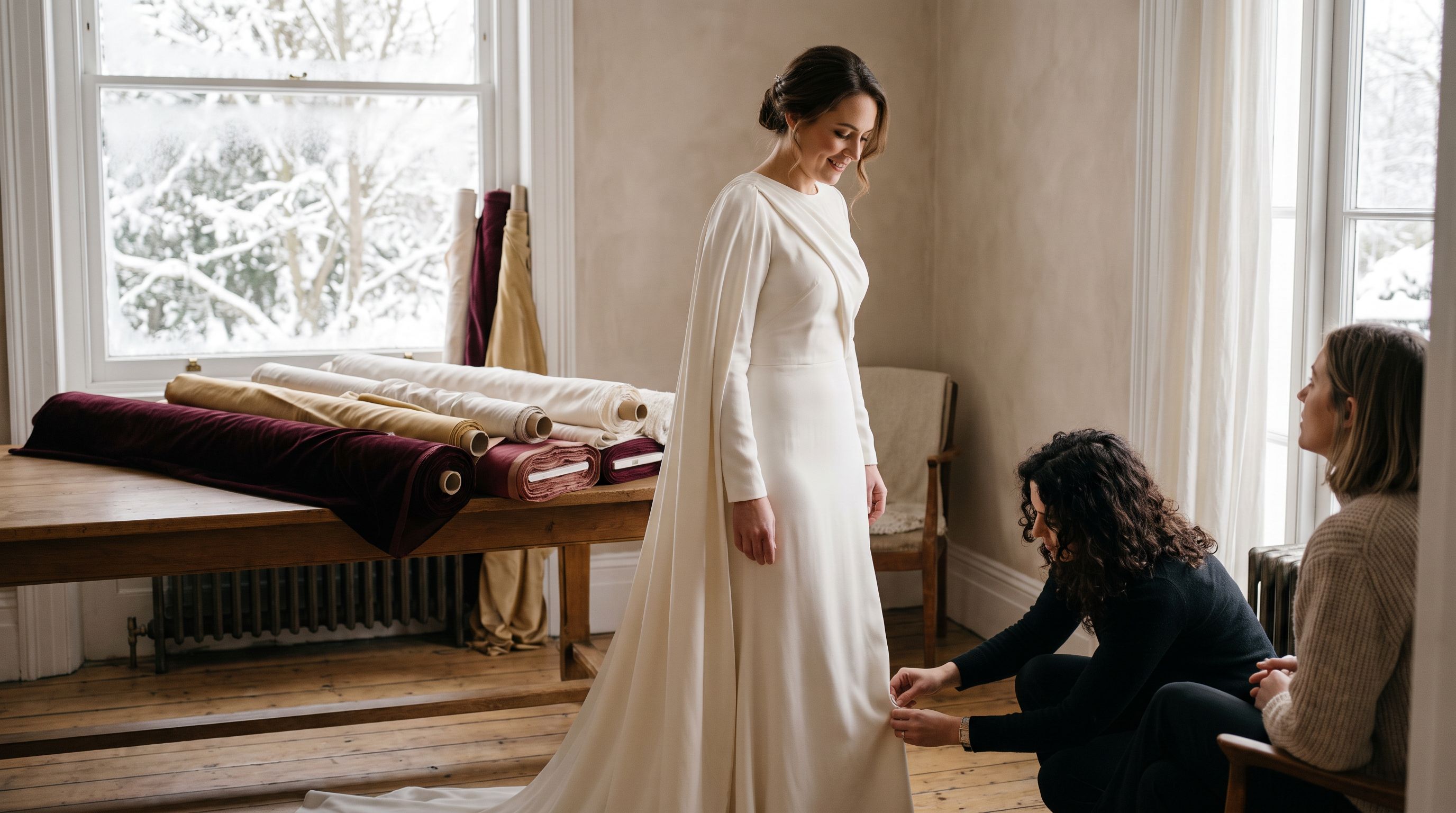
There’s a particular kind of disappointment that happens in January: someone standing outside a stone church for photos, gorgeous in their gown, shoulders locked around their ears, being handed a borrowed black puffer between shots. It’s fixable — but it has to be designed in from the beginning, not solved with a cardigan three days before.
A custom winter gown is one of the strongest arguments for going made-to-measure at all. Off-the-rack bridal is manufactured for a single global season and skews light: unlined tulle, thin crepe, illusion everything. When you’re working with your own dressmaker, warmth becomes a design variable you actually control.
This applies whether your gown is ivory, deep green or red, and whether you’re a bride, a groom or non-binary client in a made-to-measure gown, suit or jacket. It applies to multi-outfit celebrations too — and if you’re wearing a lehenga, hanbok or áo dài in January, the answer is almost always a beautifully made outer layer plus smart underlayers rather than a redesigned garment. Same principles, different silhouette.
Warmth comes from weight and layers, not sleeves alone
The most common misunderstanding: you ask for long sleeves and assume the problem is solved. If those sleeves are illusion tulle or fine lace — which is what most “long-sleeve” bridal looks are — they’re beautiful and functionally transparent. Air moves straight through them.
Real warmth comes from three stacked decisions:
- The face fabric — the weight and fiber of what people see.
- What’s underneath it — lining, underlining, and (the one most people have never heard of) interlining.
- Removable layers — a cape, coat, capelet or stole you can take on and off as the day moves indoors and out.
A skilled maker will talk you through all three. If someone only offers to add sleeves, ask what’s going under the skirt and bodice too.
The fabrics that actually hold heat
Fiber matters more than thickness. Silk and wool insulate genuinely well. Polyester crepe is affordable, durable and often what makes a gown possible at all — the trade-off is that it breathes less, so pair it with a natural-fibre lining (cotton, silk, or rayon/bemberg) or a thin interlining if you’ll be moving between cold air outside and an overheated room.
- Silk or rayon-blend velvet. The warmest bridal-appropriate option and deeply photogenic in winter light. Heavy, drapes into liquid columns, unforgiving of fussy seaming.
- Wool crepe and wool-silk blends. Underrated. Matte, structured, beautifully modern for a city hall or restaurant wedding, and warm without bulk.
- Mikado and heavy duchesse satin. Thick, sculptural, wind-resistant. See our crepe vs satin vs mikado comparison for how each behaves in a seam.
- Double-faced crepe. Substantial, matte and self-lining in effect — a favorite for sleeves that need to look sleek rather than puffy.
- Heavy corded lace over an opaque base. Lace is airy on its own, but backed with charmeuse or crepe it reads warm and rich.
Heavy fabrics don’t sit the same way on every body, and that’s a fitting conversation, not a limitation. Velvet and mikado add visual volume wherever they fall, so on a fuller bust a heavy bodice usually needs real internal support — boning, a wider strap, or a built-in bra — so the weight hangs from structure rather than dragging on your shoulders. On a petite frame, a full-length velvet can read like a blanket unless the maker reduces yardage in the skirt or breaks the column with a waist seam. Chiffon, georgette, fine net and unlined tulle are still lovely in winter as overlays — see our tulle, organza and chiffon skirt guide — but everything beneath them has to do the work.
Sleeves that do more than decorate
If warmth is a priority, the sleeve needs to be opaque and lined. A lined long sleeve in crepe, velvet or satin-backed lace is a genuinely different garment from a tulle sleeve with appliqué floating on it. Sleeves must also be drafted to your actual bicep and armscye measurements — on wider upper arms, a lined sleeve cut from a standard block will restrict your arms all night, and adding the lining without re-drafting the armhole is exactly how that happens.
- Fitted long sleeve, fully lined — sleekest and warmest per square inch; needs precise fitting through bicep and elbow.
- Bishop or blouson sleeve — romantic volume gathered into a cuff, trapping a pocket of warm air.
- Detachable sleeves — buttoned or hooked at the shoulder seam. Expect these to cost more than fixed sleeves, because the attachment has to be invisible and secure.
If modesty or coverage is part of your brief as well as warmth, our guide to modest custom gowns and sleeve construction goes deeper.
A long sleeve you can’t raise your arms in is not a warm sleeve — it’s a warm sleeve you’ll take off by 8pm.
The layer you take off: capes, coats and stoles
The most elegant solution to a winter wedding is almost always a removable layer, because it lets one gown handle a cold ceremony, a warm reception and photos outside in between.
Other small, unglamorous things that work: opaque silk or bamboo base layers, fleece-lined tights, hand warmers in a pocket sewn into the lining, and closed shoes with a real sole.
What warmth actually adds to the budget
Warmth is a cost driver like any other: more yardage, pricier fiber, extra internal layers, additional pieces. Nothing here is fixed — it depends on fabric, beading, your maker’s experience and your local market.
The honest math: a heavy gown uses similar yardage at a higher price per yard, and takes longer to sew because every seam is bulkier to press and finish. Velvet in particular is slow work — it shifts, marks under an iron, and has a nap direction that eats extra yardage. A maker quoting velvet higher than crepe isn’t padding the bill.
Planning the build, step by step
-
Bring the venue, not just the dress, to your consultation
Tell your maker where the ceremony is, whether you’ll be outdoors for photos, how long the gap is, and whether the reception space is heated or a converted barn. -
Handle the fabric in cold-weather weight
Ask to drape samples over your shoulders, not just hold a swatch. Heavy fabrics behave completely differently at scale. -
Decide the removable layer early
A cape or coat is a second garment with its own pattern and fittings. Deciding at fitting three is expensive; deciding at consultation is not. -
Fit in the underwear and layers you'll actually wear
Bring your base layers and thicker tights to every fitting. A quarter inch of extra layer across the torso changes how a fitted bodice closes. -
Test range of motion at the toile stage
Raise your arms, hug someone, reach for a glass. Sleeve mobility is fixed at the pattern stage — after the good fabric is cut, options narrow fast.
How to tell you’ve found the right maker for this
A dressmaker comfortable with winter work will ask about your venue before your inspiration board. They’ll volunteer the difference between a lined and unlined sleeve without prompting, and tell you honestly if the silhouette you love doesn’t work in velvet. They should be able to show you finished work in heavier fabrics — velvet, mikado, wool blends — not just tulle ballgowns; pressing and seam finishing on heavy cloth is a specific skill that photographs clearly.
Before you meet anyone, gather three things: photos of your venue including where you’ll stand for pictures, your inspiration images, and one honest sentence about how much cold you can genuinely tolerate. Then ask each maker the same questions: what face fabric, lining and interlining they’d use; whether the sleeves are lined; whether the removable layer is included or quoted separately; and how the hem will be finished. If you’re comparing two or three quotes, ask everyone to price the same specification — same fibre, same lining, same cape length — otherwise you’re comparing a silk-lined gown to a poly-lined one without knowing it. A quote that itemises fabric, lining, internal structure and fittings separately is easier to compare, and far easier to adjust if the total lands higher than you’d hoped.
Ready to bring your dream dress to life?
Tell us what you're picturing — style, timeline, and budget — and we'll connect you with custom dressmakers who can make it. Free, no obligation.
Get matched with a dressmakerRelated guides
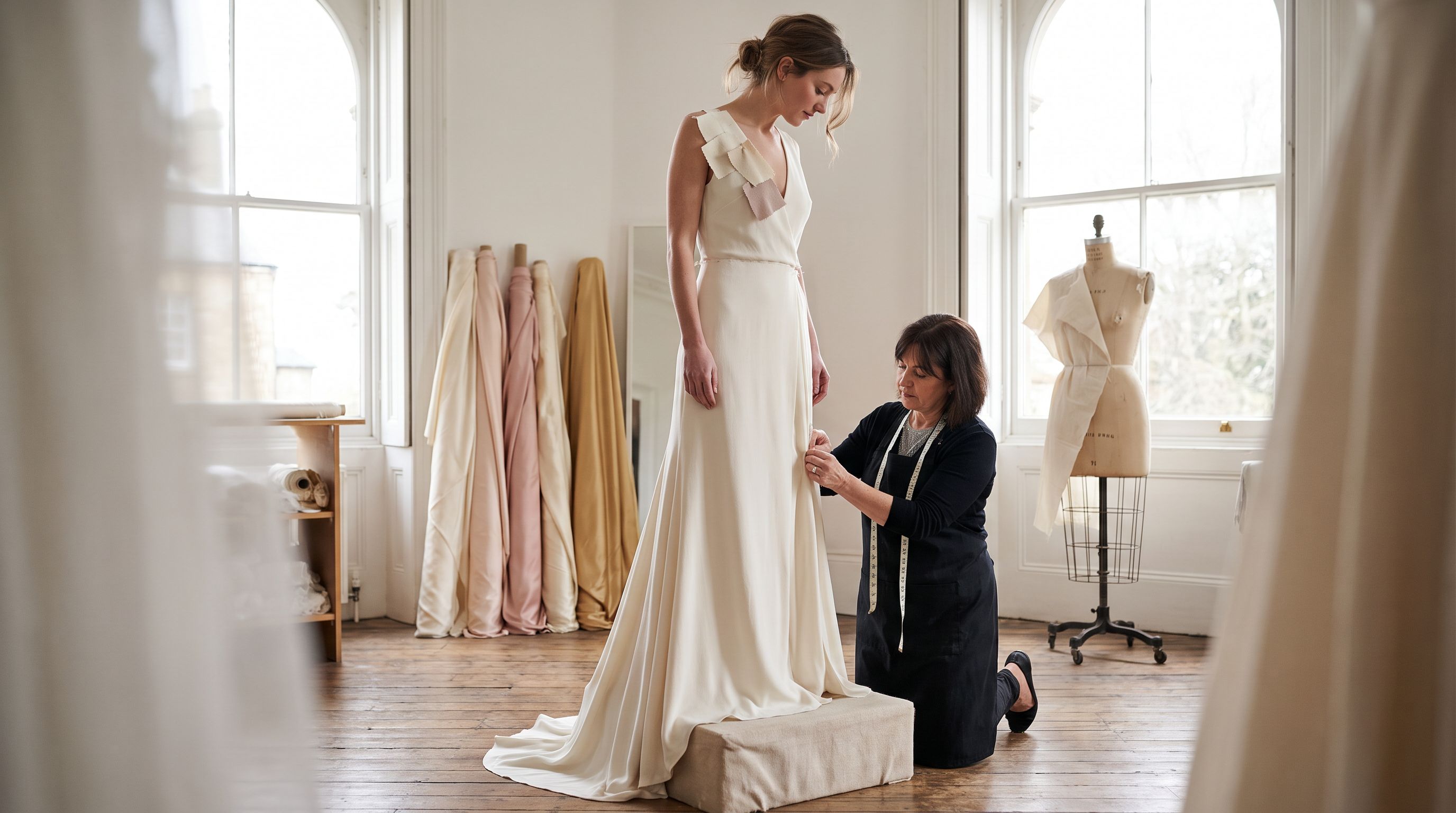
Custom Wedding Dress for Apple-Shaped Brides: Fit Guide
How a custom wedding dress solves fit for apple-shaped brides: the best silhouettes, internal support, fabrics, fittings, and realistic costs.
Read guide →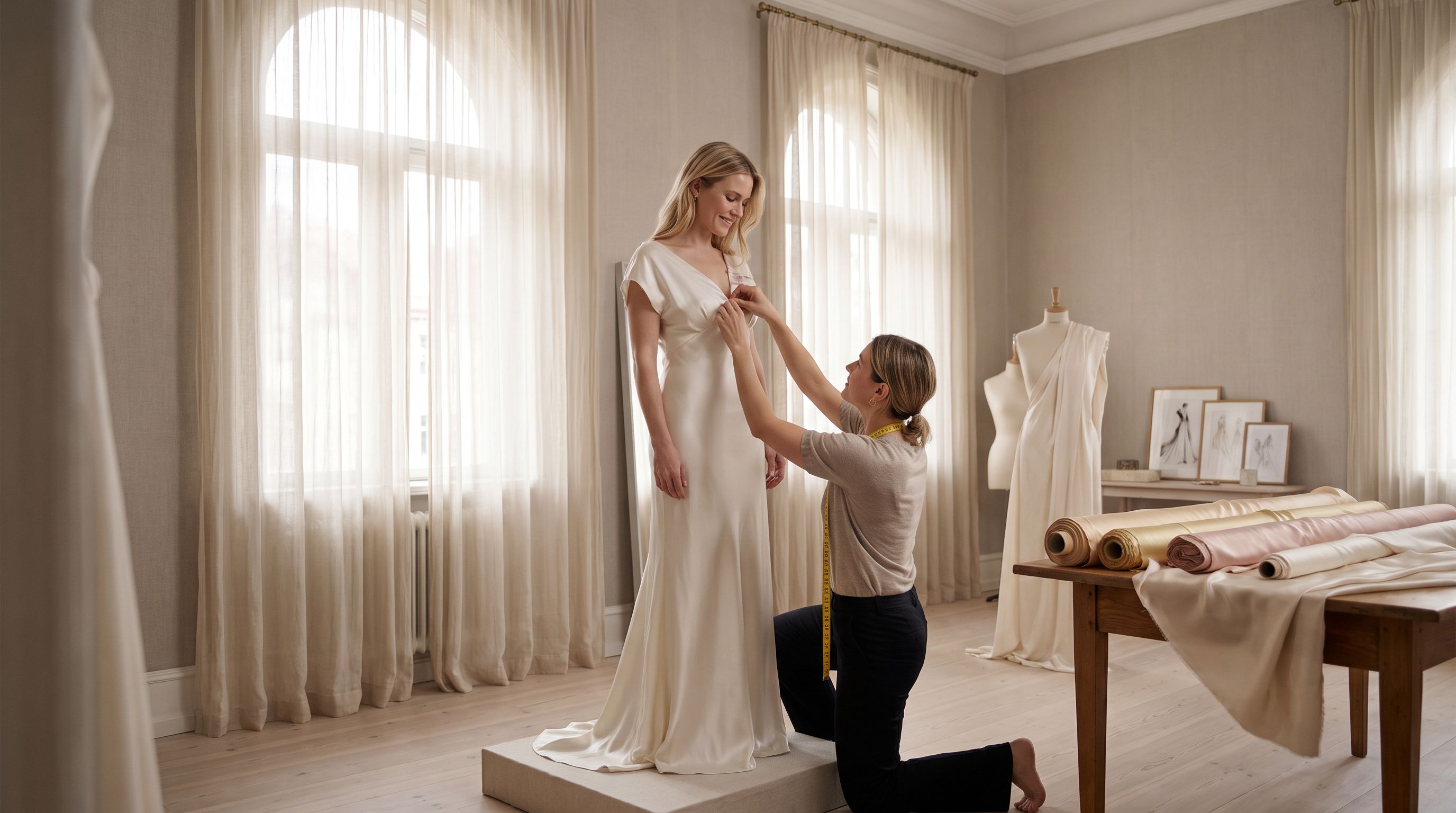
Custom Wedding Dress for a Small Bust: A Real Fit Guide
A custom wedding dress for a small bust: how bodices get cup-sized, strapless support without heavy padding, flattering necklines, and realistic cost ranges.
Read guide →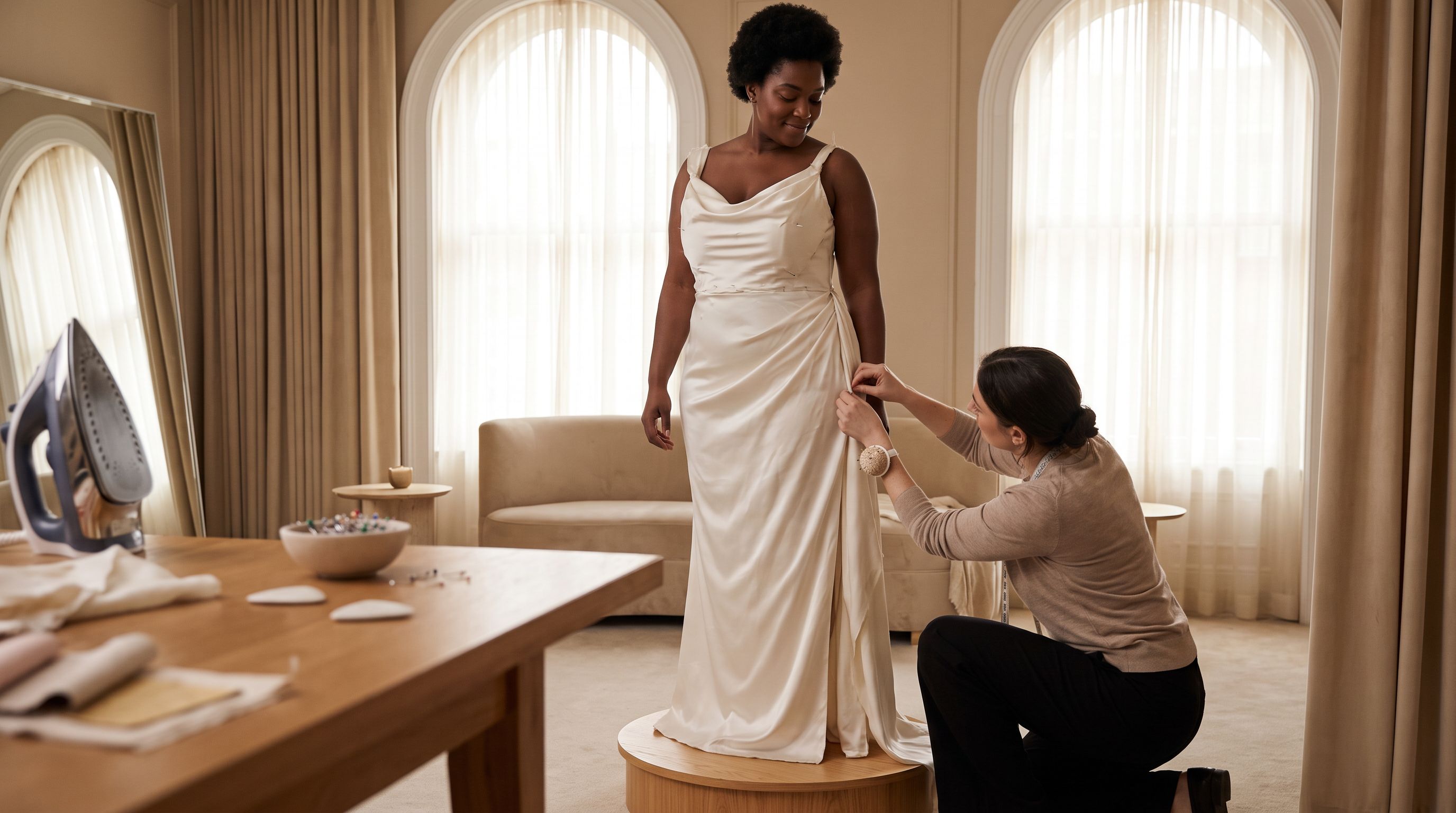
Custom Wedding Dress for Pear-Shaped Brides: Fit Guide
A custom wedding dress for pear-shaped brides solves the hip-to-waist gap standard bridal sizing can't. Silhouettes, fabrics, fittings, and real cost ranges.
Read guide →