 Custom
Sweetheart vs V-Neck vs Square: Custom Neckline Guide
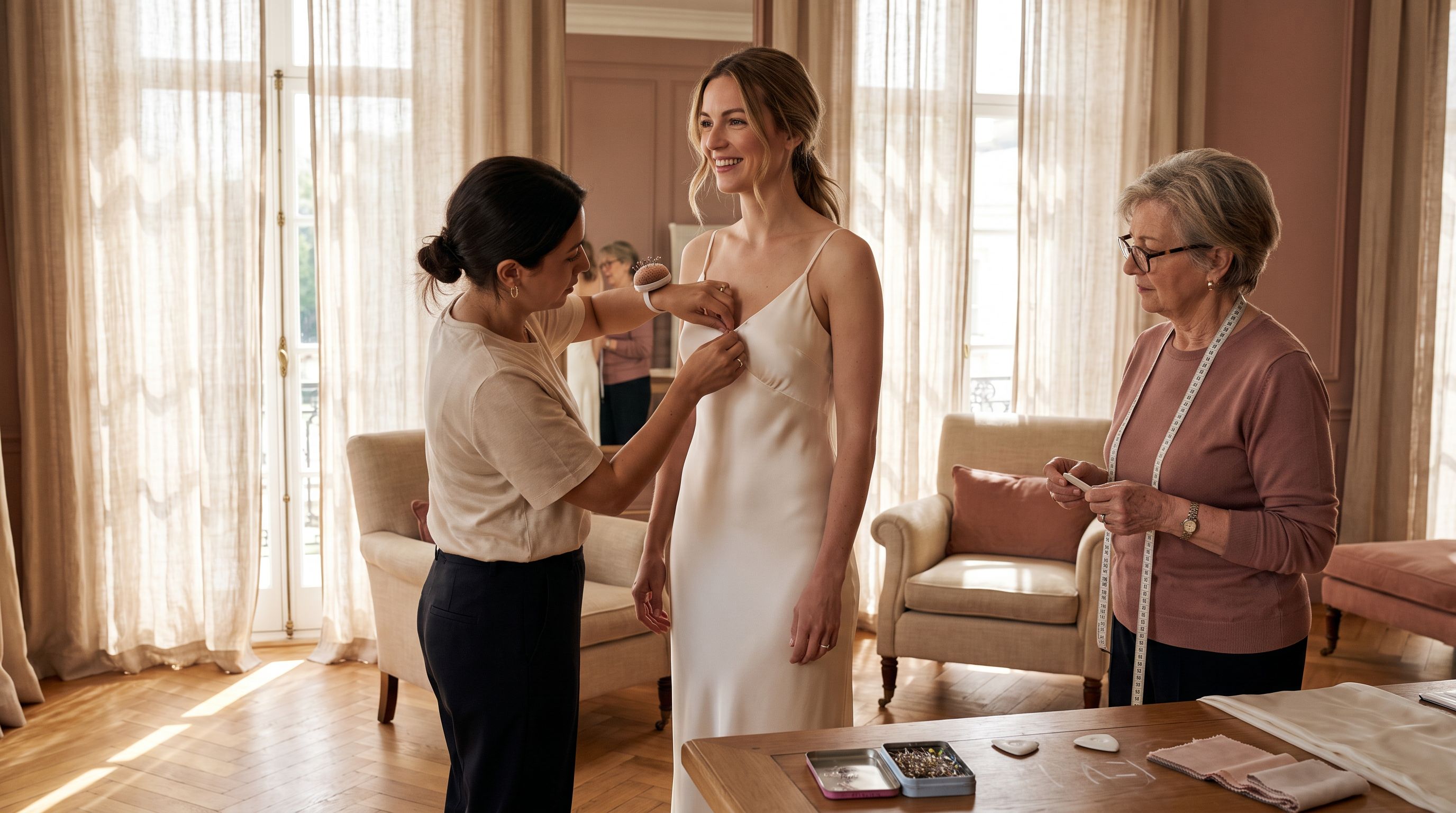
Why the neckline matters more than people expect
Most people start with silhouette — A-line, mermaid, ball gown — and treat the neckline as a finishing detail. In the fitting room, it’s the opposite. The skirt is what guests see walking down the aisle; the neckline is what appears in every photograph from the chest up, which is most of them.
The neckline does three jobs at once. It frames your face and jawline. It divides your upper body horizontally or vertically, which changes how long your neck and torso appear. And structurally, it determines where boning can end, where a cup can sit, and how much the bodice can grip — which is why a good maker asks about it early and keeps adjusting it until the last fitting.
Everything here applies to any gown wearer, regardless of gender or how you describe your body — the fitting logic is about shoulders, chest depth, and posture, not labels. And if you’re planning multiple ceremonies or a change of outfit, or if shoulder and chest coverage rules, religious modesty standards, or family expectations shape what the neckline can be, raise all of it at the very first consultation. Those requirements are design constraints like any other, and they’re far easier to build around than to retrofit.
The real advantage of going custom for necklines specifically: the same “sweetheart” looks entirely different scaled to a 32B versus a 40DDD, and in a made-to-measure process the line gets drawn on your actual body and moved half an inch at a time until it’s right.
The sweetheart: soft, romantic, and all about scale
A sweetheart dips into two gentle curves over the bust. It reads traditional, shows collarbones, and gives natural-looking lift when the curve sits exactly where your breast tissue begins — not above it, not through the middle of it.
Where it goes wrong is scale. A deep, pronounced sweetheart on a small bust can look empty, with fabric standing away from the body. On a very full bust, a shallow sweetheart pushes tissue upward and creates the “double bust” line that no amount of steaming fixes. The fix in custom is straightforward: your maker adjusts the depth and width of the curve and the cup seaming underneath. If you have a full bust and a smaller waist, ask specifically for a seamed or molded cup inside the sweetheart rather than a flat lined bodice.
The V-neck: the lengthening line
A V-neck draws the eye vertically, which is why it’s the quiet workhorse if you want to look longer through the torso or break up a full bust. It also softens the horizontal line across broad or square shoulders.
Depth is the variable that matters. A shallow V is polite and photographs beautifully with a necklace. As a working rule in fittings, once the point of the V drops more than roughly two inches below the fullest part of the bust — which on a D cup or above often means it’s heading toward the underbust — it needs engineering: internal tape, a modesty panel or illusion mesh, and sometimes discreet fashion tape on the day. Where a V genuinely misfires is on a short neck combined with a high, shallow cut: a V that stops above the bust shortens the whole upper body rather than lengthening it. If that’s your proportion, go deeper or choose another shape.
V-necks pair unusually well with sleeves — a long sleeve plus a V keeps coverage without closing in your face. Our guide to sleeves and coverage in modest custom gowns goes deeper on keeping a dress modest and still unmistakably yours.
The square neckline: architectural, modern, widely flattering
In our fittings over the last few seasons, square necklines come up more often than any other shape, and the appeal is easy to see. A clean horizontal front with straight or near-straight sides creates a strong, calm frame for the face and makes shoulders look intentional rather than accidental.
It’s particularly good on sloped shoulders, where it fills the visual gap, and on athletic or broad-shouldered frames when the width is pulled slightly inward from the shoulder point.
The risk is squareness itself. As a rough guide, once your shoulder-point-to-shoulder-point measurement is past about 16 inches, a square cut to the full shoulder width starts to broaden the frame rather than flatter it — pulling each corner in three-quarters of an inch to an inch usually solves it. Cut too high, a square flattens the bust and erases the waist-to-bust ratio entirely. Custom solves both at the muslin stage, half an inch at a time.
Beyond the big three
Scoop and round necklines are gentle and forgiving — lovely with softer fabrics — but on a very full bust a wide scoop can slide outward and show bra engineering. Bateau (boat) runs straight across near the collarbones: elegant and covered, strong on a long neck, visually shortening on a short one. Halter opens the shoulders and narrows the upper body visually, useful if your hips read wider than your shoulders and you want to balance the two; it’s the wrong call if you have neck or shoulder sensitivity, since the gown’s weight hangs from your neck all day. High neck and illusion necklines add coverage without weight, though a high neck on a short neck needs a lower front panel seam to avoid a boxed-in look. Off-shoulder and portrait necklines frame collarbones beautifully but restrict arm movement — if you can’t comfortably raise your arms to shoulder height in the muslin, it will only get worse in fashion fabric.
Choose the neckline for your shoulders and your face, not for the dress in the photo. The silhouette can be adapted; the line across your chest is the one you’ll see in every portrait.
What your neckline does to support
This is where necklines stop being decorative. A strapless sweetheart puts all the load on bodice circumference and boning — which means a snug underbust, a stable waist stay, and usually a corseted or heavily structured interior. A deep V removes the center-front support line, so support moves to the sides and the back. A square or high neckline can anchor to the shoulders, which takes pressure off the ribcage and is often more comfortable for a full bust or a long day.
If you’re weighing internal structures, our breakdown of corsetry versus a built-in bra explains which pairs with which neckline, and why strapless doesn’t have to mean uncomfortable.
What neckline changes typically cost in a custom gown
Neckline shape itself is rarely a line item — it’s part of the design in a made-to-measure or bespoke build. Reshaping at the muslin stage is normally included in your quote; confirm that in writing before you book. What costs money is added material and added hand-work.
These figures reflect one market — the US — so if you’re elsewhere, treat them as a shape to calibrate against local labor and fabric costs rather than a number to anchor to. A hand-beaded scalloped edge on imported lace sits at the top of any range; a clean crepe square neckline adds nothing beyond the original quote. If you’re still mapping your overall spend, what different budgets actually buy in a custom gown puts these choices in context.
How to test necklines at your fittings
-
Bring real reference photos — and one you dislike
Showing your maker a neckline that doesn’t work on you is as useful as showing one that does. It tells them what you’re reacting to. -
Try the line in muslin first
A muslin costs a fraction of the fashion fabric and is meant to be drawn on, pinned, and cut into. Ask your maker to chalk two or three neckline options directly onto it. -
Photograph yourself from three angles
Front, three-quarter, and seated. Necklines look different in a mirror than in a camera, and your photographer will use all three. -
Move properly
Hug, raise your arms, sit, lean forward. A neckline that only works standing still isn’t finished. -
Check it with your hair and jewelry
Hair up changes a bateau completely. A pendant can either complete a V or fight it. Test the whole picture before signing off.
What to ask the maker you’re considering
A strong dressmaker will talk about your shoulders, posture, and bust shape before they talk about trends — and will tell you plainly when they’d steer you away from a shape. If the answers you get are specific, measured, and honest about limits, you’ve found someone worth working with. Bring your photos, and bring these questions:
How would you adapt this neckline to my frame? What support will sit under it, and will it anchor to my shoulders or my ribcage? At which fitting is the neckline locked in? What happens if I change my mind after the muslin — and what would that cost? If I need coverage for part of the day, how would you build that in from the start?
Ready to bring your dream dress to life?
Tell us what you're picturing — style, timeline, and budget — and we'll connect you with custom dressmakers who can make it. Free, no obligation.
Get matched with a dressmakerRelated guides
Outdoor Wedding Dress: Rain, Grass, and Humidity Guide
How to choose a custom outdoor wedding dress that survives rain, grass, wind, and humidity — fabric picks, hem strategy, and what weatherproofing costs.
Read guide →
Halter vs One-Shoulder vs Asymmetric Gown: Fit & Cost
Halter vs one-shoulder wedding dress: how each neckline carries weight, flatters different shoulders and busts, what it costs custom, and what to ask your maker.
Read guide →
Butter Yellow Wedding Dress: Custom Color, Fit, Cost
Butter yellow is bridal's softest new neutral. Here's how custom dyeing works, which fabrics hold the shade, what it costs, and how to pick your tone.
Read guide →