 Custom
Made-to-Order vs Made-to-Measure: Salon or Dressmaker?
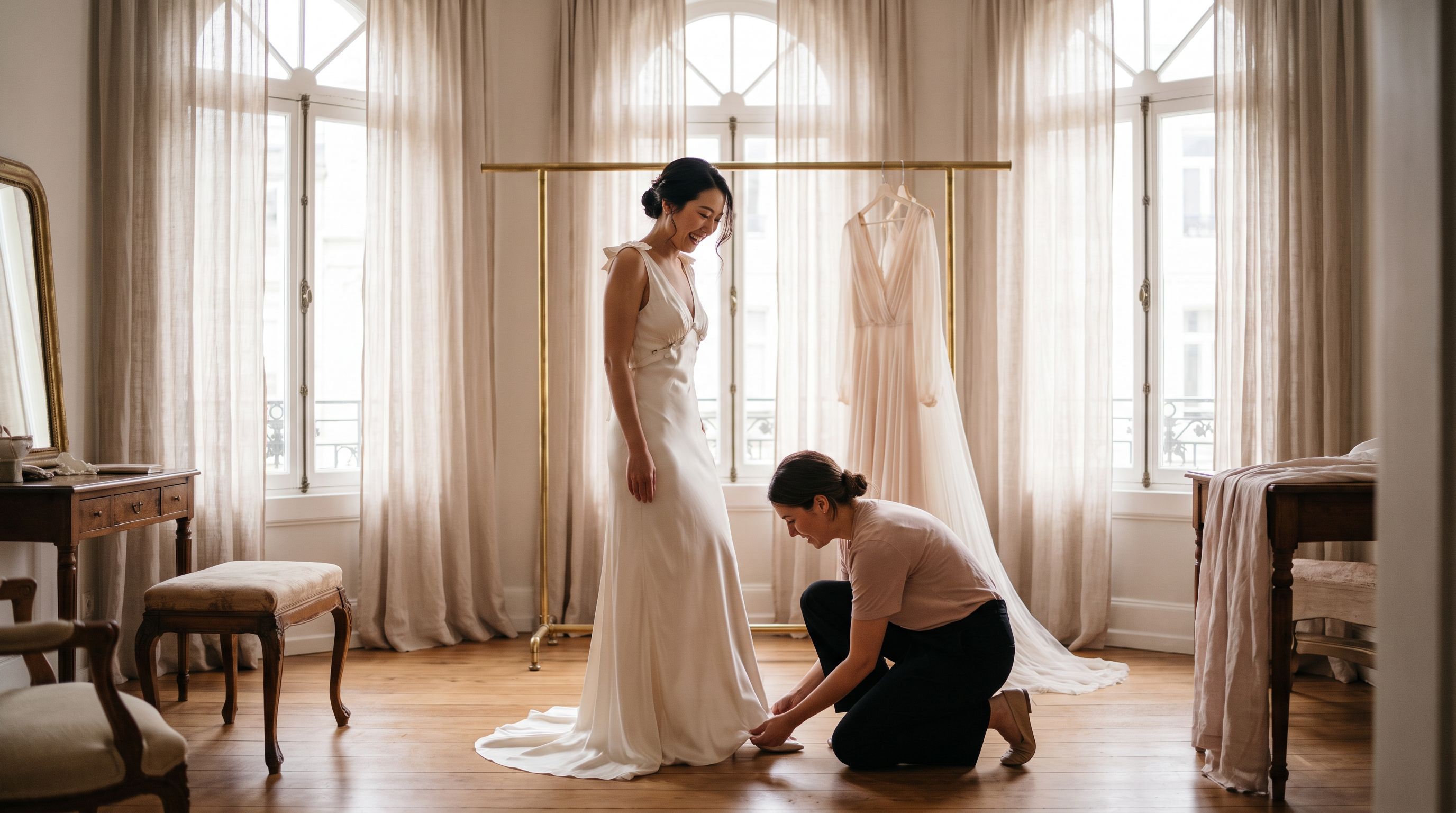
Every figure below is in US dollars and illustrative; adapt the ranges to your own market and currency.
There’s a moment in almost every bridal appointment when a consultant says, “Don’t worry — it’s made to order.” It sounds like the gown will be made for you. Usually that’s not quite what happens, and understanding the difference early is one of the most money-saving things you can do.
What “made-to-order” really means on a shop tag
When you order through a salon, the shop sends your order to the designer, who cuts and sews a new gown — in one of their standard stock sizes. Your consultant measures bust, waist, and hips, compares them to the chart, and orders the size that fits your largest measurement. Everything else is taken in later.
The gown is new, it’s yours, and nobody has worn it. But it wasn’t cut to your shape, your torso length, or your posture.
Off-the-rack means you buy the sample or stock gown hanging in the store and take it home that day — no production wait, and usually a discount because it’s been tried on. We cover that route in off-the-rack wedding dresses and what they really cost.
Where made-to-measure and bespoke part ways
With made-to-measure, a dressmaker starts from an existing pattern and redrafts it to your measurements — often a dozen or more, not three. With bespoke, the pattern is drafted from scratch for a design you develop together. Both usually involve a toile (or muslin): a cheap cotton test garment you try on and mark up before anyone cuts your real fabric.
That toile is the heart of the difference. In made-to-order, fit problems surface after the gown exists, and the fixes are limited by seams already sewn. In made-to-measure, they surface on a $20 piece of calico, when changing them costs nothing.
What each route typically costs
Prices swing enormously by city, fabric, and the maker’s experience. A heavily beaded silk gown in a major metro sits at the top of every range below; a clean crepe sheath in a smaller market sits near the bottom.
The cost drivers are the same in both worlds, which is why the two routes converge more often than the sticker price suggests:
- Fabric. Silk mikado, double-faced satin, and good French lace cost many times their polyester equivalents — and a full skirt can need 8–12 metres / 9–13 yards.
- Surface work. Hand-beading and appliqué are priced in hours: the biggest multiplier in custom, the steepest surcharge in alterations.
- Structure. Internal corsetry, built-in cups, and a proper waist stay take time to draft and sew well.
- How far the fit has to travel. If the waist comes in four inches while the bust goes out, you’re paying someone to re-engineer a finished garment.
- Experience and location. Studio overhead in an expensive city shows up in the quote, and so does a decade of skill.
If those ranges sit well above what you can spend, there are honest cheaper routes. Preloved and sample gowns resold by previous wearers often go for a third to half of original retail — frequently the low hundreds up to around $1,200. Rental is cheaper again, often a few hundred dollars for a few days. A newer maker building a portfolio, working in unembellished crepe, linen, or cotton, can sometimes make to measure in roughly the $900–$1,800 band. And a hybrid works beautifully: buy a plain, inexpensive gown and commission only the pieces that make it yours — detachable sleeves, an overskirt, a beaded belt — often a few hundred dollars of work.
So is it cheaper to buy off the rack?
Sometimes, genuinely yes. A sample gown at a discount, needing only a hem and a light take-in, is often the cheapest path to a dress you love — especially if you’re near sample size.
But compare landed costs, not tags. A $2,400 made-to-order gown needing $1,100 of alterations is a $3,500 dress. A $3,400 made-to-measure gown with fittings included is a $3,400 dress.
Made-to-order splits the bill in two and shows you the smaller half first. Made-to-measure shows you one number up front — and asks you to trust a gown you can’t yet try on.
That trust is the real cost of custom, and an honest comparison has to say so. There is no try-before-you-buy: you’re committing to a sketch, a swatch, and a maker’s track record. The outcome depends almost entirely on that maker’s skill — a weak dressmaker working from your measurements will deliver a worse gown than a good seamstress altering a well-made stock dress. Deposits are commonly non-refundable, and cut fabric can’t be uncut if plans change. And a toile only tells you so much: calico doesn’t fall like heavy silk mikado or fluid crepe, so some of how the finished gown hangs reveals itself only at the first fabric fitting. Good makers schedule extra fittings for exactly that reason.
Where custom pulls clearly ahead: if you’re outside a designer’s stock size range, significantly between sizes, very petite or very tall, need coverage nobody stocks, or have a full bust with a small waist. There, alterations stop being tweaks and become reconstruction — expensive, risky, sometimes impossible. (If you’ve been told you’re a bridal 16 when you buy a street 10, our explainer on bridal sizing vs street size will make it click.)
Timelines: which route needs more runway
-
Off-the-rack: same day to a few weeks
You take the gown home immediately; only alterations need scheduling, usually starting 8–10 weeks out. -
Made-to-order: roughly 6–9 months
Production commonly runs 4–6 months, plus another 6–10 weeks for alterations. Rush fees apply if you order late. -
Made-to-measure or custom: roughly 6–9 months, comfortably
Design and sourcing, a toile fitting, construction, then two to four fittings. Many dressmakers can work in 3–4 months, and a few will accept 8–10 week turnarounds for an unembellished silhouette, usually with a rush fee.
Both ordering routes need about the same runway. Custom isn’t the slow option — it front-loads the fittings instead of saving them for the end.
How to choose, honestly
Go made-to-order if you’ve tried a designer’s gown, it already skims your body, you love it as designed, and the alterations quote fits your budget. It’s the safer choice when you want certainty — you’ve seen the dress.
Go made-to-measure if the thing in your head doesn’t exist on any rack, if every stock gown would need major surgery on you, or if you’d rather choose your own fabric — and you can find a maker whose finished work you’ve seen in person.
And not everyone commissioning a gown is a bride: grooms, non-binary clients, attendants, and parents of the couple order made-to-measure too. The same questions apply whoever is wearing it.
If you’re not sure which camp you’re in, talk to someone. Many makers offer a free initial consultation; ask upfront, as some charge a fee that’s credited against your order. Bring inspiration photos, your real budget, and your date, and a skilled dressmaker will tell you plainly whether custom serves you better than a stock gown and a great seamstress. Our guide to vetting a custom wedding dress maker covers what a trustworthy answer sounds like.
Related reading
Ready to bring your dream dress to life?
Tell us what you're picturing — style, timeline, and budget — and we'll connect you with custom dressmakers who can make it. Free, no obligation.
Get matched with a dressmakerRelated guides
Getting a Wedding Dress Made Abroad: Is It Worth It?
Thinking of having your wedding dress tailored in Bangkok, Hoi An or Bali? Real costs, timelines, risks and how it compares to a custom dressmaker at home.
Read guide →
Bought a Wedding Dress Online? Alter, Remake, or Custom
Your online wedding dress arrived and the fit is wrong. Here's how to tell what's fixable, what alterations cost, and when going custom is the smarter buy.
Read guide →
Custom Veil vs Heirloom Veil: Cost, Length, and Fit
What a custom wedding veil costs, how to choose a length, and when wearing (or restoring) an heirloom veil is the smarter, more meaningful choice.
Read guide →