 Custom
Preowned vs Custom Wedding Dress: Cost, Fit, Risk
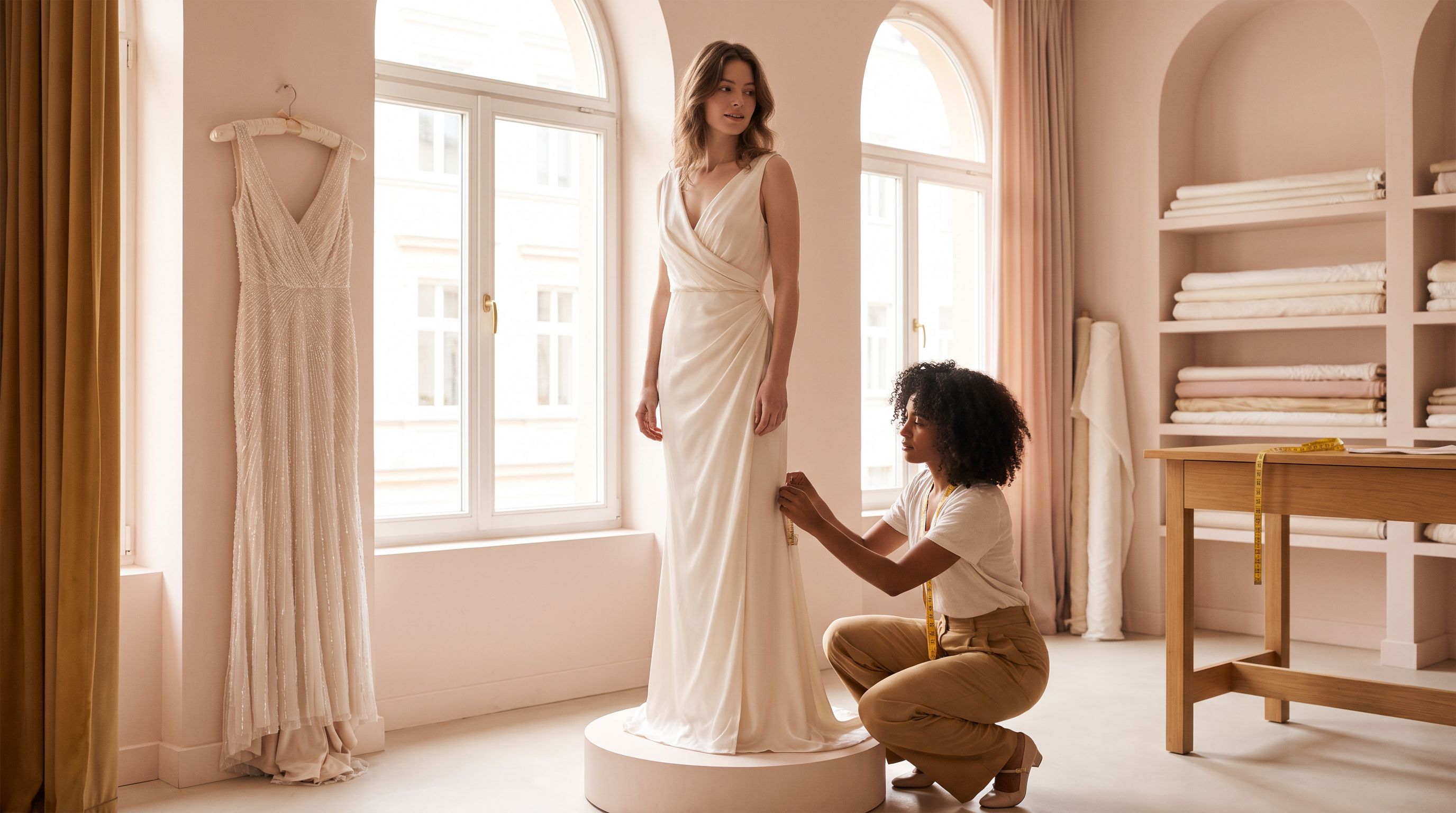
There’s a moment in almost every dress search where someone sends you a link: a gorgeous designer gown on a resale site, worn once, half price. The temptation is completely reasonable. But the number on the listing is rarely the number you’ll pay, and the gap between a bargain and a money pit comes down to a few specific things about the dress and about your body.
Here’s how to read that listing honestly — and how it stacks up against having a gown made for you.
Preowned, off-the-rack, and sample sale are three different things
People use these interchangeably, and that’s where the confusion starts.
Off-the-rack means you buy the physical dress in front of you and take it home that day — no 6–8 month production wait. It’s typically new stock in standard bridal sizes. (We go deeper in our guide to what “off the rack” actually means and costs.)
Sample sale is off-the-rack with a twist: the gown has been tried on by dozens of people in the shop, usually exists in one or two sizes only, and sells as-is at a steep discount.
Preowned means a private seller is reselling a gown — worn once, never worn, or ordered and never collected. Marketplaces like Stillwhite and Nearly Newlywed, plus bride-to-bride groups, are where most of this happens. You’re buying from an individual, often sight unseen, usually final sale.
All three are “not custom.” Only one of them involves shipping from a stranger.
What each path realistically costs
These are our working estimates from the fitting room, not survey data. Treat them as starting points you adapt to your own situation: a heavily beaded gown in a major metro costs multiples of a clean crepe sheath in a smaller market.
On purchase price alone, resale and off-the-rack almost always win, sometimes dramatically. But purchase price is only one of three line items:
Dress + alterations + risk = your real cost.
Custom bundles all three into one number you agree to in advance. Resale splits them up, and the second two only reveal themselves after the box arrives.
The alterations math nobody puts in the listing
This is the part that decides everything. Some changes are routine; others are reconstruction.
Usually straightforward: taking in side seams a size or so, hemming, adding a bustle, adjusting straps, swapping a zipper for a corset back.
Expensive and sometimes impossible: letting a gown out when there’s no seam allowance left, shortening a bodice through a boned, lined, beaded torso, moving the natural waist, re-cutting armholes, raising a neckline on lace, altering an all-over sequin or structured mikado skirt.
A gown two sizes too big in the waist but correct through the shoulders and torso is a great buy. A gown that fits your waist but is three inches too long in the body is a project — the bodice is where the engineering lives. Our guide to where alterations stop and custom begins walks through which changes are worth paying for.
Time matters as much as money. Book an alterations seamstress 2–3 months before the wedding for standard work, and earlier in spring and summer, when fitting rooms fill up months ahead. Heavy beading, a bodice rebuild, or adding sleeves can mean three or more fittings spread across several months — that gown wants a four-to-six-month runway, not a six-week scramble.
A discount is only a discount if the dress can actually become yours. Measure the gap first, then do the math.
How to vet a preowned listing before you send money
-
Get flat measurements, not a size
Bridal sizing bears little relation to street sizing and varies by designer — which is why gowns run small compared to what you wear day to day. Ask the seller to lay the gown flat and measure bust, waist, hip, hollow-to-hem, and shoulder seam to natural waist. -
Verify the gown is what the listing says it is
Counterfeit and misrepresented designer gowns are the resale market’s quietest problem. Ask for the original boutique order form or receipt, request a clear photo of the interior label and style number, and check that style against the designer’s own archive or current collection. A brand-new “designer” gown priced far below every other listing of the same style is a red flag, not a find. -
Ask what was already altered
A gown altered to someone else’s body may have had the bodice shortened or the hem cut on a curve. Previous alterations can quietly make a dress unalterable for you. -
Request daylight photos of the problem zones
Underarms, hem edge, the seat, and anywhere it was pinned. Look for yellowing at the neckline, dulled beading, and broken lace at stress points. -
Confirm cleaning status
”Professionally cleaned” should come with a receipt. Uncleaned gowns carry invisible sugar and oil stains that oxidize brown over months. -
Settle shipping and returns in writing before you pay
Agree who covers return shipping if the gown isn’t as described, insist on insured tracked shipping, and check the platform’s dispute window — it’s often short. International listings can add customs duties and import taxes billed to you at delivery. Film the unboxing in one unbroken take; that video is what wins disputes. -
Book an alterations consult BEFORE you buy
Take the flat measurements to a seamstress and ask for a quote range based on your own numbers. Many will estimate from measurements alone. This single step prevents most regret.
When each option is genuinely the right call
Worth saying plainly: not every wedding is one white gown. If you’re planning multiple ceremonies or outfit changes, wearing a lehenga, hanbok, áo dài, cheongsam, or another non-Western bridal garment, or you want color — red, gold, blue, black — resale inventory thins out fast, and what exists is rarely in your size. That scarcity alone often tips the decision toward made-to-measure.
There’s also a third scenario: buying preowned and budgeting for substantial reworking, using an existing gown as high-quality raw material. That can be beautiful, but price it like custom, because the labor is custom labor.
What different budgets actually buy
Around $1,200–$2,000, custom is still possible if the design stays honest: a clean silhouette, a well-chosen crepe or simple lace, minimal embellishment, a tight fitting cycle. In the same range you could buy a sample sale gown or a preowned designer dress and cover light alterations comfortably. What this budget can’t absorb is a resale bargain that turns out to need bodice reconstruction — so vetting matters more here, not less.
Around $5,000, you’re in comfortable territory in most markets. You can usually have a well-constructed made-to-measure gown in good fabric with proper internal support and a full fitting cycle included. Or buy a preowned designer gown that originally retailed at two or three times that and still have real room for alterations and a second look. What $5,000 doesn’t reliably buy is extensive hand-beading, yards of silk in a dramatic train, or a famous label at full retail. Something has to flex: fabric, embellishment, silhouette, or source. Our breakdown of what different budgets actually buy in custom shows where those tradeoffs land.
The questions that tell you a maker is the real thing
Ask: How many fittings are included, and what triggers an extra charge? Do you make a toile (a test garment in cheap fabric) before cutting my real fabric? What’s your realistic lead time for this design, and what’s your cutoff date? Is alterations labor included or billed separately? What happens if my measurements change between now and the wedding?
A good maker answers all five without hesitation, gives you the timeline in writing, and tells you honestly when an inspiration image won’t translate to your fabric budget. That candor is the single best signal you’re in safe hands.
One disclosure: we make custom gowns, so take our view with that in mind — a local alterations seamstress can price the resale route just as well as we can. The most useful thing you can do is get both numbers side by side: a free, no-obligation consultation with a custom dressmaker for a real quote on your design, fabric, and measurements, and an independent alterations quote from a seamstress with no stake in which dress you buy. Once you have both, the cheaper path for you stops being a guess.
Ready to bring your dream dress to life?
Tell us what you're picturing — style, timeline, and budget — and we'll connect you with custom dressmakers who can make it. Free, no obligation.
Get matched with a dressmakerRelated guides
Getting a Wedding Dress Made Abroad: Is It Worth It?
Thinking of having your wedding dress tailored in Bangkok, Hoi An or Bali? Real costs, timelines, risks and how it compares to a custom dressmaker at home.
Read guide →
Bought a Wedding Dress Online? Alter, Remake, or Custom
Your online wedding dress arrived and the fit is wrong. Here's how to tell what's fixable, what alterations cost, and when going custom is the smarter buy.
Read guide →
Custom Veil vs Heirloom Veil: Cost, Length, and Fit
What a custom wedding veil costs, how to choose a length, and when wearing (or restoring) an heirloom veil is the smarter, more meaningful choice.
Read guide →