 Custom
Empire vs Drop Waist vs Natural Waist: Custom Fit Guide
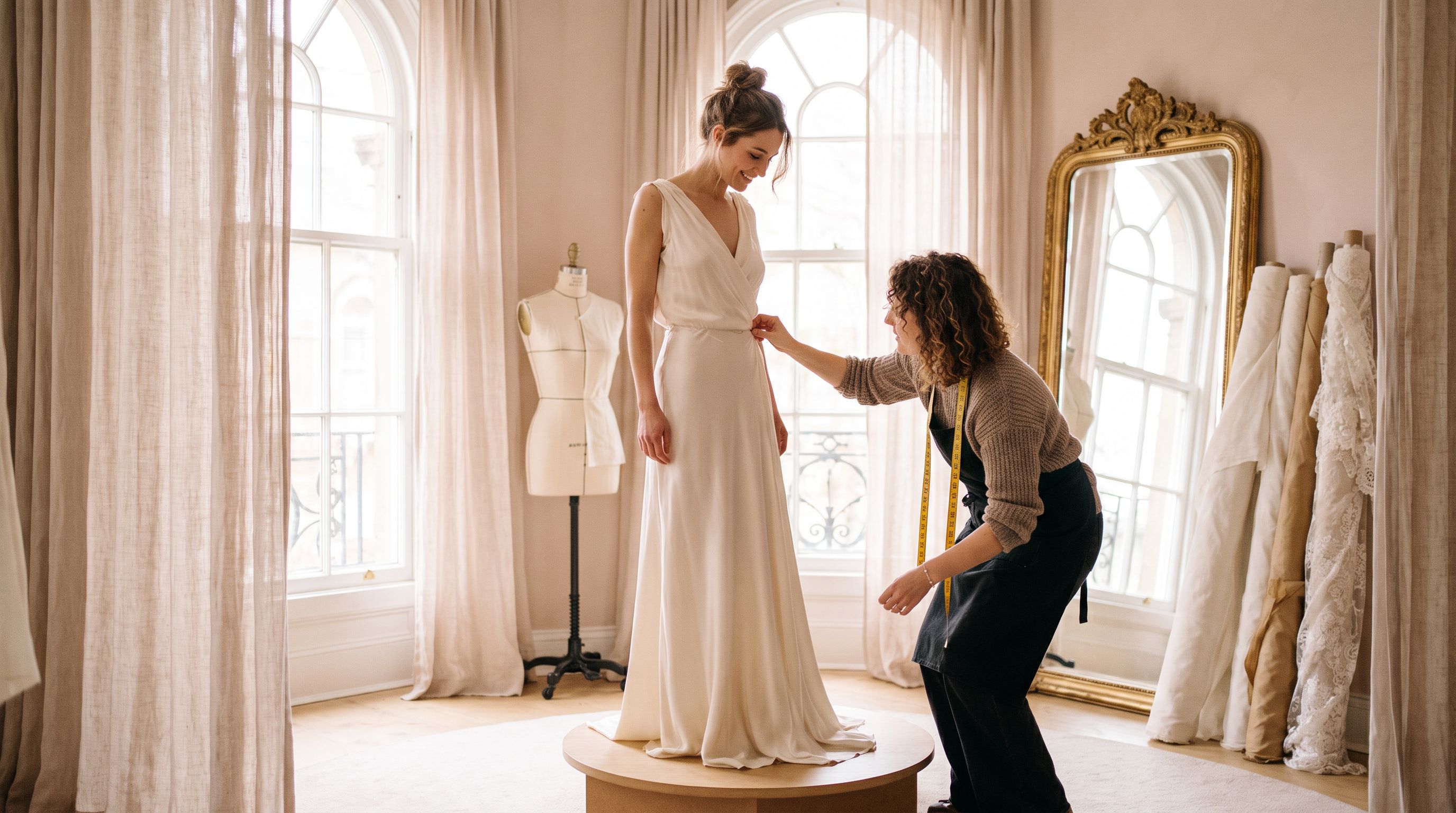
Most people arrive at a first consultation with a silhouette in mind — A-line, mermaid, slip. Very few arrive thinking about the horizontal seam that holds the whole thing together. But if you’ve ever tried on two gowns in the same silhouette and felt tall and elegant in one, boxy and short-legged in the other, the waistline placement was almost certainly the culprit.
This is the part of gown design where custom work earns its keep. A dressmaker can move that seam half an inch and change your entire reflection.
Where the waist sits, and what each placement actually does
There are three common reference points, and they behave very differently on a moving body.
Natural waist. Your narrowest point, usually an inch or so above your belly button. (Find it by bending sideways — the crease that forms is your true natural waist, not where your jeans sit.) A seam here creates the classic hourglass read: it marks the smallest circumference and lets the skirt flare from there. It’s the most adaptable placement and the one most custom gowns default to.
Empire waist. The seam sits directly under the bust, with the skirt falling from there. It shortens the visible bodice dramatically and lengthens everything below it. Empire is the most forgiving over the midsection, which makes it a genuine favorite for pregnant brides, for anyone who doesn’t want fabric gripping their stomach, and for anyone after a soft, Grecian, unstructured feeling.
Drop waist. The seam sits below the natural waist — anywhere from a subtle 2 inches to a full 5 or more, sometimes landing at the high hip. It elongates the torso, delays the flare, and reads as modern, architectural, and slightly 1920s depending on the fabric. A basque waist is drop waist’s close cousin: a V-shaped or U-shaped dip at center front, which narrows the waist visually while still dropping the hemline of the bodice.
Choosing by torso length, not by body type
Forget the fruit chart for a moment. The most useful thing to know here is your torso length relative to your leg length, and your waist-to-hip depth — how much room sits between your narrowest point and the fullest part of your hip.
- You have a long torso and want to visually shorten it while lengthening your legs.
- You want zero pressure across your stomach — for comfort, pregnancy, surgery recovery, or simple preference.
- You love fluid fabrics: chiffon, crepe, soft silk that wants to fall rather than hold a shape.
- You want a gown that accommodates a changing body between fittings and the wedding day.
- You’re petite and want maximum leg line — though the seam must be placed precisely or it swallows you.
- You have a short torso and want to borrow a couple of inches of visible length.
- Your hip measures noticeably fuller than your waist, so the seam has somewhere to land that isn’t your widest point. (Dressmakers often use a working rule of thumb here — a hand’s width or so of difference — but it’s a craft habit, not a standard.)
- You want structure: mikado, duchess satin, heavy lace, anything that can hold a clean horizontal line.
- You’re drawn to modern, sculptural, or vintage-1920s looks rather than a traditional ballgown moment.
- You’re tall and want the gown to acknowledge your proportions rather than fight them.
If you’re between the two, the natural waist is rarely a mistake. It’s the placement that handles the widest range of bodies with the least negotiation — which is why it anchors most of the classic A-line, ball gown, and sheath silhouettes.
Waistline placement also interacts with coverage. If you’re wearing sleeves, a higher neckline, or a lining or underdress for modesty, the seam has to be drafted so it doesn’t fight those layers — an empire line under a sheer overlay, for example, needs the overlay seam and the bodice seam to agree. And if you’re wearing a non-white gown, a red or gold outfit, or changing between two looks across a celebration, tell your maker early: a seam placed for a lehenga blouse or a second-outfit change is a different drafting conversation than a single white gown.
Two honest cautions. On a short torso, an empire line can leave almost no bodice at all — the seam collides with the bust and the whole gown reads like a nightgown. And on a long torso with a shallow waist-to-hip difference, a drop waist can land squarely at the widest part of the hip and add visual width exactly where you didn’t want it. Neither is a rule against trying; both are reasons to test it before cutting good fabric.
The waistline is the only design line that changes how tall you look. Everything else is decoration.
Why this is the fit problem custom actually solves
Sample gowns are built to a standard torso length — and if yours isn’t standard, the seam lands wrong before anyone has taken a measurement. Raising or lowering a finished waistline in alterations is possible, but it’s major surgery: the bodice, the boning channels, the skirt gathers, and any beading across the seam all have to be rebuilt. Many alterations specialists will decline it outright on a heavily embellished gown, which is one of the clearest limits of what alterations can do.
In a made-to-measure process, your maker takes a nape-to-waist measurement and a waist-to-floor measurement at your first appointment, then draws the seam where it belongs on you. If you’re measuring at home before a consultation, our guide to taking your own measurements walks through getting those two numbers right — they’re the ones people most often fudge.
What the waistline does to your budget
The style of waistline is not usually a line item. What costs money is what has to happen underneath and around it.
That range isn’t the only way in. Independent and home-based dressmakers frequently work well below it; so does choosing a simple unlined crepe or cotton over beaded silk, commissioning a custom bodice to wear with a ready-made skirt, or having a sample gown reworked substantially rather than built from scratch. Waistline placement can be solved at any of those price points — it’s drafting, not luxury.
The real cost drivers:
- Boning and internal structure. A natural or drop waist in a strapless gown needs real engineering to stay put — more labor than a soft empire seam. This is the same calculation behind corset versus built-in bra support.
- Seam count. A basque point or a shaped drop waist is multiple pattern pieces and a precisely matched curve, not one straight seam.
- Beading or lace across the seam. Appliqué has to flow over the waistline without a visible break. That’s hand-placement time.
- Fitting time. Drop waists are the placement most likely to need adjusting between the first fitting and the final one, and many makers budget an extra appointment for them. Fittings are labor, so ask how many are included.
- Precision. Because a shift of roughly half an inch is enough to change how the gown reads, waistline work rewards a maker who takes the time to pin, photograph and re-pin — time that is part of what you’re paying for.
How to test your waistline at the toile fitting
This is the appointment where the decision is actually made. Not every maker builds a full muslin toile at every price point — some fit directly in the fashion fabric or use a partial bodice mock-up — so confirm at booking whether a toile fitting is included and, if it isn’t, where in the process you’ll get to see the seam placement before it’s permanent.
-
Arrive in your real shoes and undergarments
Heel height changes your apparent leg length, which changes where the seam should sit. Bring the actual shoes, or the closest height you own. -
Have the seam pinned at your natural waist first
Start from the default. Look, breathe, move. This is your baseline for comparison. -
Ask to see it moved — both directions
A half inch up, a half inch down, then two inches down. Your maker can pin a drop line without committing anything. The change is usually larger than people expect. -
Photograph every version, full length, straight on
Mirrors lie about proportion because you look down at yourself. The camera, held at your chest height from eight feet away, tells the truth. -
Sit, walk, and raise your arms in the favorite
Then check the seam again. If it travels, say so — that’s a construction note, not a complaint. -
Confirm it in writing before the real fabric is cut
The final waistline measurement should be noted on your worksheet. Once silk is cut, this is the hardest thing to undo.
A quiet note on trusting your eye
People often arrive apologizing for a preference — “I know drop waist isn’t supposed to work on me.” There is no supposed to. There are proportions, and there are ways to place a seam that honor them. A skilled dressmaker will tell you honestly when a placement is fighting your frame, and will almost always have a version of the look you love that does work: a shallower drop, a basque point instead of a straight line, a soft empire that isn’t quite so high.
If you’re not sure which way your body wants to go, half an hour with a tape measure, a mirror and someone who drafts for a living will answer this question better than any article can. When you book, ask whether the first consultation is free or paid, and whether a paid consult is credited toward the gown — practice varies from maker to maker.
Ready to bring your dream dress to life?
Tell us what you're picturing — style, timeline, and budget — and we'll connect you with custom dressmakers who can make it. Free, no obligation.
Get matched with a dressmakerRelated guides
Outdoor Wedding Dress: Rain, Grass, and Humidity Guide
How to choose a custom outdoor wedding dress that survives rain, grass, wind, and humidity — fabric picks, hem strategy, and what weatherproofing costs.
Read guide →
Halter vs One-Shoulder vs Asymmetric Gown: Fit & Cost
Halter vs one-shoulder wedding dress: how each neckline carries weight, flatters different shoulders and busts, what it costs custom, and what to ask your maker.
Read guide →
Butter Yellow Wedding Dress: Custom Color, Fit, Cost
Butter yellow is bridal's softest new neutral. Here's how custom dyeing works, which fabrics hold the shade, what it costs, and how to pick your tone.
Read guide →