 Custom
 Custom Wedding Dress for a Small Bust: A Real Fit Guide
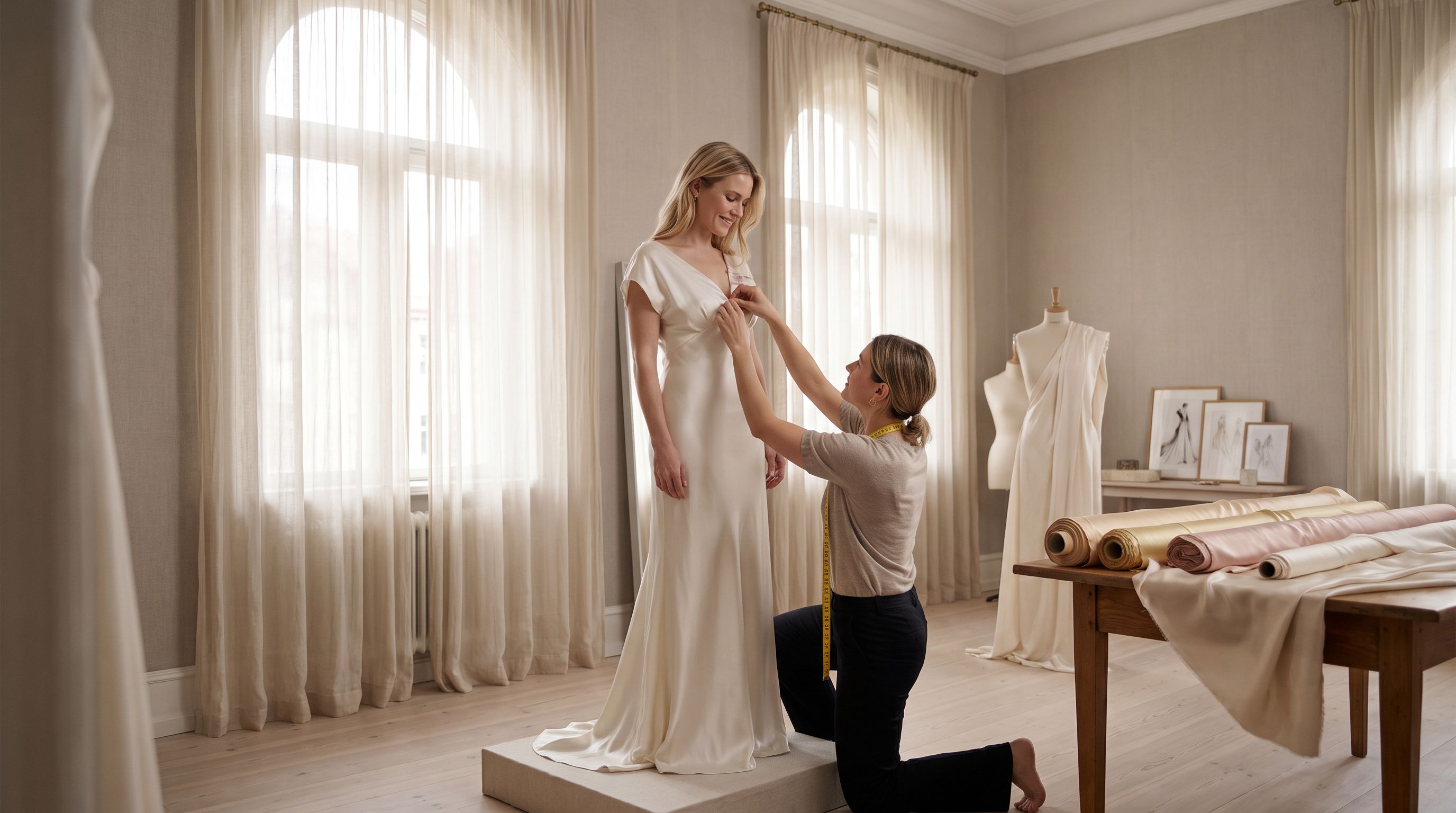
Why sample gowns gape (and why it isn’t your body)
If you’ve tried on a dozen gowns and every single one has the same problem — a neckline that stands away from your chest, a cup that wrinkles, a strapless edge that creeps down — you’re not imagining it. Bridal samples are cut from a single block and graded up and down. In most houses, that block is built around a sample fit model with a relatively full bust for the ribcage measurement. And standard grading practice mostly adds or removes width and length: when a gown is graded smaller, the cup narrows, but it rarely gets shallower.
The result is that you can find a gown that fits your ribcage and still have two inches of empty air at the neckline. That gap is a depth problem, not a size problem, and no amount of taking in the side seams will close it properly. (If you’re new to how bridal numbers work at all, our guide to why bridal sizing runs smaller than street sizing is worth ten minutes.)
What a custom bodice does differently
The core shift in a made-to-measure gown is where the dress gets its grip. A well-built bridal bodice is held up by a snug band at the bottom of the ribcage — under the bust, not on it. Once that band is properly fitted, the top edge can simply rest against you instead of clinging.
Specific things a dressmaker can do that a retail alteration usually can’t:
- Shallow, correctly placed cups. Cut to your actual depth and positioned at your apex, so there’s no fabric bubble between the cup and your body.
- A princess or panel seam through the bust. Vertical seams let a maker shape the curve gradually rather than relying on a dart that has to “absorb” volume that isn’t there.
- Boning placed for grip, not just structure. Vertical bones at the side seams with a firm underbust band stop the gown from migrating south.
- A waist stay. A grosgrain ribbon inside the dress that hooks at your natural waist and carries the skirt’s weight — this single detail is the reason couture strapless gowns stay put.
- Neckline edges cut on grain or lightly stayed so they lie flat instead of flaring open.
Padding, or no padding? An honest comparison
This is the conversation that makes people nervous, so let’s be plain: padding is a styling choice, not a correction. Plenty of people want a little shaping; plenty want none at all. Both are entirely normal requests, and any good dressmaker will hear them without comment.
Our deeper breakdown of corsetry versus built-in bra construction walks through how each feels to wear over a long day.
Necklines and silhouettes worth asking for
None of this is a rule — wear what makes you feel like yourself. These options are worth discussing because of how they’re built, not because of how anyone looks in them:
- Square necklines. A straight top edge sits flat against the chest, so there’s structurally less to gape.
- Halters and high necks. Support is drawn from the neck and shoulders, which removes the strapless edge from the equation entirely.
- Cowl backs and bias-cut slips. Fluid silk hangs from the shoulders and needs almost no bust volume to fall correctly.
- Deep V or plunge with an internal stay. Very doable in custom — the maker adds a hidden mesh or stayed edge so the neckline holds its line without tape.
- Sheer illusion yokes and sleeves. These anchor the bodice at the shoulders, so the fit doesn’t depend on grip at the top edge.
- Fitted bodice, generous skirt. A clean, snug top with volume below moves the structural work to the waist, where a waist stay can carry it.
All of this transfers directly outside a Western white-gown context. The same drafting logic applies to a coloured or metallic gown, a lehenga choli or qipao blouse, a fitted ao dai bodice, or a modest gown with a high neck and long sleeves — the bodice still needs to be built to your bust depth and anchored at the ribcage. If you’re planning a ceremony look and a reception change, say so at the first consultation: makers often quote a two-look commission more efficiently when they can share patterns, fittings, and fabric orders across both. If you’re separating the pieces mentally already, a two-piece approach can be especially flexible here, since the top and skirt are fitted independently.
What this usually costs
Prices vary enormously by country, city, and how established your maker is, so treat these as starting points to adapt — not benchmarks. Figures below are in US dollars; GBP and EUR quotes tend to land at broadly similar numbers, and regional labour costs move the low end most.
The cost drivers that matter most here: internal structure (a boned corselette is real labour), fabric (bias-cut silk demands more yardage and more skill than a stable crepe), embellishment, and fitting rounds. A simple gown with an excellent bodice can cost less than a heavily beaded one with a mediocre one — the money is in where you put it.
If four figures isn’t reachable, custom still is. Emerging and home-based makers building a portfolio often charge a fraction of an established studio’s rate, and many are excellent technicians. Some fashion schools run final-year or graduate programmes that take real commissions under tutor supervision. A simple crepe or mikado column with no lace and no beading, but with a properly drafted, boned bodice, is one of the best value-per-dollar gowns in bridal. And you can commission only the part that needs engineering — a custom corset or bodice top to pair with a ready-made, rental, or simply gathered skirt — which is often the single highest-impact spend available.
Worth knowing: paying for a sample gown and then paying again to alter a bodice that can’t truly be re-engineered is a common false economy. Our guide to what alterations can and can’t fix covers exactly where that line sits.
The process, step by step
-
Consultation and measurements
Bring inspiration images, your shoes if you have them, and be ready to talk honestly about padding, coverage, and how you want to feel. Expect high bust, full bust, underbust, waist, hip, and several vertical measurements. -
Design and quote
You agree on silhouette, fabric, neckline, and internal support, and receive a written quote and payment schedule before anything is cut. -
Toile / muslin fitting
A cheap-fabric mock-up, usually 3–5 months out. This is where bust depth, apex placement, and the underbust band get solved — and where gaping gets eliminated for good. Wear the underwear you’ll actually wear. -
First fitting in real fabric
Typically 6–10 weeks before the wedding. Structure is in, seams are basted, and refinements happen. -
Final fittings and hem
One to three more sessions. The hem is set in your shoes; the waist stay and any bustle are finished. Final fitting is usually 1–2 weeks out.
Most makers want 6–9 months; many can work in 3–4 with a rush fee. Know what a compressed build actually cuts: usually one toile and one real-fabric fitting instead of three or four, stable fabrics like crepe or mikado instead of bias-cut silk or lace that needs pattern-matching, machine finishing in place of hand-beading and hand-rolled hems, and far less room to change direction after the toile. If the bodice is your priority, protect the fitting rounds and let the embellishment go.
Questions that quickly reveal a good maker
A maker who lights up at these questions — who reaches for a tape measure and starts sketching seam lines — is the one you want. A maker who says “we’ll just add cups” without measuring your high bust is telling you something too.
Ready to bring your dream dress to life?
Tell us what you're picturing — style, timeline, and budget — and we'll connect you with custom dressmakers who can make it. Free, no obligation.
Get matched with a dressmakerRelated guides
Custom Wedding Dress for Apple-Shaped Brides: Fit Guide
How a custom wedding dress solves fit for apple-shaped brides: the best silhouettes, internal support, fabrics, fittings, and realistic costs.
Read guide →
Custom Winter Wedding Dress: Fabric, Sleeves, Warmth
How to design a custom winter wedding dress that's genuinely warm: the best fabrics, sleeve and lining choices, capes, realistic costs, and timeline tips.
Read guide →
Custom Wedding Dress for Pear-Shaped Brides: Fit Guide
A custom wedding dress for pear-shaped brides solves the hip-to-waist gap standard bridal sizing can't. Silhouettes, fabrics, fittings, and real cost ranges.
Read guide →