 Custom
 Custom Bridal Separates vs a Gown: Cost and Fit
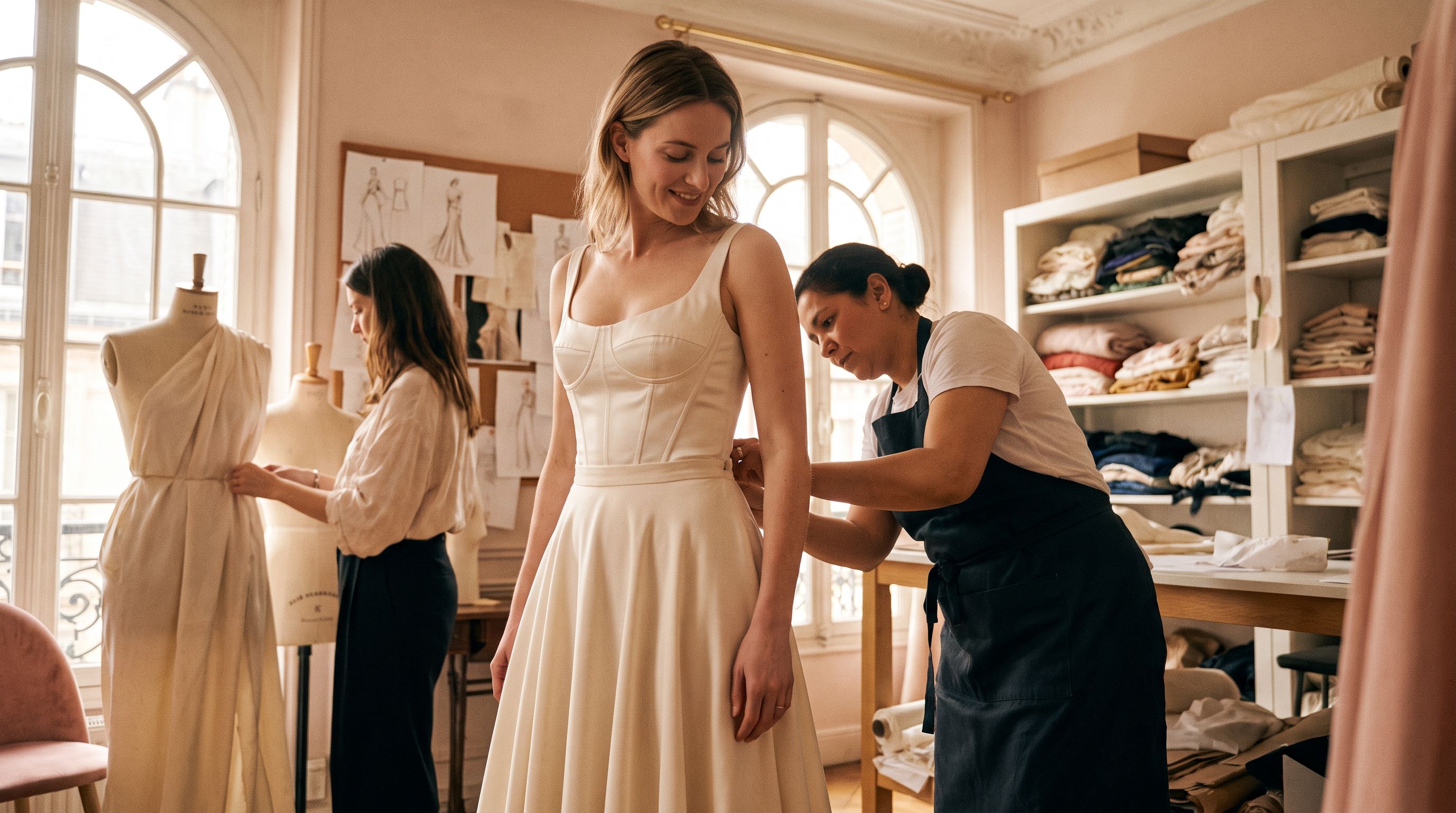
What “bridal separates” actually means in a custom context
Off the rack, separates are usually a skirt and a top you buy in two sizes and hope will meet in the middle. In a custom or made-to-measure context they mean something more interesting: your maker drafts a skirt to your waist and hip, and a top to your bust, shoulder, and torso length, then designs the meeting point deliberately.
That top might be a boned corset, a soft draped blouse, a cropped jacket, a lace overlay, or a fitted bodysuit with a body foundation built in — a built-in foundation layer is the internal corselette that carries bust support and, in some designs, the weight of the skirt. The skirt might be a clean crepe column, a full mikado ballgown, layers of tulle, or a slim satin bias with a train. Each half is drafted for a different part of you, which is exactly why separates solve fit problems a single garment can struggle with.
Who separates genuinely flatter
This isn’t only a stylistic choice. For several bodies, a two-piece draft is simply the more forgiving engineering solution:
- Different sizes top and bottom. A size 10 top and a size 18 skirt, or any pear or apple proportion, forces a compromise in a single-size gown. Separates remove that compromise — each half is drafted to its own size, with no fabric borrowed from one area to rescue another.
- Long or short torsos. A one-piece gown places the waist seam where the pattern says it goes. Separates let the skirt sit exactly where your natural waist is, and the top can end above, at, or below it. If a gown has ever hit your ribs or your hips, this is your format.
- A significant bust-to-waist difference. Drafting a top for a G cup and a skirt for a 27-inch (69 cm) waist as separate garments removes the tug-of-war that happens in one piece. See our deeper notes on dressing a full bust with a small waist.
- Modesty and layering needs. A high-neck, long-sleeve top over a simple skirt gives full coverage without the gown reading as heavy — and the top can be swapped for a different one later in the day.
- Bodies that are changing. Pregnancy, medical treatment, training, or simply a long engagement. A skirt with a wider waistband allowance and a top with lacing gives your maker more room to adjust late.
- Travel and elopements. Two smaller garments pack, steam, and carry far more easily than one boxed gown.
Where a one-piece gown still wins
Be honest about the look you’re chasing. A seamless, sculpted column — where the eye travels uninterrupted from bust to hem — is genuinely easier in one piece. So is anything with continuous beading or lace motifs flowing across the waist; matching a pattern across two garments that move independently is fussy and expensive.
Heavy skirts also argue for a one-piece. A 13-yard (12 m) tulle skirt, or a cathedral train in duchesse satin, is a lot of weight to hang from a waistband. In a gown, that weight is distributed into a boned bodice and up over the shoulders. In separates it sits on your waist and hips all night — unless your maker suspends the skirt from an internal body foundation, which is very doable, and which is exactly the kind of question that separates a skilled maker from a hopeful one.
So do two pieces cost more than one dress?
This is the question most people arrive with, and the honest answer surprises them: separates rarely save money. You’re commissioning two finished garments, each with its own internal structure, finishing, and pressing time. Most makers also add a fitting, because you fit the pieces individually and then together.
What separates can do is let you spend unevenly — a simple, quietly beautiful crepe skirt with a lavishly beaded top, so the money goes where the eye goes.
The drivers are the ones that move any custom price: fabric quality and yardage, how much handwork is involved, the level of internal structure, your maker’s experience and overhead, and your local market. A boned, hand-finished corset top is a small couture project on its own — often as labour-intensive as an entire simple gown. For the wider picture, our breakdown of what different budgets actually buy in a custom gown maps the same money onto a one-piece commission.
You’re not buying half a dress. You’re paying for two hems, two linings and two closures — plus the fitting hours that make them agree at the waist.
Two looks now, and something wearable later
Here’s where separates genuinely change the maths. A skirt plus two tops — a covered, structured one for the ceremony and something lighter for dancing — often costs less than a ceremony gown plus a separate reception dress, because you’re paying for one skirt and one round of major fitting labour.
Re-wearing afterwards is realistic, but it isn’t free. Shortening a train or cutting a full skirt down to floor or midi length is a proper alteration job, usually a few hundred dollars, and silk dyeing is genuinely risky — dye takes unevenly over boning channels, horsehair braid, and polyester thread, so many dyers won’t guarantee bridal work. Ask your maker at the outset whether they offer post-wedding alterations, roughly what they charge, and how long they keep your pattern on file.
The waistline is where separates succeed or fail
Almost every disappointing two-piece story traces back to the same three inches. Ask your maker directly how they plan to handle it:
-
Decide the overlap
Does the top sit on the skirt, tuck into it, or meet it edge to edge? Overlap is safest — a top finishing 2–4 inches (5–10 cm) below the waistband will never reveal a gap when you lift your arms. Edge-to-edge looks cleanest and demands the most precision. -
Anchor the pieces to each other
Good makers add hidden snaps, a waist stay, or grosgrain tabs so the top can’t ride up and the skirt can’t rotate. Ask for this by name — it decides whether you spend the reception tugging at yourself. -
Settle the support question
Is the top self-supporting (boned, with a built-in foundation) or worn over separate underpinnings? This changes the price, the fitting count, and the silhouette — our guide to corsetry versus a built-in bra is worth reading first. -
Reserve fabric from one dye lot
If both pieces share a fabric, they must be cut from the same roll. Silk dye lots vary noticeably in daylight and photographs. A good maker will have flagged this already. -
Fit them together, not just apart
Insist on at least one fitting where you wear both pieces with your shoes and undergarments, and move — sit, hug, raise your arms, dance. Ride-up shows up in motion, never standing still.
Timeline, fittings, and finding the right maker
Expect a similar overall lead time to a one-piece commission — often six to nine months for comfort, less if your maker has capacity — but budget for one extra fitting. Many makers fit the skirt first, then develop the top over two or three sessions, since that’s where the structure and handwork live. If you’re building a toile, ask for both pieces in calico; hem length and waistband placement in your actual shoes are what make a two-piece look intentional rather than improvised.
When you talk to dressmakers, listen for whether they volunteer the waist strategy before you ask. A maker who immediately mentions overlap, waist stays, dye lots, and how the skirt’s weight will be carried has built separates before. Ask to see photos of their separates — ideally on a body like yours, and ideally in motion — how many fittings they schedule, what happens if your measurements change, and whether extra tops can be added later and at what cost. Ask upfront whether the first consultation is free or carries a design fee that’s credited against your order — both are normal, and either way that conversation is the fastest way to learn whether your two-piece idea is a fit dream or a fit gamble in this particular pair of hands.
Ready to bring your dream dress to life?
Tell us what you're picturing — style, timeline, and budget — and we'll connect you with custom dressmakers who can make it. Free, no obligation.
Get matched with a dressmakerRelated guides
Off the Rack Wedding Dresses: What It Means and Costs
What "off the rack" really means in bridal, how off-the-rack wedding dress costs compare to custom and made-to-measure, and how to set a realistic budget.
Read guide →
Chapel vs Cathedral Train: Length, Cost, and Bustles
Chapel vs cathedral train for a custom wedding dress: real length measurements, what extra train costs, bustle types and prices, and how to decide at your fitting.
Read guide →
Bridal Sizing vs Street Size: Why Gowns Run Small
Bridal sizing vs street size explained: why wedding dresses run 2–3 sizes small, what off-the-rack really means, alteration costs, and when made-to-measure wins.
Read guide →