 Custom
 Wedding Dress for Short-Waisted Brides: Fit Guide
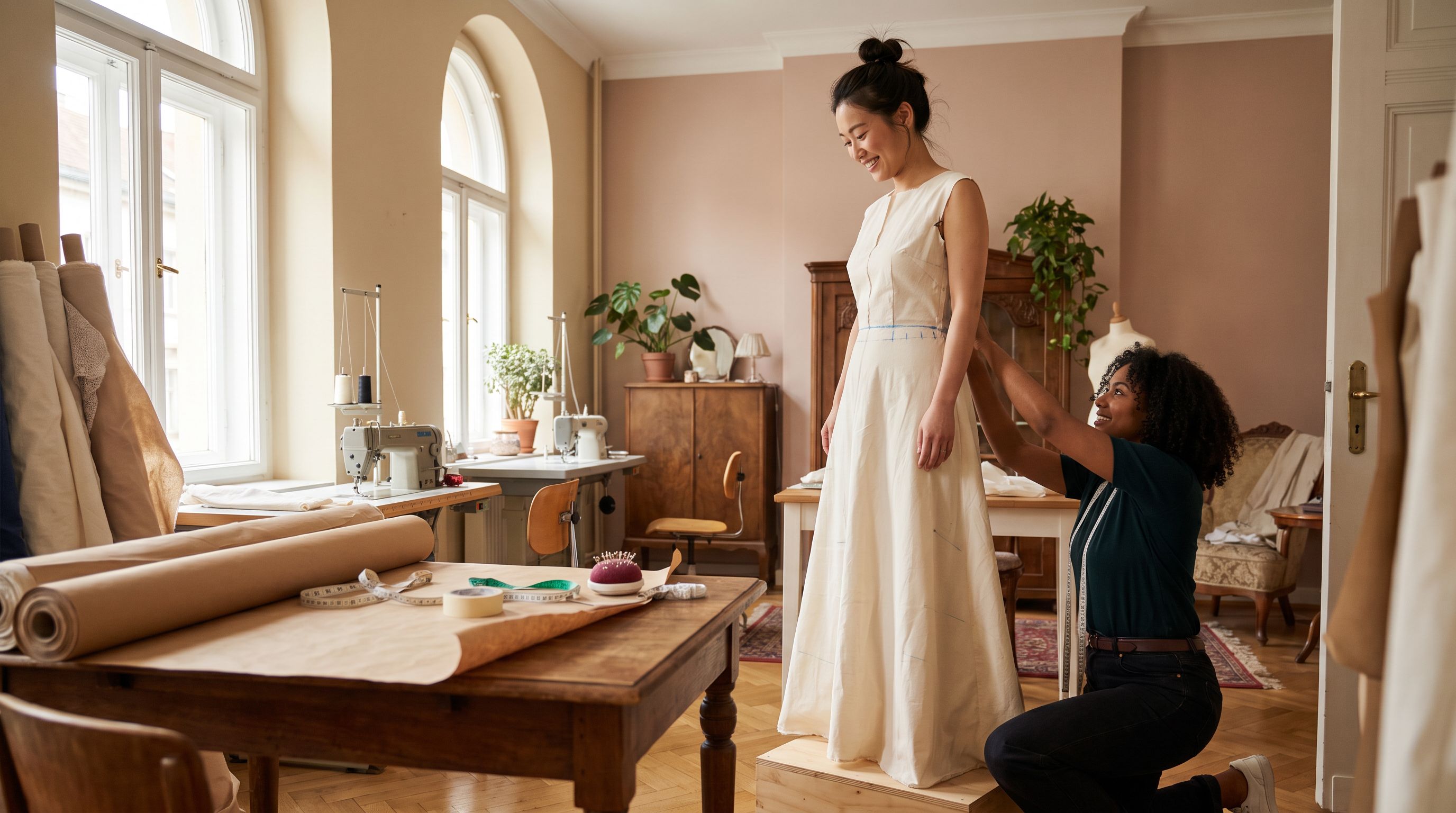
How to tell if you’re actually short-waisted
“Short-waisted” has nothing to do with your height or your size. It means the distance from your shoulder to your natural waist is short relative to the rest of your body — you can be 5’1” or 5’10” and short-waisted. Plenty of people spend years assuming dresses just “don’t suit them” when the real issue is two inches of vertical proportion.
Two quick self-checks:
- The hand test. Place your fingers sideways in the gap between the bottom of your ribcage and the top of your hip bone. Room for less than two fingers often points to a short waist; three or more suggests a long torso — though this varies a lot with ribcage shape and body composition, so treat it as a rough first impression rather than a verdict.
- The tape test. Measure nape of neck to natural waist down your back, then natural waist to floor. If the top number is noticeably smaller in proportion to the bottom — and if standard bodices always feel like they extend past your waist — you’re working with a short torso. This is the measurement that actually settles the question.
If you want to do this properly before any appointment, our walkthrough on how to take your own measurements for a custom gown includes the nape-to-waist measurement most people skip.
Why sample gowns fight a short torso
Bridal patterns are graded from a fit model, and the vertical measurements scale far less than the horizontal ones. A size 8 and a size 20 from the same label often have nearly the same bodice length. So if your nape-to-waist is shorter than the pattern’s, every gown in the salon does the same three things:
- The waist seam lands below your waist, cutting your torso at its widest point instead of its narrowest.
- Boning channels run past your ribs into your hip bones, so the bodice rides up, buckles, or stabs you the moment you sit down.
- The bust point sits low, which drags the whole silhouette down even when the cup measurement is right.
Bridal sizing compounds it — being told to order two sizes up for your hips when your bodice is already too long is how a lot of short-waisted shoppers end up with gowns that never quite work; our guides to why bridal gowns run small and where empire, natural, and drop waistlines actually land explain both halves of that problem.
A dress that doesn’t fit your proportions isn’t a size problem. No amount of taking in the side seams will move a waistline.
The waistlines and silhouettes that genuinely help
The goal isn’t to hide anything — it’s to give the eye a longer vertical line between shoulder and hip.
- A V-point or basque waist is the single most useful detail. Dipping the center front into a V or a shallow basque adds visual torso length without changing your real waist placement.
- A dropped waist works beautifully if the drop is calibrated to you — on a short torso, a drop that’s too deep just relocates the problem.
- No horizontal waist seam at all — a sheath, a bias slip, or a princess-seamed A-line with seams running unbroken from bust to hem — reads as one continuous line.
- Deeper necklines and narrower straps open vertical space above the bust.
- Skirts that start with minimal gathering at the waist keep bulk off your shortest dimension. Flat-front panels with fullness released at the sides or back are your friend.
None of this assumes anything about what sits above your waist. If you have a small or flat chest, wear a binder, have had a mastectomy with or without reconstruction, or simply want a bodice that doesn’t emphasize that area, the same proportion principles apply — the drafting just changes. A good maker asks what you want the bodice to do and how you want to feel in it, rather than assuming a shape and building cups into it by default.
What to be cautious with: wide contrast sashes, horizontal beaded bands at the waist, high boat necks paired with cap sleeves, and heavily gathered empire seams that sit directly under the bust and shorten the torso further. None of these are forbidden — they just need a skilled hand and a toile to test.
What it costs: custom versus altering an off-the-rack gown
“Off the rack” means buying the actual sample or a stocked gown and taking it home that day; “made-to-order” means a salon orders your size from the designer’s standard pattern. Neither changes vertical proportion. Only a dressmaker does — and whether that’s cheaper depends entirely on how structured the gown is.
Price drivers are fabric (silk versus high-quality synthetics can double a materials bill), surface work (hand-beading is the biggest multiplier), construction complexity, and your maker’s experience and city. A clean crepe sheath with a corseted interior sits at the low end; a beaded, boned ball gown with a cathedral train sits well above it. For where the line falls between altering and starting fresh, read alterations versus custom: knowing the limits.
If full custom is above your budget
Made-to-measure is not the only route to correct proportion. If your budget sits below that range, three paths work well. First, shop deliberately for a soft, unlined or lightly structured bodice — a crepe sheath, a bias slip, a cotton or linen gown — because raising a waist seam on these is a genuinely affordable alteration rather than a reconstruction. Second, buy a secondhand, sample, or preloved gown and take the savings straight to a skilled local seamstress, who can re-draft the bodice or shorten the straps and seam with money you didn’t spend at retail. Third, consider a two-piece bodice and skirt: separates let you set the waistline wherever you like simply by choosing where the top ends, and a dressmaker can make or adjust just the top — the cheaper half — while you buy the skirt. Any of these can give you a waist that lands correctly without a four-figure commission.
How the custom process solves it, step by step
-
Consultation and measurements
Bring inspiration photos and the shoes and undergarments you plan to wear. A good maker measures nape-to-waist front and back, underbust, waist-to-hip depth, and shoulder-to-bust-point — not just bust, waist, hip. -
The toile (muslin)
A calico mock-up is where proportion gets solved. Your maker will pin the waist seam up or down, test a V-point, and mark boning lengths. This is the single most valuable appointment when you’re short-waisted — never skip it to save time. -
Fabric cut and first fitting
The real fabric is cut from your corrected pattern. At fitting one you check that the waist seam still lands correctly once lining and interfacing add structure. -
Refinement fittings
Two or three more appointments fine-tune the bust, armholes, boning comfort, and hem length with your shoes on. -
Final fitting
Sit, walk, hug someone, raise your arms. Confirm the bodice holds without riding up and that the hem clears the floor in your actual shoes.
What to ask before you commit
- “Where do you plan to place my waist seam, and why?”
- “Will we do a toile? Can I see photos of bodices you’ve drafted for short-waisted clients?”
- “How will the boning be cut so it doesn’t catch my hip bones when I sit?”
- “What’s included in the quoted price, and what counts as an extra?”
If you’ve tried on a dozen gowns and every one felt slightly off in a way you couldn’t name, this is very likely why. A conversation with a dressmaker who drafts to your torso will tell you quickly whether custom, a careful alteration, or a cleverly chosen simple gown is the smarter route for your dress, your date, and your budget.
Ready to bring your dream dress to life?
Tell us what you're picturing — style, timeline, and budget — and we'll connect you with custom dressmakers who can make it. Free, no obligation.
Get matched with a dressmakerRelated guides
Outdoor Wedding Dress: Rain, Grass, and Humidity Guide
How to choose a custom outdoor wedding dress that survives rain, grass, wind, and humidity — fabric picks, hem strategy, and what weatherproofing costs.
Read guide →
Halter vs One-Shoulder vs Asymmetric Gown: Fit & Cost
Halter vs one-shoulder wedding dress: how each neckline carries weight, flatters different shoulders and busts, what it costs custom, and what to ask your maker.
Read guide →
Butter Yellow Wedding Dress: Custom Color, Fit, Cost
Butter yellow is bridal's softest new neutral. Here's how custom dyeing works, which fabrics hold the shade, what it costs, and how to pick your tone.
Read guide →