 Custom
 Custom Wedding Dress for Pear-Shaped Brides: Fit Guide
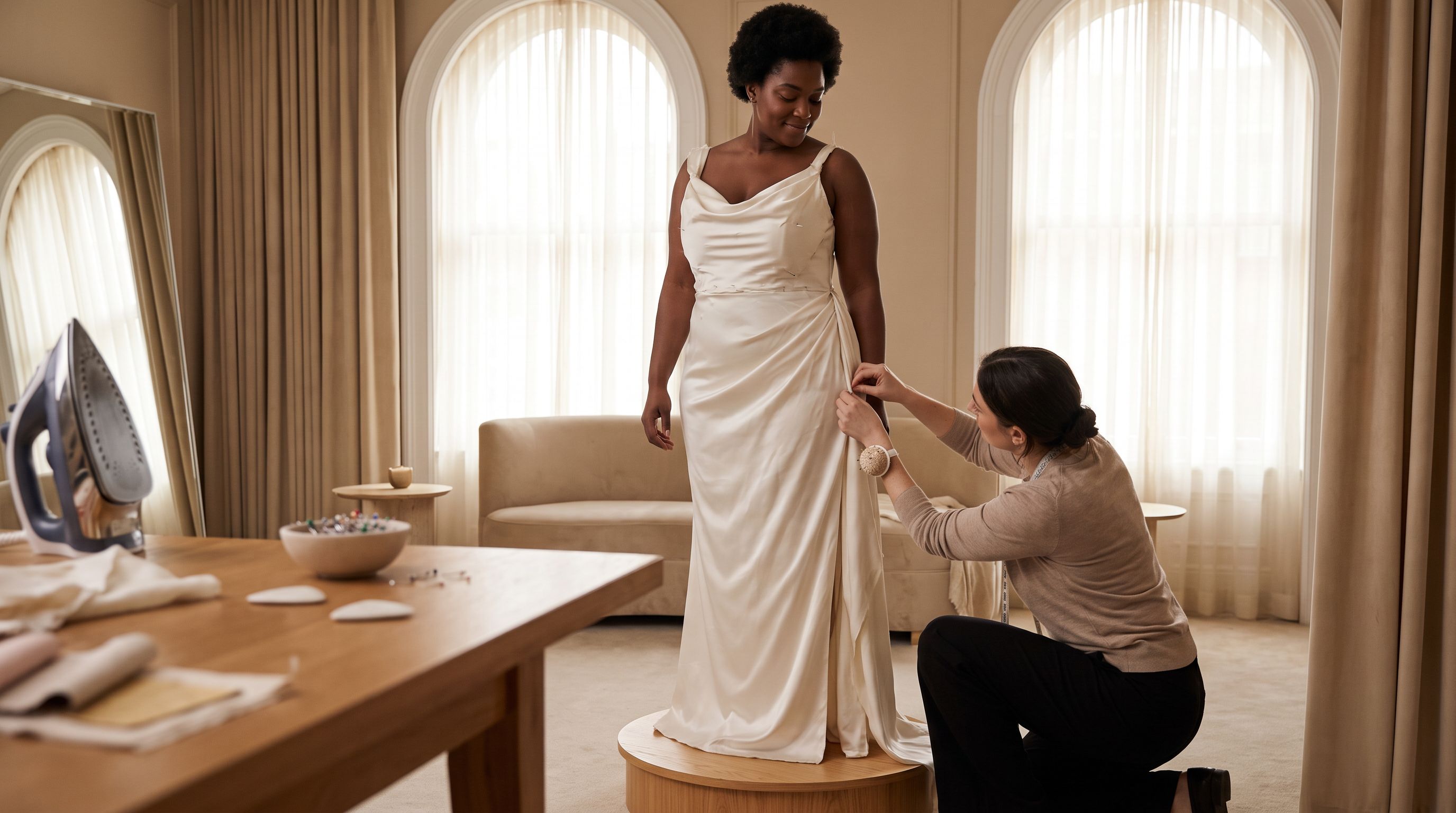
Why standard bridal sizing struggles at the hip
“Off the rack” in bridal usually means one of two things: buying the actual sample gown off the shop floor, or ordering a stock size from a designer’s existing size chart. Either way, the gown is built to a fixed set of proportions — a size 14 assumes a particular bust, waist, and hip relationship, and a particular distance between them.
If your hips sit six, eight, or ten inches larger than your natural waist, that chart stops working. A consultant will fit you to your hip (the measurement you can’t easily make bigger), which means the bodice arrives with room to spare through the ribcage, gaping at the back, and straps that slide. You’re then paying to take in a bodice that was never drafted for your torso — often re-cutting side seams through boning, linings, and lace placement.
The other quiet issue is vertical. Two people can share the same hip measurement but carry it at different depths below the waist. A skirt that releases at the high hip on one body sits mid-thigh on another, which changes everything about how it moves. That’s the part alterations can rarely fix, because a skirt’s flare is built into the pattern pieces.
The measurements a good maker will take
At a proper consultation, expect far more than three numbers. A dressmaker drafting for a hip-dominant figure will typically record bust, underbust, natural waist, high hip (roughly 3–4 inches below the waist), full hip, waist-to-hip depth, waist-to-floor front and back, and often thigh circumference if the skirt is fitted.
You can arrive already knowing two of the hardest ones. Tie a ribbon at your natural waist, stand relaxed rather than sucked in, and measure straight down your side from the ribbon to the fullest point of your hip — that’s your waist-to-hip depth. For back-waist-to-floor, wear the shoes and undergarments you expect to wear on the day, keep the tape snug but not tight, and ask a second person to measure from the ribbon at your centre back to the floor; vertical numbers are where self-measuring goes wrong most often.
That back-waist-to-floor number matters more than people expect: when the hip and seat are fuller, a skirt cut to a single length hangs shorter at the back. A custom pattern adds length there so the hem sits level all the way around — the difference between a hem that reads deliberate and one that looks like it’s riding up.
Silhouettes that work with a fuller hip — and how to adjust them
There is no forbidden shape. There are shapes that need more thought.
A-line is the reliable friend: it skims from the waist and releases before it reaches the fullest part of the hip, so nothing has to pull. Ask for the flare to begin above your full hip rather than at it.
Fit-and-flare and trumpet are entirely wearable and often spectacular — the trick is the release point. A flare that starts at mid-thigh can look abruptly wide; starting it at the upper thigh usually reads more fluid. This is precisely the adjustment that’s simple in a custom draft and expensive in alterations.
Ballgown creates balance instantly, but a heavy gathered skirt attached at the natural waist adds visual bulk right where you may not want it. Ask about a smooth, panelled or godet-built skirt front with fullness pushed to the sides and back.
Sheath and slip styles in crepe are absolutely on the table — they just demand precision. A bias-cut or four-way stretch-lined crepe will follow you honestly; a stiff fabric will not. Our guide to crepe, satin, and mikado breaks down which hold a sculpted line and which cling.
What a custom gown actually costs, and what drives it
There is no meaningful “average” here. A dressmaker in a major city with twenty years of couture experience and one working from a home studio in a smaller market will quote very differently for the same sketch. The figures below are US-market ballparks; UK, AU and EU pricing differs, as does the availability of home-studio makers.
The real cost drivers are consistent: fabric quality and yardage (a full silk skirt is simply more yards — often 8–12 metres rather than 4), hand-beading or appliqué hours, internal construction (boned bodice, built-in support, horsehair hems), the number of fittings included, and the maker’s experience and location. A hip-heavy figure doesn’t inherently cost more — but a fitted skirt in a luxury fabric may warrant an extra toile stage before anyone cuts into it.
If that range isn’t your starting point, several routes still solve the hip problem. Semi-custom adapts an existing block to your measurements — cheaper and faster, though vertical proportions are adjusted rather than drafted from zero. A secondhand or sample gown re-cut by a skilled alterations specialist puts your money into labour instead of fabric, but you’re limited by the original pattern’s release point. Separates — bodice and skirt bought in different sizes — sidestep the compromise size entirely, as long as you check fabric and shade match in person. And an emerging maker or sewing-school graduate often charges markedly less; ask for photos of finished clients, not coursework, and build in extra time.
When you compare paths, compare finished numbers. A $1,600 off-the-rack gown that needs the bodice rebuilt, the skirt re-hung, and a horsehair hem added is not a $1,600 gown. Our real math on custom versus off-the-rack cost walks through that arithmetic, and the honest limits of what alterations can and can’t do will tell you when re-cutting stops being worth it.
How the fitting process protects you
-
Consultation and design
You bring inspiration images, budget, venue, and your comfort priorities — sitting, dancing, sleeve coverage. A good maker sketches, discusses fabric, and gives a written quote with what’s included. -
Measurements and pattern draft
Your full measurement set becomes a bespoke pattern, or an adapted block if you’re going semi-custom. Ask which one you’re getting; it affects both price and precision. -
Toile (muslin) fitting
A mock-up in cheap calico or a similar-weight substitute. This is where the skirt release point, waist placement, and hem balance get corrected — before anyone touches your silk. Never skip it if you have a significant waist-to-hip difference. -
Fabric fittings
Usually two or three. The bodice gets fitted first, then the skirt is hung and left to drop (bias and heavy fabrics stretch under their own weight) before the hem is marked. -
Final fitting and bustle
Hem, bustle points, hook-and-eye placement, and a full test: sit, walk stairs, raise your arms, hug someone.
A dress that fits your hips without swallowing your ribcage isn’t a luxury — it’s just a pattern drafted for one person instead of an average.
What to ask before you book
When you’re shortlisting makers — whether from Instagram, a bridal-shop referral, or a local sewing guild — these questions separate the confident from the merely enthusiastic:
- “Have you drafted for a waist-to-hip difference like mine before — can I see that gown?” Photos of finished clients matter more than a portfolio of sketches.
- “Do you include a toile, and how many fittings are in the quoted price?”
- “Where would you place the skirt release for my proportions, and why?” You want a specific answer, not reassurance.
- “What happens if my measurements change by a few inches before the wedding?” Ask about built-in adjustability — lace-up backs, wider seam allowances, corset panels.
- “What’s your written policy on deposits, timeline, and who owns the toile?”
If you’re also navigating full-bust support or plus-size sizing alongside the hip question, our plus-size custom gown guide covers structure, straps, and internal support in more depth.
Ready to bring your dream dress to life?
Tell us what you're picturing — style, timeline, and budget — and we'll connect you with custom dressmakers who can make it. Free, no obligation.
Get matched with a dressmakerRelated guides
Custom Wedding Dress for Apple-Shaped Brides: Fit Guide
How a custom wedding dress solves fit for apple-shaped brides: the best silhouettes, internal support, fabrics, fittings, and realistic costs.
Read guide →
Custom Wedding Dress for a Small Bust: A Real Fit Guide
A custom wedding dress for a small bust: how bodices get cup-sized, strapless support without heavy padding, flattering necklines, and realistic cost ranges.
Read guide →
Custom Winter Wedding Dress: Fabric, Sleeves, Warmth
How to design a custom winter wedding dress that's genuinely warm: the best fabrics, sleeve and lining choices, capes, realistic costs, and timeline tips.
Read guide →