 Custom
 Nigerian Traditional Wedding Dress and White Gown
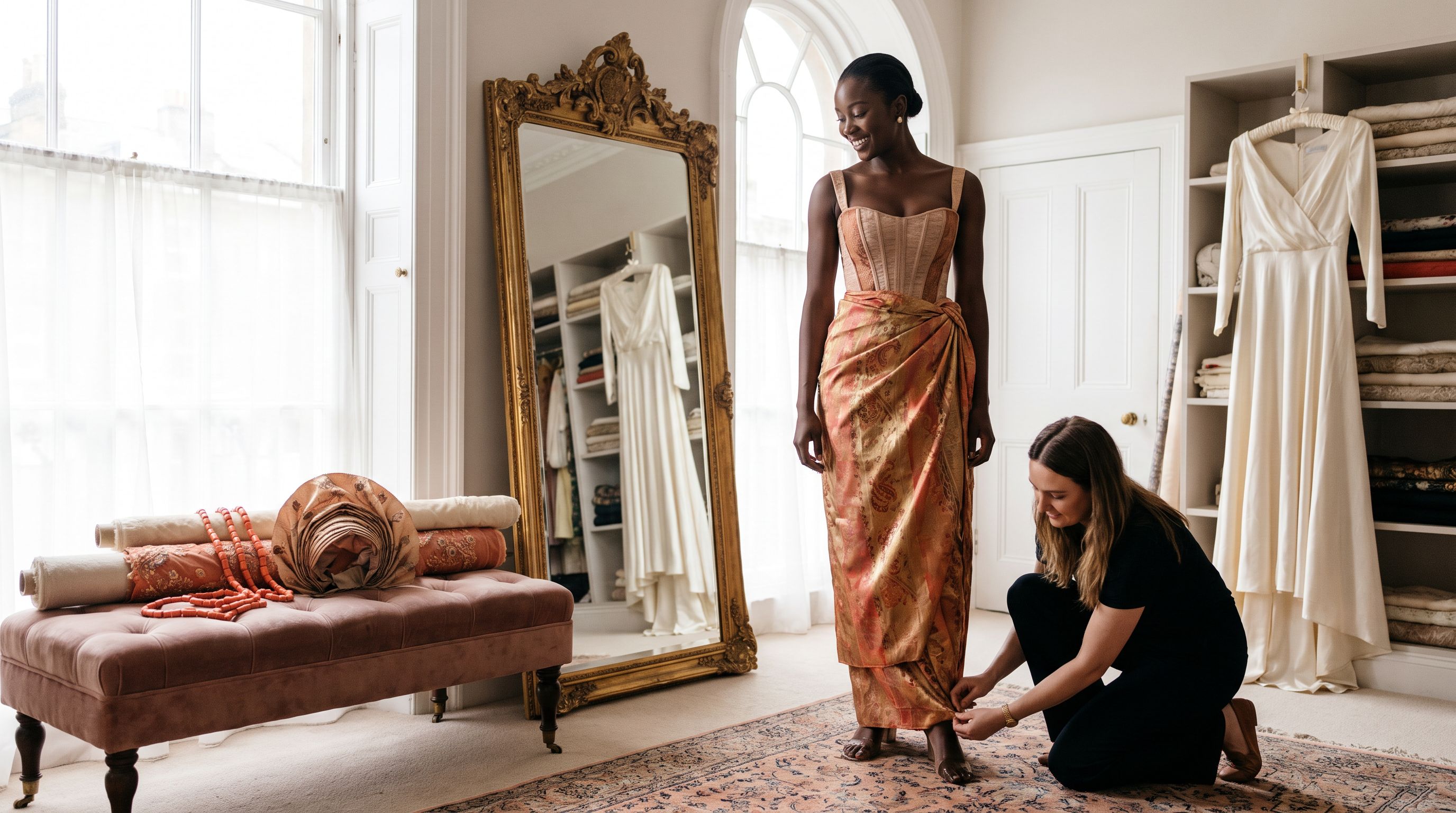
Two ceremonies, two completely different fit problems
A traditional ceremony and a white wedding ask opposite things of a garment. The traditional look is usually built around cloth — a wrapper that’s pleated, tucked, or wrapped around the body, a blouse or corseted bodice that has to sit cleanly under it, and a headpiece tied on the day. The white gown is built around you — a structured foundation, a seam line that follows your waist, a hem measured to your shoes.
That means they fail in different ways. A traditional outfit most often goes wrong because the blouse rides up, the wrapper slips during dancing, or the bodice was cut for a standing-still photo rather than four hours of greeting elders. A custom gown most often goes wrong because the support layer wasn’t engineered properly. Knowing which risk you’re managing with each look changes the questions you ask at your fittings.
This is also exactly where made-to-measure earns its money, because bodies differ in ways the rack ignores. If you carry a fuller hip and a defined waist, a wrapper has a natural shelf to sit on and usually needs anchoring at the narrowest point with a hidden waist stay or hook-and-bar rather than tucking alone. If your hip runs straighter, there’s nothing holding the cloth up, so ask for a built-in band, grosgrain tape, or a side zip so it can’t travel downward over a long day. A larger bust needs the support engineered into the bodice — wider-set straps or sleeves, a boned or foam-cupped underlayer, a bust dart placed at your actual apex — not a separate bra fighting the garment. And armholes are the quiet culprit in both looks: a sleeve cut too high or too tight will stop you raising your arms to dance or to receive a blessing, so test that range of motion at every fitting.
What actually goes into the traditional look
The single biggest cost and timeline driver is cloth, not sewing. Hand-woven aso-oke — especially newer soft, fine-strand weaves — is priced by the number of yards woven to order, and weaving takes weeks. Silk george and heavily stoned Indian george are sold as sets and vary enormously in quality. Cord lace, brocade, damask, Swiss voile, and ankara all behave differently once a tailor starts manipulating them.
Then there’s everything that isn’t the dress: the gele or ichafu (and a professional gele tyer for the day), coral beads — sometimes heirloom, sometimes bought new — a fan, jewellery, and often a coordinating outfit for your partner. Those line items surprise people because they’re usually sourced from different vendors than the garment.
What each outfit tends to cost — and why
People ask constantly what a custom-made dress costs, and the honest answer is that there’s no meaningful average, because the same silhouette can be cut from anywhere between roughly $15–20 a yard for synthetics and well north of $100 a yard for silk, depending on supplier and market — by a tailor charging anything from modest local rates to couture-level fees. What you can do is price your own situation from the drivers.
One important caveat on the numbers below: traditional outfits commissioned in Nigeria are quoted and paid in naira, and the dollar figures here are a converted planning reference only. Exchange rates move, and shipping, customs duty, and handling on the finished garment or the cloth can add meaningfully to what you actually spend. Treat the ranges as a shape to adapt, not a uniform price across markets.
What pushes the traditional outfit up: hand-woven versus machine-woven cloth, the density of stonework and hand-beading, a fully boned corset bodice instead of a simple blouse, and a long train or over-cape. What pushes it down: a well-chosen printed or brocade fabric, a cleanly cut blouse-and-wrapper rather than a constructed gown, and reusing family coral.
For the white gown, the drivers are the same ones that govern any made-to-measure bridal commission: fibre content, how much internal structure the bodice needs, lace and beadwork by hand, train length, and your maker’s experience and city. Our breakdown of what a custom gown costs at different budget levels walks through what changes between a $2k and a $10k commission.
One maker for both, or a specialist for each?
If you go the two-maker route, have your measurements taken properly once and share the same sheet with both, noting the date and the undergarments you wore. Re-measure for both garments around six to eight weeks out.
Ordering from Lagos versus a dressmaker where you live
Many brides abroad have the traditional outfit made in Nigeria — often through family, often by a tailor whose work they’ve seen on cousins — and the white gown made locally. That’s a sensible split, but it has real risks: measurements taken by a relative rather than a professional, no toile, limited recourse if the fit is off, and a garment that lands two weeks before the ceremony.
Protect yourself the same way you would with any remote commission: video-call fittings, photos of the garment on a dress form, a written description of every element, and a clear agreement about what happens if it arrives wrong. Our guide to ordering a custom gown overseas covers deposit structure, shipping, and customs in detail. Whatever arrives from abroad, book a local alterations appointment for the week it lands — not the week of the wedding. A dress made 5,000 miles away still needs someone within driving distance who can take in a side seam.
A realistic timeline for both looks
-
8–9 months out: decide the ceremonies and the looks
Confirm how many outfits you need — traditional, white wedding, and often a reception change. Talk to family about expectations now, not later. -
7–8 months: source cloth and book makers
Hand-woven aso-oke and ordered george take weeks. Book both makers once fabric is confirmed, and get measurements taken professionally. -
5–6 months: first fittings and a toile for the gown
Your bridal dressmaker should fit a calico toile before cutting silk. Your traditional tailor should at minimum fit the blouse or bodice in a mock-up. -
3–4 months: aso-ebi and the wedding party
Order family and bridal-party fabric early — mixed sizes always take longer than expected. Our guide to coordinating custom outfits across mixed sizes helps you brief everyone at once. -
6–8 weeks: second and third fittings
Refine both looks with the actual shoes and undergarments. Decide now how the wrapper is secured and practise it. -
2–3 weeks: final fittings and a full dress rehearsal
Put each look on completely, including gele, beads, and jewellery. Sit, dance, raise your arms, kneel. Fix anything that pulls. -
Only have 3–4 months (or a tight budget)? Drop in this order
First to go is hand-woven, woven-to-order cloth — choose ready-stock george, brocade, or a quality print that’s already on a shelf. Next, accept a single fitted mock-up of the blouse or bodice instead of a full toile for the traditional outfit. If the runway is really short, keep the custom traditional look (it’s the one that must be culturally right) and buy an off-the-rack white gown to be altered by a skilled seamstress — a changed neckline, added sleeves, or an aso-oke sash can make it feel commissioned. Book alterations the week you buy, not later.
Questions that separate a great maker from a risky one
Ask to see three finished pieces in the fabric you’re using — george and heavy beaded lace behave nothing like crepe. Ask how the wrapper or skirt is anchored and whether the bodice is boned. Ask who tries the garment on before you do (a dress form in your measurements is a good sign). Ask what’s included in the quote — is a toile in there, how many fittings, are final alterations billed separately? And ask what happens if you gain or lose weight, which is a normal, expected conversation, not an awkward one.
A maker who answers all of that plainly, writes it into a contract, and takes a staged deposit is showing you how they work. Our guide to vetting a dressmaker has the full checklist, including the red flags worth walking away from.
Making the white gown feel like yours, too
The white wedding doesn’t have to be a blank slate. Brides regularly carry one thread through both looks — a coral-toned beaded detail on an ivory bodice, aso-oke used as a sash or in a detachable overskirt, embroidery of a family motif inside the hem where only you know it’s there. Some commission a reception look that nods to the traditional palette without repeating it.
It’s also a genuinely good moment to be commissioning this work. HelloBeautiful recently profiled designer Ugochi Iwuaba as one of the few Black women designing in luxury bridal — a sign of a wider shift toward makers who understand both halves of a two-ceremony wedding and don’t treat the traditional look as an afterthought.
When you’re ready, a first conversation with a dressmaker — fabric in hand, questions written down — tends to make the whole thing feel far less overwhelming than the spreadsheet does.
Ready to bring your dream dress to life?
Tell us what you're picturing — style, timeline, and budget — and we'll connect you with custom dressmakers who can make it. Free, no obligation.
Get matched with a dressmakerRelated guides
Bridal Seamstress vs Regular Tailor: Who to Trust
Can a regular tailor alter a wedding dress? Here's how a bridal seamstress differs, what each job costs, and when to hire a custom dressmaker instead.
Read guide →
Church Wedding Dress Code: Shoulders, Sleeves, Coverage
Does your church require covered shoulders? Here's how to confirm the dress code and design a custom wedding dress with sleeves, a cape, or removable coverage.
Read guide →
Custom Wedding Dress After a Mastectomy: Fit & Support
A practical guide to a custom wedding dress after mastectomy or breast surgery: prosthesis pockets, support without underwire, scar coverage, timing, and real costs.
Read guide →