 Custom
 Custom Bridesmaid Dresses in Mixed Sizes and Colors
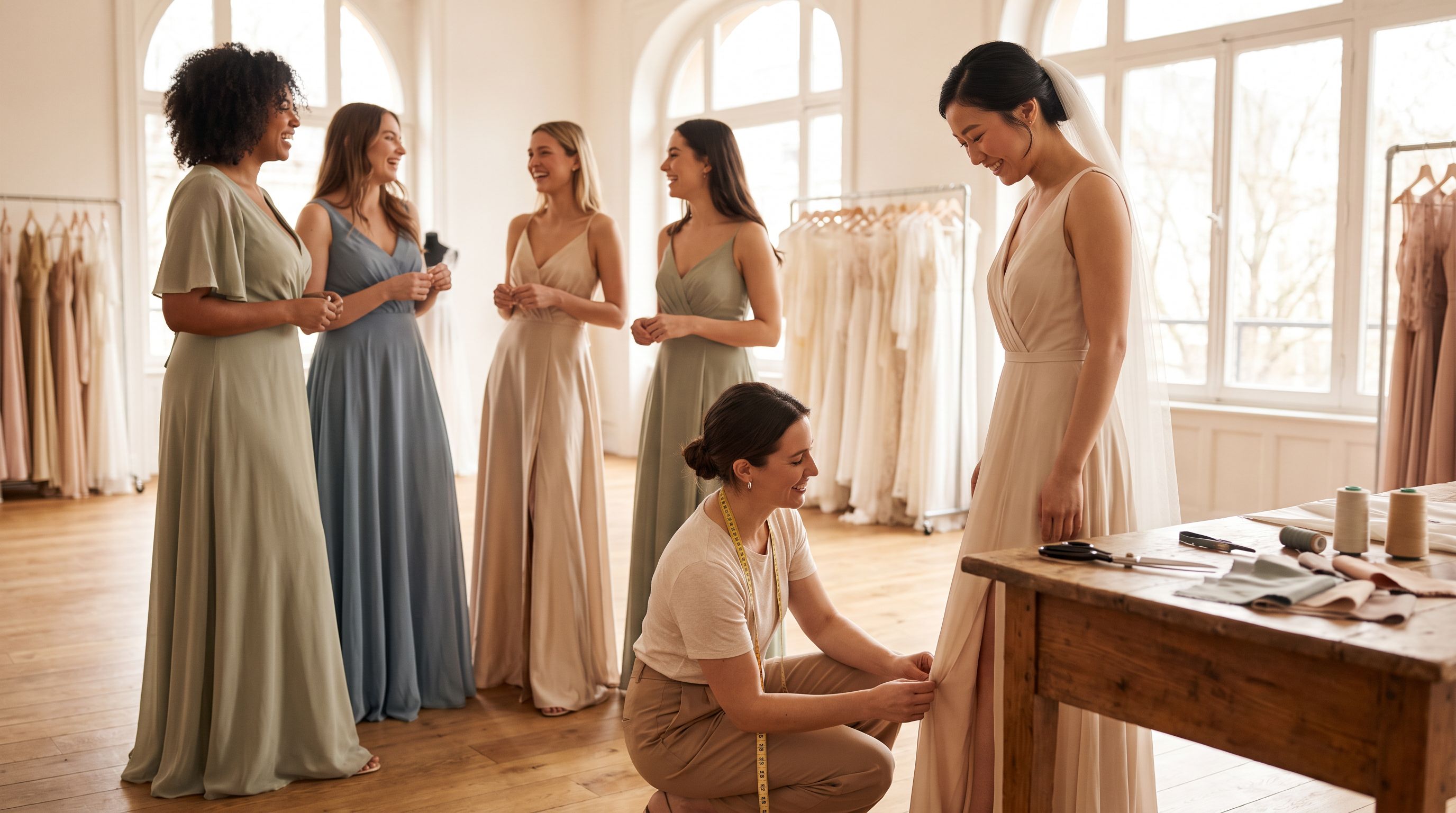
There’s a moment in most planning timelines where the bridesmaid dress question stops being fun. You check the size chart and it stops at 20. Your maid of honour will be seven months pregnant. One friend won’t wear strapless, another needs sleeves for religious reasons, and there’s a foot of height between the shortest and tallest person in the group. Suddenly one dress in eight sizes doesn’t feel like a solution at all.
That’s exactly the situation custom bridesmaid dresses exist for — and also a situation where custom isn’t automatically the right answer. Here’s how to tell the difference, what it realistically costs, and how to run the process without it swallowing your planning year.
Why mixed sizes send parties toward custom
Off-the-rack bridesmaid lines are built around a single fit model, then graded up and down. That grading works reasonably well within a few sizes of the original. Stretch it across a full party and the seams start to show: the size 4 gaps at the bust, the size 22 pulls across the hip, and the person in between is fine except the dress is three inches too long.
A few realities worth naming plainly:
- Check the size chart’s top end and ask whether extended sizes carry a surcharge — some lines add one, some don’t.
- Standard bridesmaid lengths are drafted for an average height. Petite and tall members often need real hem and torso work regardless of size.
- Bust-to-waist ratios vary enormously. A fuller bust in a standard-graded bodice frequently means altering the whole top of the dress, not just taking in a seam.
When three or more people will need substantial alterations anyway, the maths shifts. It’s the same calculation we walk through for brides in the real cost comparison between custom and off-the-rack: the sticker price is only half the story.
What custom bridesmaid dresses typically cost
Prices vary by region, by the maker’s experience, and enormously by fabric. Treat these as starting points to adapt to your own situation, not quotes:
The drivers behind those numbers are the levers you actually control:
Fabric. The single biggest swing. A good polyester crepe or matte satin blend drapes beautifully at a fraction of silk’s cost, while silk crepe, silk satin, and velvet can double the materials bill. If you love a look but not the price, ask your maker to show you the mid-range equivalent in hand.
Construction. An unlined bias slip is a few hours of work. A fully lined, boned bodice with internal support is many more. Pockets, linings, and covered zips all add time.
Number of styles. Eight identical dresses is efficient; eight silhouettes means eight patterns. Most makers land in between — three or four bodice options and two skirt shapes from one core block.
Fittings. Local members usually get one or two each. Remote members typically get a mailed toile or generous seam allowance plus local alterations at the end, which is a real cost to plan for.
When off-the-rack is still the smarter call
Be honest about bandwidth too. Custom for a group means someone is collecting measurements, chasing deposits, and scheduling fittings. A good dressmaker takes most of that on — but you’ll still field the group-chat questions.
How to make mismatched dresses look intentional
The difference between “beautifully mismatched” and “we all just wore something” is almost always one unifying element held rigidly constant. Pick one:
- One fabric, many styles. Same fabric, same colour, four necklines. The most reliable version — light hits every dress identically in photos.
- One silhouette, many colours. The same simple column in five shades of one palette. Choose shades against your party’s varied skin tones in daylight, not on a screen; one colour that flatters everyone is rare, but a family of colours that does is very achievable.
- One colour, many textures. Champagne in crepe, velvet, and soft satin. Rich and modern, but it needs a good eye to keep the values matched.
The group timeline, step by step
-
6+ months out: consultation and direction
Meet the maker in person or by video with inspiration images, your palette, an honest headcount, and a per-dress budget. Ask to see swatches in hand before anything is ordered. -
5 months out: measurements collected
The maker sends a measurement guide or runs a video-guided session; anyone local is measured in person. Deposits are typically taken here, commonly around 50%. -
3–4 months out: toiles or first fittings
Local members try a calico mock-up or first version. Remote members may receive a toile by mail, or a dress cut with extra seam allowance. -
6–8 weeks out: second fittings and finishing
Adjustments confirmed, hems set with the actual shoes. Pregnant or postpartum members should be fitted now — later, not earlier. -
2–3 weeks out: final pickup
Buffer for last body changes. Never schedule a final fitting for the week of the wedding.
Measuring a party spread across the country
Remote measurements are routine now, but accuracy depends on process. Ask whether your maker runs a live video measuring session — one person measuring, the maker watching and correcting tape placement — because unguided self-measurement is where most fit problems begin. Have each person measure in the undergarments they’ll actually wear, note shoe height, and photograph themselves front and side in fitted clothing. Reputable makers also plan for the final local alteration and tell you upfront who pays for it.
Special situations worth flagging early
Pregnancy and postpartum. Custom handles this far better than retail: lace-up backs, empire seams, generous side allowances, and a late fitting. Say the due date out loud at the consultation.
Nursing access. Hidden front openings, wrap bodices, and side zips are all quietly achievable and rarely available off-the-rack.
Sleeves and coverage. Whether the reason is religious, cultural, medical, or simply preference, custom is the path of least resistance. The construction principles in our modest gown guide translate directly to bridesmaids.
Wheelchair users and anyone seated for much of the day. Ask for a skirt cut with less volume through the back so fabric doesn’t pool or catch in wheels, seams and zips moved off the centre back where they press against a backrest, a shorter back rise so the waistline sits right when seated, and a closure the wearer can reach and manage independently. Fit the dress seated as well as standing.
Extended sizes. Ask directly whether the maker regularly drafts above a US 18 and what boned-bodice approach they trust for a fuller bust — the same questions we’d ask for a plus-size bride.
What to ask before you commit
The answers should be specific and unhesitating. Vagueness about fittings, deposits, or change policies is the clearest early warning sign — the same red flags that matter when vetting a dressmaker for your own gown.
A note on who pays
Customs vary widely by family, culture, and community. What matters is deciding before you fall in love with a $900 silk option, and saying it plainly: “Dresses will be around $X and I’m covering / asking you to cover it.” If someone can’t stretch to the number, a quiet offer to cover the difference protects both the friendship and the photos. No one remembers fabric weight. Everyone remembers who felt comfortable.
If you’re heading into a first consultation, bring four things: your headcount with each person’s rough size range, your ceiling per dress, images showing the shape and coverage each person wants, and your wedding date along with any known due dates or body changes ahead. At most studios that first conversation is free and carries no obligation — you should be able to leave with a realistic quote and timeline and decide afterwards.
Ready to bring your dream dress to life?
Tell us what you're picturing — style, timeline, and budget — and we'll connect you with custom dressmakers who can make it. Free, no obligation.
Get matched with a dressmakerRelated guides
Off the Rack Wedding Dresses: What It Means and Costs
What "off the rack" really means in bridal, how off-the-rack wedding dress costs compare to custom and made-to-measure, and how to set a realistic budget.
Read guide →
Chapel vs Cathedral Train: Length, Cost, and Bustles
Chapel vs cathedral train for a custom wedding dress: real length measurements, what extra train costs, bustle types and prices, and how to decide at your fitting.
Read guide →
Bridal Sizing vs Street Size: Why Gowns Run Small
Bridal sizing vs street size explained: why wedding dresses run 2–3 sizes small, what off-the-rack really means, alteration costs, and when made-to-measure wins.
Read guide →