 Custom
Corset Back vs Zipper vs Buttons on a Custom Gown
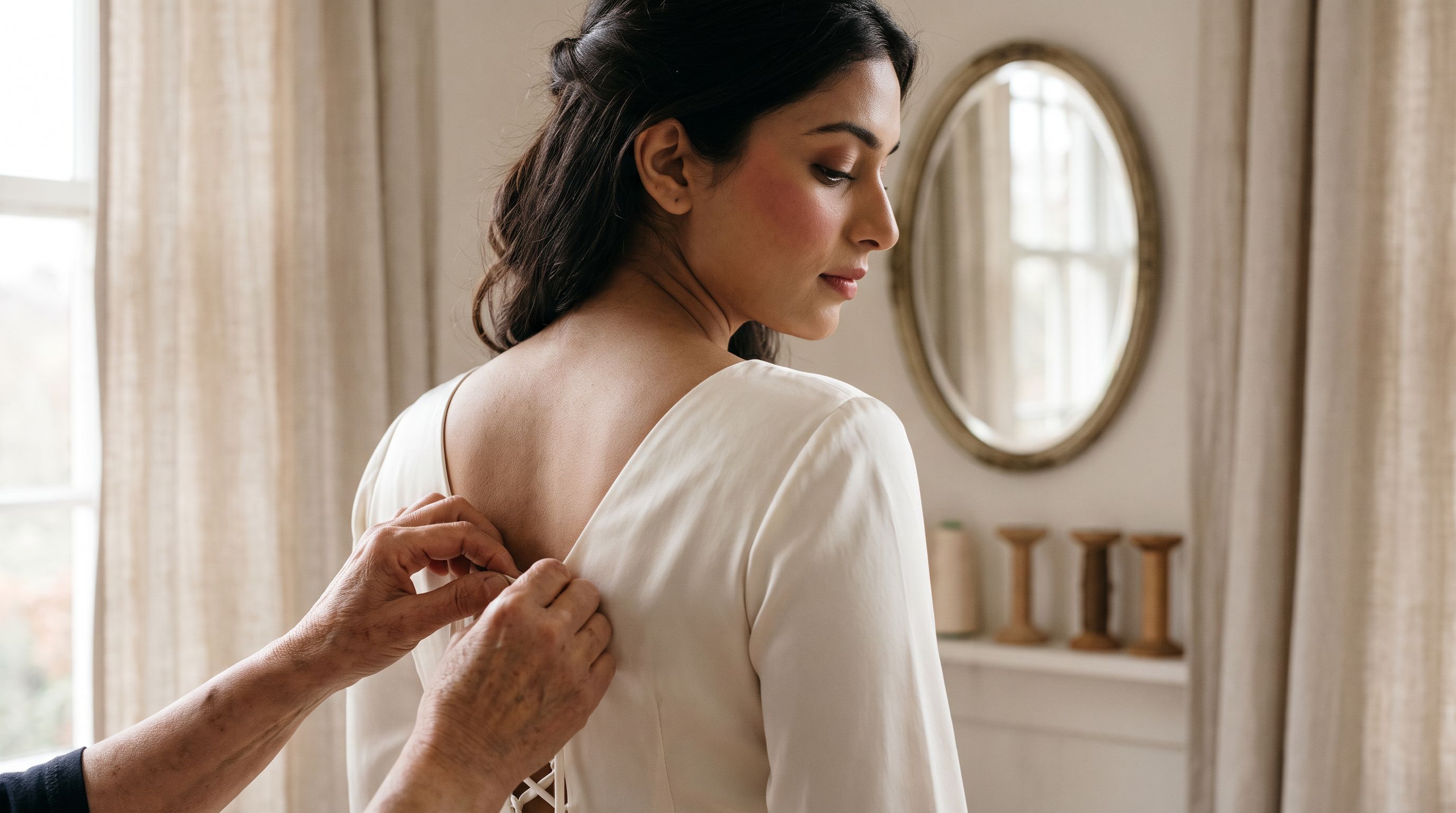
Your closure is a fit decision in disguise
When people picture the back of a gown, they’re usually picturing a mood: the romantic ladder of tiny buttons, the ribbon lacing that cinches a waist, the clean unbroken line of a minimalist crepe sheath. All of those are beautiful. But in a custom gown, the closure is also doing structural work. It determines how bodice tension is distributed, how much the dress can be let out or taken in later, how quickly you can get in and out of it, and how your dressmaker builds the inner support layer.
That’s why a good maker will ask about your back before you’ve even finished describing the neckline. It’s worth having an opinion — or at least knowing the trade-offs — before your first consultation.
The invisible zipper: quiet, light, and precise
An invisible zipper gives you the most seamless silhouette. In smooth fabrics like crepe, mikado, or satin, nothing disrupts the line — which is exactly why it’s the default on sleek, modern gowns. It’s lightweight, it’s fast to get into, and because it requires the least hand labor, it’s generally the most economical choice.
The trade-off is precision over flexibility. A zipper holds the measurement it was sewn to. Taking it in or letting it out later means unpicking and resetting the zipper and often the lining too — perfectly doable, but it’s alteration labor, not a ribbon you loosen the morning of. For a gown with a fitted bodice, your maker will usually anchor the zipper to a boned inner structure so it carries tension cleanly rather than straining at the teeth.
The corset lace-up: the most forgiving back there is
A true lace-up back — grommets or hand-worked eyelets with a ribbon or cord, over a modesty panel — is the most adjustable closure you can have. Most working lace-ups we see allow roughly an inch or two of give either way, which is why it’s the go-to when a body may shift between fittings and the wedding day.
It also does real structural work. Lacing distributes tension horizontally across a boned bodice, which can mean genuinely reliable support without a bra. That matters differently depending on what you’re asking the bodice to hold: with a full bust or a larger frame, lacing combined with wider, more numerous boning channels spreads the load far better than a zipper alone, and a strapless zipped bodice usually needs a longer, more thoroughly boned underbodice to stay where you put it. On a smaller bust, a lightweight invisible zip over a modest boned lining is often plenty. If you’re weighing internal support options, our guide to corset bodices versus a built-in bra walks through how that structure is actually built.
The honest downsides: you cannot lace yourself, so someone has to dress you (and re-lace you after bathroom breaks, which is a two-person job in a big gown). A corset back is heavier and warmer. And it needs a modesty panel behind the lacing, so your “open back” will always have fabric behind it — a feature if you want coverage, a limitation if you wanted skin.
Dressing is also an accessibility question, and a reasonable one to raise at the first meeting. If limited hand dexterity, shoulder mobility, or dressing independently is part of your picture, ask about long zipper pulls or ribbon tabs, a side-seam zip you can actually reach, a hook-and-bar placket, magnetic or snap-backed buttons under a decorative row, or a laced underbodice that gets set once and left alone. Then ask your maker to test the closure at a fitting with the person who will genuinely be helping you — or with you on your own, if that’s the plan.
Covered buttons are usually decoration — and that’s fine
Here’s the thing most clients are surprised by: on the vast majority of gowns, that gorgeous column of fabric-covered buttons is not holding the dress closed. There’s a zipper underneath, and the buttons sit on a placket over it. Functional loop-and-button closures do exist — they’re traditional, exquisite, and genuinely slow to fasten, which is worth knowing before you build your morning schedule around one.
Buttons are priced by count and labor. Each one is covered by hand in your dress fabric, each loop is made and placed, and the placket is set so it lies flat. A short row to the waist is a modest addition; a row running the length of a cathedral train is a significant hand-finishing line item — often something like twenty buttons on a bodice-only placket and several times that down a train.
If budget is tight, this is one of the easiest places to scale down without losing the look: a short placket to the waist only, machine-covered buttons instead of hand-covered ones, or lacing in a plain cotton cord rather than a matched silk ribbon. All three read beautifully in photographs and cost a fraction of the hours.
Rough planning figures, not measured data — adapt them to your own gown:
Labor rates vary enormously between countries and cities, so treat any dollar figure as a conversation starter rather than a quote. Ask for the placket priced as a separate line item, in your own currency, before you commit to it.
If your body might change before the day
This is the real reason to think about closures early. Bodies move — training, medication, stress, pregnancy, surgery, or simply the ordinary fluctuation of a year. A lace-up back absorbs that quietly. A zipper requires a fitting appointment.
If there’s any chance of change, say so at the consultation rather than at fitting three. Good dressmakers build in options: generous seam allowances, a laced underbodice beneath a zipped outer shell, or a hidden row of hooks that can be reset. Our guide to planning a gown when your body is changing covers how to build that flexibility in from the start.
A closure isn’t the last decision you make about your dress. It’s one of the first, because everything behind it is built to support it.
How your train and bustle factor in
Your closure and your bustle are neighbors. A long button placket running into the train has to be planned around bustle points so the ties or hooks don’t fight the buttons. A lace-up’s ribbon tails need somewhere to go — tucked, tied, or trimmed to a deliberate length — or they’ll swing through your reception photos.
If you’re still deciding on train length, read our breakdown of chapel versus cathedral trains and how bustles work alongside this, because the two choices genuinely influence each other.
What to ask at your consultation
-
Which closure suits this fabric and silhouette?
A good maker will have a clear reason — weight, drape, how the fabric handles grommets or buttonhole loops — not just a preference. -
How much adjustment will I have after the final fitting?
Ask for a specific answer in inches or centimetres, and ask what happens if you need more. -
Are the buttons functional or decorative, and what's the count?
Pricing should be itemized so you can scale the placket up or down to fit your budget. -
Who dresses me, and how long does it take?
Ask them to time it at a fitting, with your actual helper if you’ll have one. Fifteen minutes of lacing changes your morning schedule. -
How does this interact with my bustle and undergarments?
The answer should be concrete, with the bustle points sketched or pinned at a fitting.
Making the call
If you want the cleanest modern line and your measurements are stable, the invisible zipper is a sound, economical choice. If you want structure, adjustability, and a traditional back — or you simply feel safer with room to move — go lace-up and plan for a dresser. If you love buttons, add them to whichever functional closure makes sense and set the count, and the covering method, to your budget.
And if you’re not sure, that’s genuinely a normal place to be. Bring a photo of a back you love to a fitting and let a dressmaker show you, in your fabric and on your body, what each option actually does. You’ll usually know within five minutes of standing in the mirror — and a maker who talks you through the trade-offs honestly, before taking a deposit, is exactly the kind of maker worth working with. The closure is usually settled at the toile stage, so read up on how the fitting sequence unfolds and come to that appointment with your questions ready.
Ready to bring your dream dress to life?
Tell us what you're picturing — style, timeline, and budget — and we'll connect you with custom dressmakers who can make it. Free, no obligation.
Get matched with a dressmakerRelated guides
Getting a Wedding Dress Made Abroad: Is It Worth It?
Thinking of having your wedding dress tailored in Bangkok, Hoi An or Bali? Real costs, timelines, risks and how it compares to a custom dressmaker at home.
Read guide →
Bought a Wedding Dress Online? Alter, Remake, or Custom
Your online wedding dress arrived and the fit is wrong. Here's how to tell what's fixable, what alterations cost, and when going custom is the smarter buy.
Read guide →
Custom Veil vs Heirloom Veil: Cost, Length, and Fit
What a custom wedding veil costs, how to choose a length, and when wearing (or restoring) an heirloom veil is the smarter, more meaningful choice.
Read guide →