 Custom
 Adaptive Custom Wedding Dresses: Seated Fit and Access
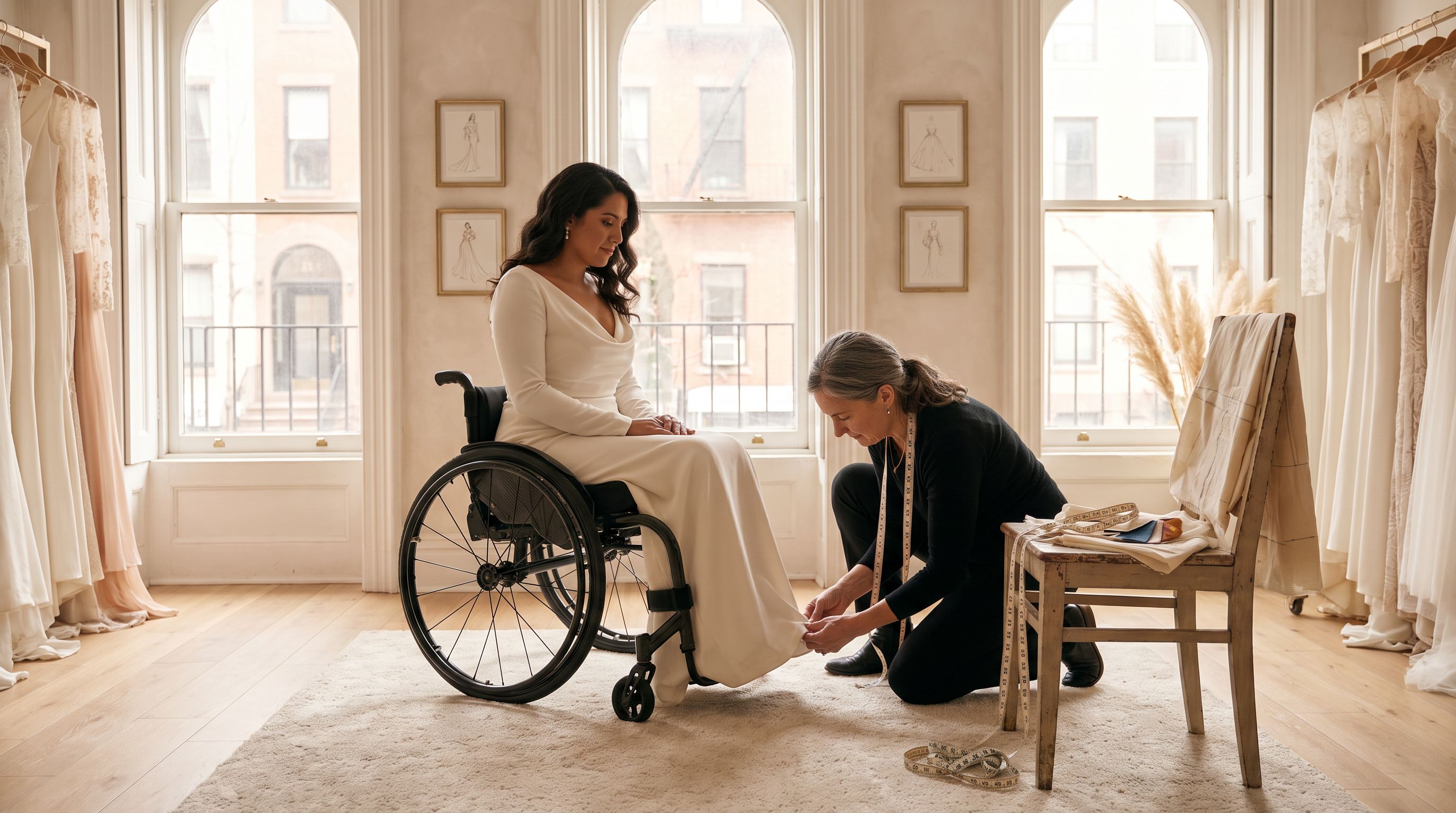
If you use a wheelchair, walk with crutches or a cane, have limited shoulder rotation, live with chronic pain or fatigue, or need discreet access to a port, pump, or catheter, you have probably already noticed that bridal salons are built around one assumption: that you will stand on a pedestal for twenty minutes and then stand at an altar.
Custom changes that assumption entirely — not because it’s magic, but because in a made-to-measure gown the pattern is drafted around your posture, your reach, and your day before a single piece of silk is cut. Here’s what adaptive construction actually involves, what drives the cost, and how to tell within one conversation whether a maker knows what they’re doing.
Why a standing pattern fights a seated body
Commercial bridal patterns assume a vertical spine, a floor-length hem, and a waist that sits at its natural height when you’re upright. Sit down and several things happen at once:
- The front hem rides up over your knees while the back pools behind you and under the wheels.
- The waistline shifts — usually up in front, down in back — so a fitted bodice buckles or gapes.
- Skirt fabric collects in your lap, adding bulk where you need clearance to push, steer, or transfer.
- Back zips, covered buttons, and heavy boning press between your spine and the backrest.
- Long trains and horsehair hems catch in casters, footplates, or crutch tips.
None of these are fit flaws in the ordinary sense. They’re a pattern solving for the wrong body position. A skilled maker re-drafts the whole thing: shorter back rise, longer front rise, a hem cut at seated length (often shorter in front, graduated around the sides), and volume moved away from the lap toward the back or side seams.
Seated drafting also interacts with your proportions. Bust, belly, and hip balance change how much front rise and lap clearance you need — on larger bodies both shift again, and a full bust or soft midline moves where the waist seam wants to sit once you’re sitting down. “Seated fit” is not one standard adjustment a maker pulls from a book; it’s a draft built from your measurements, on your body, in your chair.
What “adaptive” actually means in a custom gown
Adaptive isn’t a separate category of dress so much as a set of design decisions layered onto the gown you already want. Lace, beading, sleeves, and trains are all still on the table.
Closures you can manage. Side-seam invisible zips, magnetic plackets hidden under a button tab, front-opening bodices with a decorative overlay, an internal zip paired with corset-look detailing. Ask specifically whether you can close it yourself if that matters to you.
If someone else will help you dress or handle the skirt on the day — a partner, attendant, personal assistant, or care worker — name them at the consultation and bring them to the second fitting. Ten minutes practising the closure with the maker watching prevents a great deal of morning-of panic.
A flat, comfortable back. Fewer and shorter bones, seam allowances pressed and taped flat, no bulky darts or hardware where your spine meets the backrest.
Support without compression. Heavy internal corsetry can be painful with EDS, fibromyalgia, post-surgical sites, or breathing difficulty. Our guide to corsetry versus a built-in bra breaks down gentler ways to build support into a bodice.
Armhole mobility. If you self-propel or use crutches, the armscye shape matters far more than the sleeve style. A higher, smaller armhole with a gusset gives much more reach than a low, wide one. If you want coverage for comfort or faith reasons, the sleeve and coverage options in modest custom gowns translate directly.
Discreet access. A hidden side-seam opening for an insulin pump or feeding tube, a lined pocket for a remote, a skirt that opens cleanly for catheter management or a bathroom transfer. Say it out loud early; a good maker will simply nod and start sketching.
Sensory and weight considerations. Smooth silk or cotton linings instead of scratchy net, no interior tags, no crinoline against skin, and a total weight you can wear for eight hours without fatigue. Crepe, silk georgette, and soft satin-backed fabrics behave beautifully seated; stiff mikado and dense beading often don’t.
A gown that’s beautiful standing and unbearable sitting isn’t a beautiful gown. It’s an unfinished one.
Altering a store gown versus building one for a seated fit
The honest answer depends on how much of the problem lives in the pattern.
There are middle routes too. Separates — a bodice and skirt in different sizes or fits — let you correct proportion affordably, and the skirt can be re-hemmed at seated length. A non-bridal dressmaker or a skilled local tailor will often draft a seated fit in a simple crepe for less than a bridal studio charges. A secondhand or sample gown can be adapted, though a true seated re-draft is only realistic if the bodice is long enough and the skirt has spare fabric in the seams. Rental is the one option that generally can’t be re-drafted, since most contracts forbid cutting — so it suits you best if a standing pattern already sits comfortably.
Our piece on where alterations stop and custom begins will tell you quickly which side of the line your situation sits on.
What an adaptive custom gown tends to cost
There is no single national price, and anyone quoting one is guessing. What you can do is understand the drivers and estimate your own number.
What moves your number:
- Pattern development. A seated draft usually means an extra toile (muslin) and an extra fitting — labour you least want to cut.
- Closure hardware. Concealed magnets, custom plackets, and dual closures add hand-finishing hours.
- Fabric. Silk crepe and georgette cost more per metre than polyester equivalents but drape and breathe far better over long seated hours.
- Surface work. Hand-beading is priced by the hour, on any body.
- Where you live, and whether fittings travel. Some makers offer home or venue fittings; expect that quoted separately.
How the fittings should actually run
-
Consultation — bring the details
Bring photos of your chair or device, a note of how long you’ll be seated, transfer needs, temperature sensitivity, and any access requirements. Bring your shoes or footplate setup, and talk openly about pain, fatigue, and how long you can sit still. -
Measurements in both positions
A thorough maker measures seated and, where possible, standing or supported, plus reach range, shoulder rotation, seat-to-hem, knee-to-floor, and lap depth. Expect longer than a standard appointment. -
Toile in your chair
Try the first mock-up seated, then move in it — push, turn, reach, transfer if you can. Photograph it from seated eye level, not from above; that’s the angle your guests will see. -
Second fit with closures and lining
Test the closure yourself, and bring whoever will be helping you dress so they can practise it too. Sit in the gown for ten to fifteen minutes to find pressure points before they’re stitched permanently into silk. -
Wear test and final finishing
Full gown, real underlayers, real footwear, hair and veil if you’re wearing one. Roll or walk the route you’ll take on the day if you can.
Finding a maker who gets it — and what to ask
You don’t need someone who specialises exclusively in adaptive bridal; those are rare. You need someone curious, unhurried, and willing to re-draft. In a first conversation, ask:
- Have you drafted for a seated fit before, and how would you approach mine?
- How many toiles are in your quote, and what happens if we need another?
- Can we do a whole appointment seated, with breaks?
- Is your studio step-free, and where would I change?
- Can you build in [your specific access need] without it being visible?
The answer you want to hear is a question back — about your day, your chair, your pain, your timeline. Vagueness and reassurance-without-specifics are the warning signs; our guide to vetting a custom dressmaker covers contracts, deposits, and portfolio red flags in more depth.
You are not a difficult client, and your gown is not a special accommodation. You’re a person who needs a garment drafted for the body you actually have — which is, quite literally, the entire point of custom. Whoever you approach, go in with your photos, your access list, and your questions — and judge them by whether they ask you questions back.
Ready to bring your dream dress to life?
Tell us what you're picturing — style, timeline, and budget — and we'll connect you with custom dressmakers who can make it. Free, no obligation.
Get matched with a dressmakerRelated guides
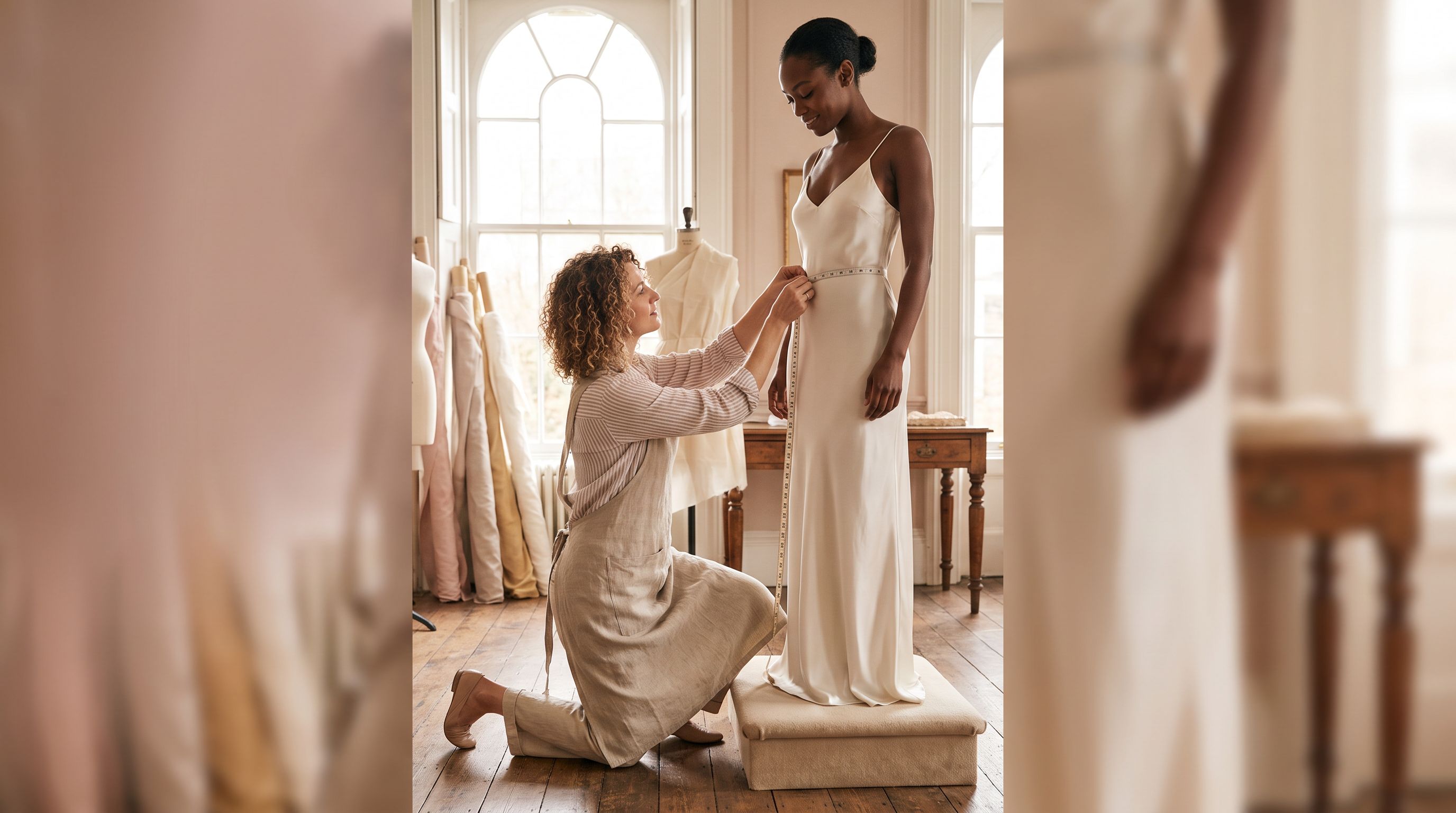
How to Measure Yourself for a Custom Wedding Dress
A step-by-step guide to taking wedding dress measurements at home: the exact list, tools, common mistakes, and how makers use them for a custom gown.
Read guide →
Corset vs Built-In Bra: Wedding Dress Support Explained
Corset, boning, or built-in bra cups? A clear guide to wedding dress support: what each does, what it costs in a custom gown, and how to choose for your bust.
Read guide →
Custom Wedding Dress When Your Body Is Changing
Weight loss, pregnancy, IVF or surgery before the wedding? How a custom wedding dress can be built to adjust — fittings, timing, fabrics and real costs.
Read guide →