 Custom
 Vintage Wedding Dress or Custom Copy: How to Decide
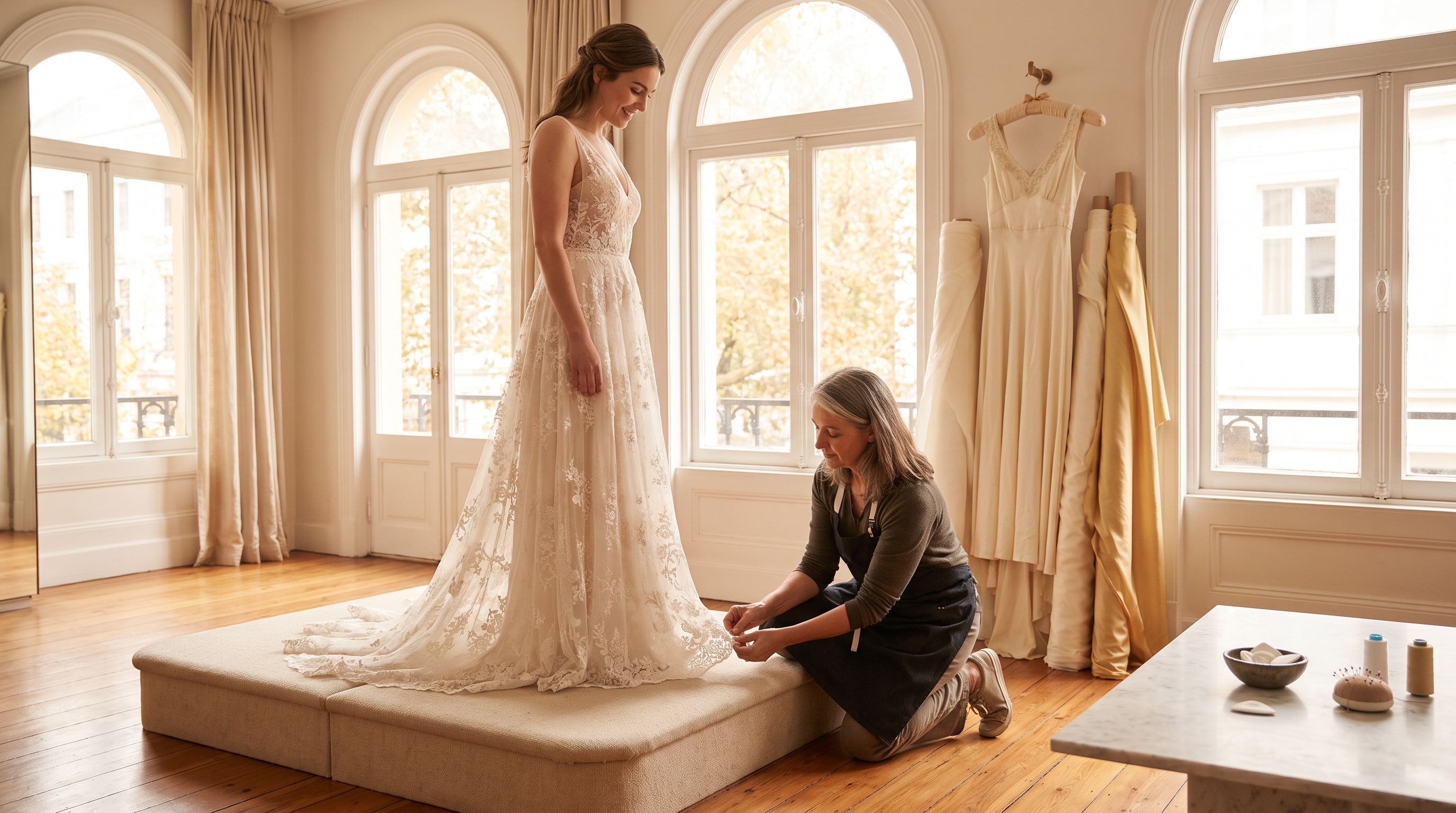
Vintage and preloved gowns are widely listed on resale platforms like Stillwhite, Etsy, and local consignment shops — 1930s bias-cut satins, 1950s tea-length silhouettes, 1980s lace with sleeves that would cost a fortune to make new. Publications have taken up the subject too; The Ethos, for instance, published a guide to buying a wedding dress that’s older than you are.
But there’s a decision hiding inside that romance: do you buy the actual old dress and adapt it, or do you take it to a dressmaker and say make me this, in my size, in fabric that won’t split? Both are valid. They just suit different people, budgets, and bodies.
What “vintage” actually means when you’re shopping
In bridal, “vintage” gets used loosely. It’s worth knowing which one you’re looking at, because the risks are completely different.
- True vintage — an original gown from a past era, usually 20+ years old. Unique, often astonishingly detailed, and structurally unpredictable.
- Vintage-style — a new dress designed to look old. No fragility risk, but also none of the original’s character or hand-work.
- Preloved modern — someone else’s recent gown resold online or through a local consignment shop. Essentially an off-the-rack dress with a discount and no returns.
This article is about the first one — and about the option most people don’t realize exists: having that exact look rebuilt for your body.
What can and can’t be altered on an old gown
This is the part that surprises people. A dressmaker isn’t being difficult when they hesitate over a 1940s satin — they’re reading the fabric.
What can usually be done: taking in side seams, shortening a hem, replacing a zipper or adding a modern closure, rebuilding the lining and bust support, shortening or removing sleeves, and adding a modesty panel. What’s genuinely hard: significantly enlarging a gown, moving a waistline, or changing a neckline on fragile lace.
If you want the full map of what alterations can and can’t accomplish on any dress, our guide to where alterations end and custom work begins covers the structural rules in detail.
Comparing the two routes honestly
One practical note before the comparison: surviving vintage stock skews small. Most gowns that made it to resale were cut for a narrower range of measurements than we sew for today, and mid-century patterns in particular assumed structured foundation garments underneath. If you wear above roughly a US 12–14, genuine vintage finds thin out fast — that’s a fact about what happened to survive, not about your body — and reproduction or harvesting is usually the more realistic route.
Best when: the dress is within roughly one to two sizes of you, the fabric passes a condition check, and the imperfection is the charm. You get irreplaceable hand-work, period-correct lace, and a story no one else has. Lower entry price. Deeply sustainable.
Trade-offs: limited fit adjustment, no undo button, and you may spend real money on restoration before you know if it works. Comfort and mobility can be compromised — old armholes and short torsos were cut for different bodies and different underpinnings.
Best when: you love a silhouette from a photo but need it in your size, with your coverage, in fabric that will handle dancing. You choose the drape, the sleeve length, the lining, the pockets. Everything is built to your measurements from the start.
Trade-offs: higher cost, longer lead time, and it won’t have hundred-year-old lace unless you supply it. A skilled maker gets remarkably close to the original spirit — but it’s an interpretation, not the artifact.
What each path tends to cost
Prices vary enormously by city, by the maker’s experience, and by how much hand-finishing your dress needs — treat these as starting points for your own math, not fixed rates.
The cost drivers on a reproduction are the same as any commission: fabric quality and yardage, how much lace or beading is applied by hand, the complexity of the internal structure (a boned, corseted bodice takes far more hours than a soft slip), and the number of fittings. Sleeves, buttons down the back, and a long train each add labor. If you want to see how those choices stack up at different budget levels, our breakdown of what different budgets actually buy is a useful reality check before you brief a maker.
The third option most people don’t know about
There’s a middle path that’s often the most satisfying of all: harvest the vintage, build the new. A maker takes the original lace, the beaded panel, the buttons, or a section of the skirt, and incorporates it into a gown constructed to your measurements.
The same technique applies to heirloom textiles of every tradition, not just old white gowns — a mother’s sari, a lehenga dupatta, a panel from an áo dài, a length of church lace, a grandfather’s embroidered shawl. If the cloth matters to you, a skilled maker can usually find a way to carry it into something wearable. It’s exactly the approach used for heirloom gowns, and the techniques we walk through in our guide to restyling a mother’s or grandmother’s dress transfer directly. Wearers get the provenance and the fit, without spending the reception worrying about a side seam.
The goal isn’t preserving the dress untouched. It’s saving the part that carries the meaning and rebuilding everything else to fit the person wearing it.
How a reproduction commission actually unfolds
-
Bring evidence, not just vibes
Photos of the original from front, back, and side; close-ups of the lace and neckline; and a note on what specifically moves you — the sleeve shape? the bias drape? Makers can hit a target far more accurately when they know which single detail is non-negotiable and which you’re relaxed about. -
Consultation and fabric decisions
You’ll discuss silhouette, structure, and materials. Period fabrics have modern equivalents — a maker can suggest a silk crepe or a matte satin that mimics 1930s bias drape without the fragility. -
Measurements and a toile
A calico or muslin mock-up is where the silhouette gets tested on your actual body. This is the step that makes made-to-measure worth the money — and it’s where a good maker will tell you honestly if a period cut needs adapting to suit your proportions. -
Two to four fittings in real fabric
Bodice, then skirt and hem, then finishing. Expect the last fitting fairly close to the wedding so the fit reflects your body on the day. -
Plan for six to nine months where possible
Hand-worked lace and multiple fittings need room to breathe. Rush timelines are sometimes possible — usually with a surcharge and fewer design options.
What to ask before you commit either way
- “Have you worked with fabric this age before, and can you show me examples?”
- “What’s your honest read on the condition — and what would you not attempt?”
- “If the fabric fails mid-alteration, what happens to my deposit and my timeline?”
- For a reproduction: “Which details of this photo can you match exactly, and which will need to change?”
- “How many fittings are included, and are alterations after the final fitting billed separately?”
A maker who answers the hard version of those questions plainly — including “I’d pass on this one” — is the one to trust. To make that assessment quick and accurate, arrive with four things: the seller’s close-up photos of the underarms, inside side seams, hem edge, and any beading; your own current bust, waist, hip, and hollow-to-hem measurements; your wedding date and any travel or climate details; and one clear photo of the look you’re chasing. With those in hand, an experienced dressmaker can usually tell you within minutes whether your vintage find is a keeper, a candidate for harvesting, or best admired and left on the rack.
Ready to bring your dream dress to life?
Tell us what you're picturing — style, timeline, and budget — and we'll connect you with custom dressmakers who can make it. Free, no obligation.
Get matched with a dressmakerRelated guides
Off the Rack Wedding Dresses: What It Means and Costs
What "off the rack" really means in bridal, how off-the-rack wedding dress costs compare to custom and made-to-measure, and how to set a realistic budget.
Read guide →
Chapel vs Cathedral Train: Length, Cost, and Bustles
Chapel vs cathedral train for a custom wedding dress: real length measurements, what extra train costs, bustle types and prices, and how to decide at your fitting.
Read guide →
Bridal Sizing vs Street Size: Why Gowns Run Small
Bridal sizing vs street size explained: why wedding dresses run 2–3 sizes small, what off-the-rack really means, alteration costs, and when made-to-measure wins.
Read guide →